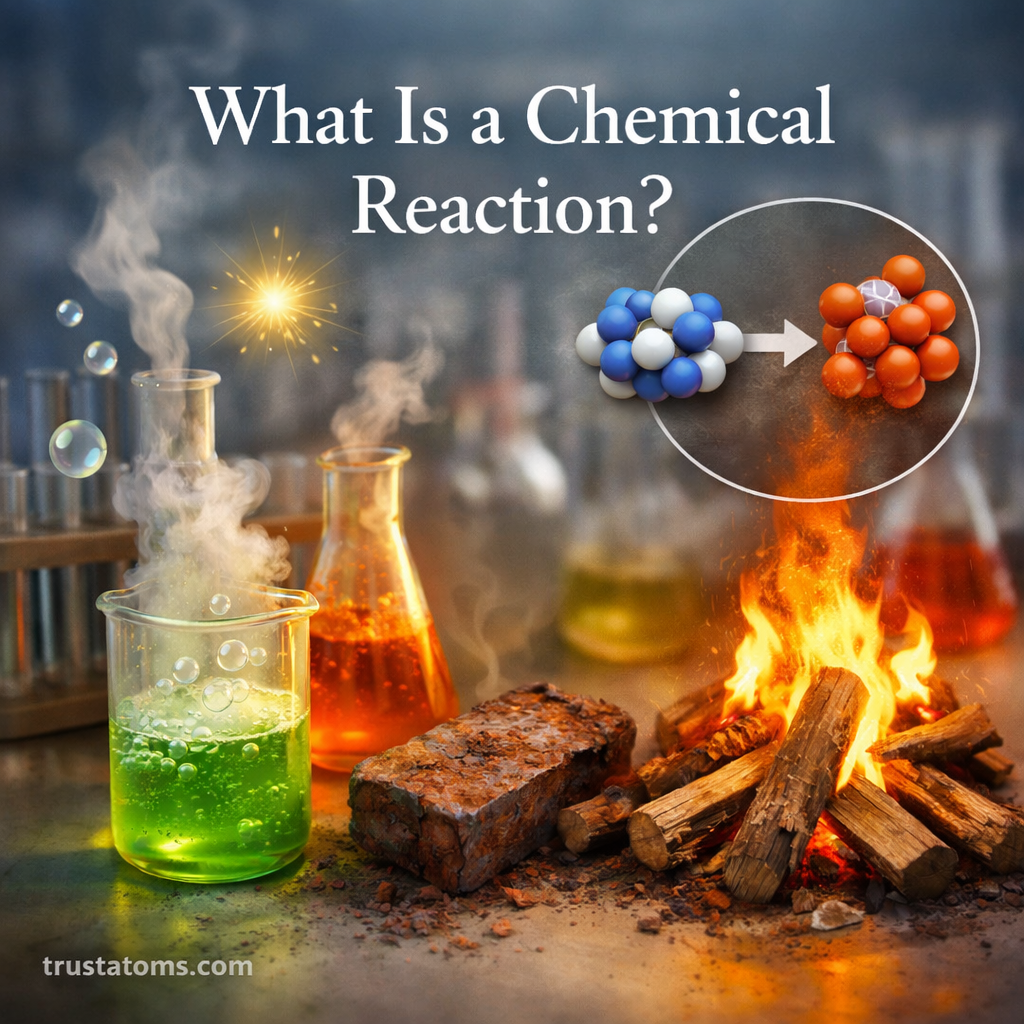
A chemical reaction is a process in which one or more substances are transformed into new substances with different properties. These new substances are formed because atoms rearrange, break old bonds, and create new ones.
Chemical reactions happen all around us — when food cooks, metal rusts, fuel burns, or even when your body digests a meal. Understanding chemical reactions is a core concept in chemistry because they explain how matter changes.
The Simple Definition
A chemical reaction occurs when:
- Atoms are rearranged
- Chemical bonds are broken
- New chemical bonds are formed
- New substances (called products) are created
The substances that start the reaction are called reactants.
The substances formed at the end are called products.
Example (in words):
Hydrogen + Oxygen → Water
Hydrogen and oxygen are reactants.
Water is the product.
What Happens During a Chemical Reaction?
At the atomic level, chemical reactions involve three key steps:
- Existing bonds between atoms break.
- Atoms rearrange.
- New bonds form to create new substances.
Importantly, atoms are not created or destroyed — they are simply reorganized. This idea is known as the Law of Conservation of Mass.
Signs That a Chemical Reaction Has Occurred
You can’t see atoms rearranging, but you can observe clues that a chemical reaction has taken place.
Common signs include:
- Color change
- Temperature change (heat released or absorbed)
- Gas production (bubbles form)
- Formation of a solid (precipitate)
- Light production
- Change in smell
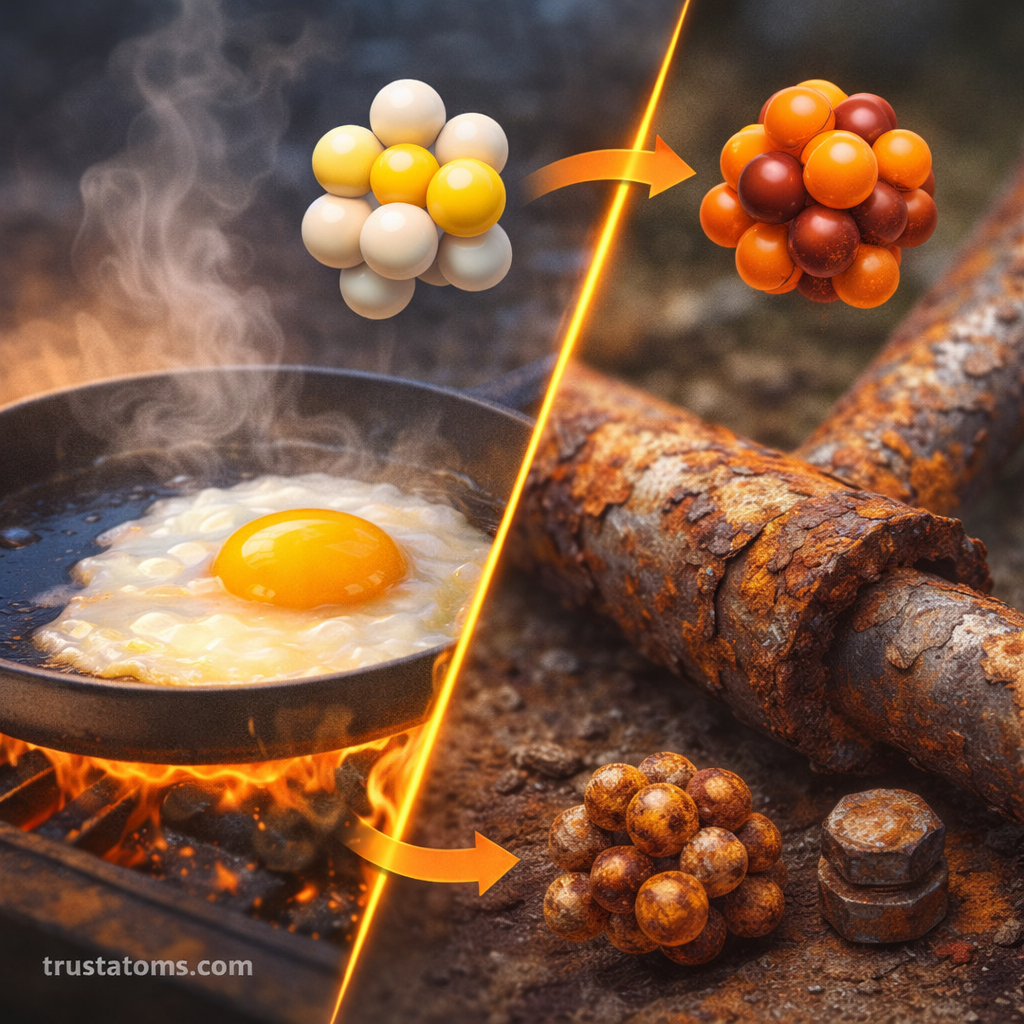
For example, when iron rusts, it changes color and forms a new substance (iron oxide). That’s a chemical reaction.
Types of Chemical Reactions
Chemists group reactions into categories based on what happens during the rearrangement of atoms.
1. Synthesis Reaction
Two or more substances combine to form one new substance.
Example (in words):
Sodium + Chlorine → Sodium chloride
2. Decomposition Reaction
One substance breaks down into two or more simpler substances.
Example:
Water → Hydrogen + Oxygen
3. Single Replacement Reaction
One element replaces another in a compound.
4. Double Replacement Reaction
Parts of two compounds swap places to form new compounds.
5. Combustion Reaction
A substance reacts with oxygen, often producing heat and light.
Burning fuel is a combustion reaction.
Chemical vs Physical Change
Not all changes in matter are chemical reactions.
Physical changes:
- Do not create new substances
- Only change form or state
- Examples: melting ice, tearing paper
Chemical changes:
- Produce new substances
- Involve bond breaking and bond forming
- Examples: burning wood, cooking eggs
If a new substance forms, it’s a chemical reaction.
Energy and Chemical Reactions
Chemical reactions involve energy changes because breaking and forming bonds requires energy.
There are two main types:
Exothermic Reactions
- Release energy
- Often feel warm
- Example: burning gasoline
Endothermic Reactions
- Absorb energy
- Often feel cool
- Example: some chemical cold packs
Energy changes are a key part of understanding how reactions work.
Why Chemical Reactions Matter
Chemical reactions are essential to life and technology.
They are responsible for:
- Digestion and metabolism
- Photosynthesis in plants
- Manufacturing medicines
- Producing electricity
- Creating new materials
- Environmental processes
Without chemical reactions, life as we know it would not exist.
Chemical Reactions in Everyday Life
You experience chemical reactions daily:
- Cooking food
- Breathing
- Charging a battery
- Cleaning with bleach
- Digesting nutrients
Even thinking involves chemical reactions in your brain.
Key Takeaways
- A chemical reaction transforms reactants into new products.
- Atoms rearrange, but they are not destroyed.
- Reactions often involve visible signs like heat, gas, or color change.
- Energy is either released or absorbed during reactions.
- Chemical reactions power life and modern technology.
Understanding chemical reactions gives you a foundation for nearly every topic in chemistry.