Acids are some of the most important and recognizable substances in chemistry. They are found in foods, industrial products, car batteries, and even your stomach. But what exactly makes something an acid?
In this guide, you’ll learn what an acid is, how acids behave, common examples, and why they matter in everyday life.
What Is an Acid? (Simple Definition)
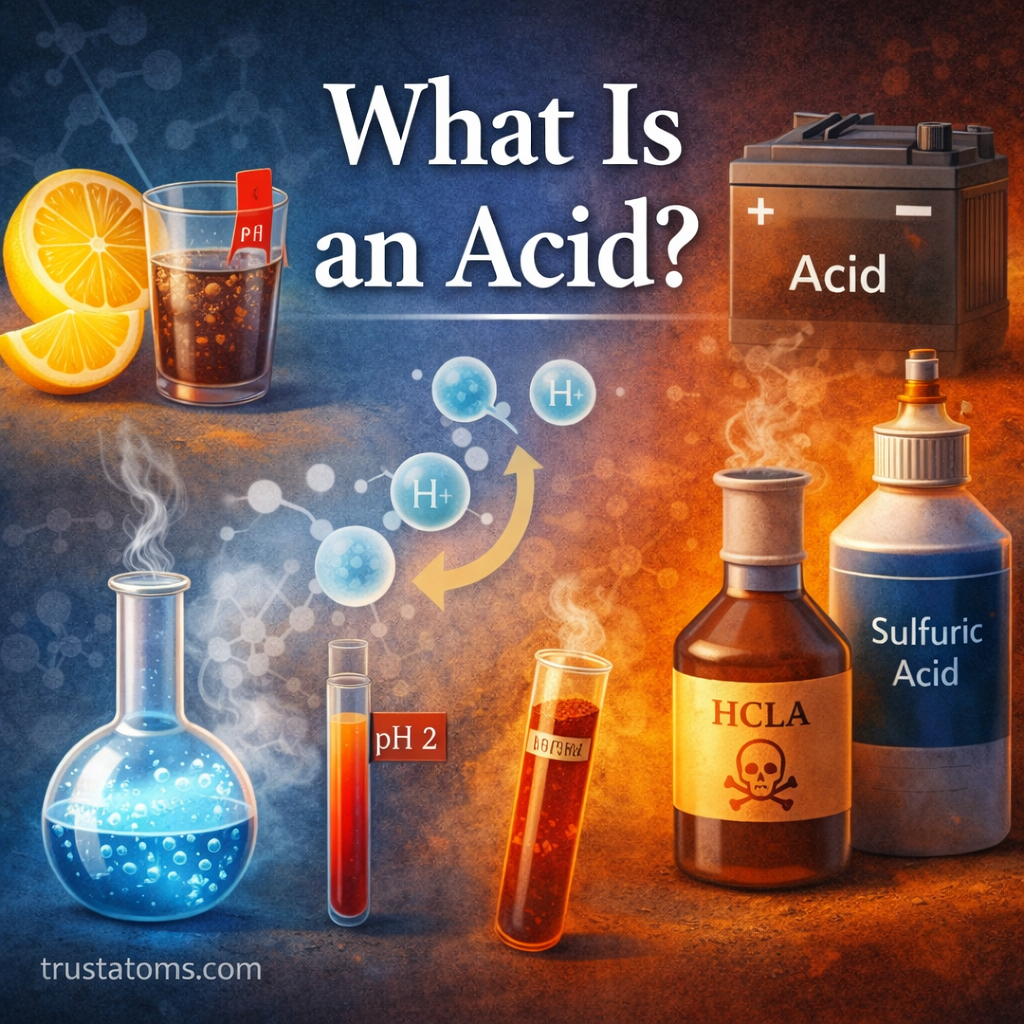
An acid is a substance that releases hydrogen ions (H⁺) when dissolved in water.
In simpler terms, acids are compounds that increase the concentration of hydrogen ions in a solution.
The presence of these hydrogen ions is what gives acids their characteristic properties.
Key Properties of Acids
Acids share several recognizable features:
- Sour taste (like lemon juice or vinegar)
- Turn blue litmus paper red
- Have a pH less than 7
- React with certain metals to produce hydrogen gas
- React with bases in neutralization reactions
These properties help chemists identify and classify acidic substances.
The pH Scale and Acids
The pH scale measures how acidic or basic a solution is.
- pH 7 = Neutral (pure water)
- pH below 7 = Acidic
- pH above 7 = Basic (alkaline)
The lower the pH number, the stronger the acid.
For example:
- Lemon juice: around pH 2
- Vinegar: around pH 3
- Stomach acid: around pH 1–2
The pH scale is logarithmic, meaning each step represents a tenfold change in acidity.
How Acids Work at the Molecular Level
When an acid dissolves in water:
- The acid molecules break apart.
- Hydrogen ions (H⁺) are released.
- These hydrogen ions interact with water molecules.
This process increases the acidity of the solution and allows it to participate in chemical reactions.
Strong Acids vs. Weak Acids
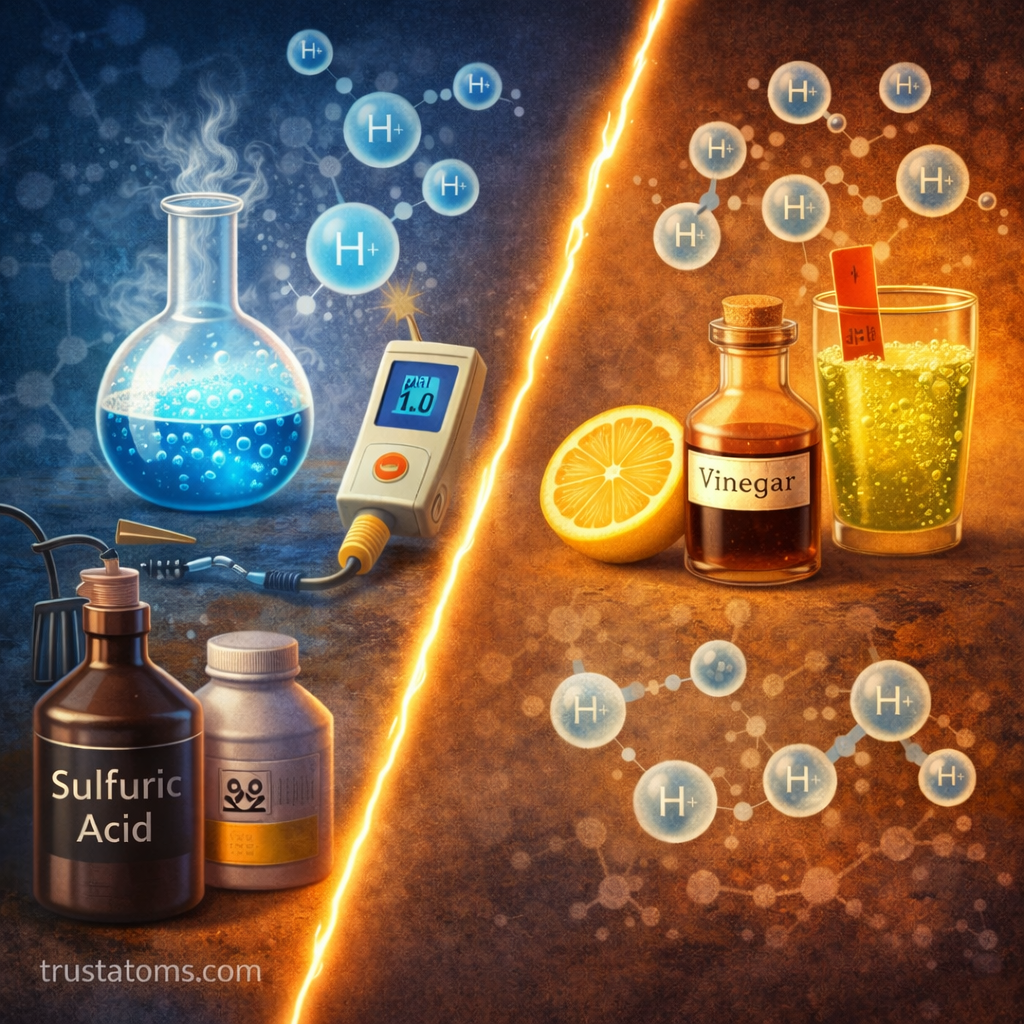
Not all acids behave the same way. Chemists classify acids based on how completely they release hydrogen ions in water.
Strong Acids
Strong acids:
- Completely ionize in water
- Release nearly all available hydrogen ions
- Have very low pH values
Examples include hydrochloric acid and sulfuric acid.
Weak Acids
Weak acids:
- Partially ionize in water
- Release only some hydrogen ions
- Have higher pH values compared to strong acids
Examples include acetic acid (in vinegar) and citric acid (in citrus fruits).
The strength of an acid depends on how easily it gives up hydrogen ions — not how concentrated it is.
Common Examples of Acids
Acids are everywhere in daily life.
Household and Food Acids
- Citric acid in oranges and lemons
- Acetic acid in vinegar
- Carbonic acid in soda
Industrial and Laboratory Acids
- Hydrochloric acid (used in cleaning and digestion)
- Sulfuric acid (used in batteries)
- Nitric acid (used in fertilizers)
These acids vary in strength and purpose, but they all share the ability to donate hydrogen ions.
Acid-Base Reactions
One of the most important reactions involving acids is neutralization.
In a neutralization reaction:
- An acid reacts with a base
- Water and a salt are produced
- The solution moves closer to neutral pH
A common example is an antacid tablet neutralizing stomach acid to relieve heartburn.
Why Acids Matter in Science and Industry
Acids play essential roles in:
- Biological processes (digestion, cellular respiration)
- Food preservation and flavoring
- Fertilizer production
- Manufacturing plastics and chemicals
- Cleaning and metal processing
Without acids, many chemical processes that support modern life would not function.
Safety Considerations
While many acids are harmless in small amounts (like those in food), others can be highly corrosive.
Strong acids can:
- Damage skin and eyes
- Corrode metals
- React violently with certain substances
Proper handling, protective equipment, and dilution are critical in laboratory and industrial settings.
Final Thoughts
An acid is a substance that releases hydrogen ions in water, giving it distinct chemical properties. From the lemon in your kitchen to industrial manufacturing plants, acids are part of everyday life.
Understanding what an acid is helps explain:
- Why certain foods taste sour
- How batteries generate energy
- How the body digests food
- How chemical reactions are controlled
Acids may seem simple at first, but they are fundamental to chemistry and to the world around us.