Avogadro’s number is one of the most important constants in chemistry. It connects the microscopic world of atoms and molecules with the measurable quantities scientists use in laboratories.
In simple terms, Avogadro’s number tells us how many particles—such as atoms, molecules, or ions—are present in one mole of a substance. This concept allows chemists to measure incredibly tiny particles using amounts we can weigh and observe.
Understanding Avogadro’s number is essential for topics like chemical reactions, molecular formulas, and stoichiometry.
The Definition of Avogadro’s Number
Avogadro’s number is defined as:
6.022 × 10²³ particles per mole
This means that one mole of any substance contains exactly 6.022 × 10²³ particles.
These particles can include:
- Atoms
- Molecules
- Ions
- Electrons
- Other microscopic entities
For example:
- 1 mole of carbon atoms contains 6.022 × 10²³ carbon atoms
- 1 mole of water molecules contains 6.022 × 10²³ H₂O molecules
- 1 mole of sodium ions contains 6.022 × 10²³ Na⁺ ions
This constant provides the bridge between atomic-scale particles and real-world quantities.
Why Avogadro’s Number Is So Large
Atoms and molecules are extremely small. Because of their tiny size, even a small amount of matter contains an enormous number of particles.
For perspective:
- A single grain of sand contains billions of atoms.
- A glass of water contains far more molecules than there are grains of sand on Earth’s beaches.
Avogadro’s number reflects this reality. It gives chemists a practical way to count particles indirectly by measuring mass.
What Is a Mole in Chemistry?
To understand Avogadro’s number, you must understand the mole.
A mole is a standard unit used in chemistry to measure the amount of a substance.
Definition of a Mole
A mole is the amount of substance that contains exactly 6.022 × 10²³ particles.
Chemists use moles because counting individual atoms or molecules would be impossible in practice.
Instead, they measure substances using:
- Mass (grams)
- Volume (liters)
- Concentration (moles per liter)
How Avogadro’s Number Connects Mass and Particles
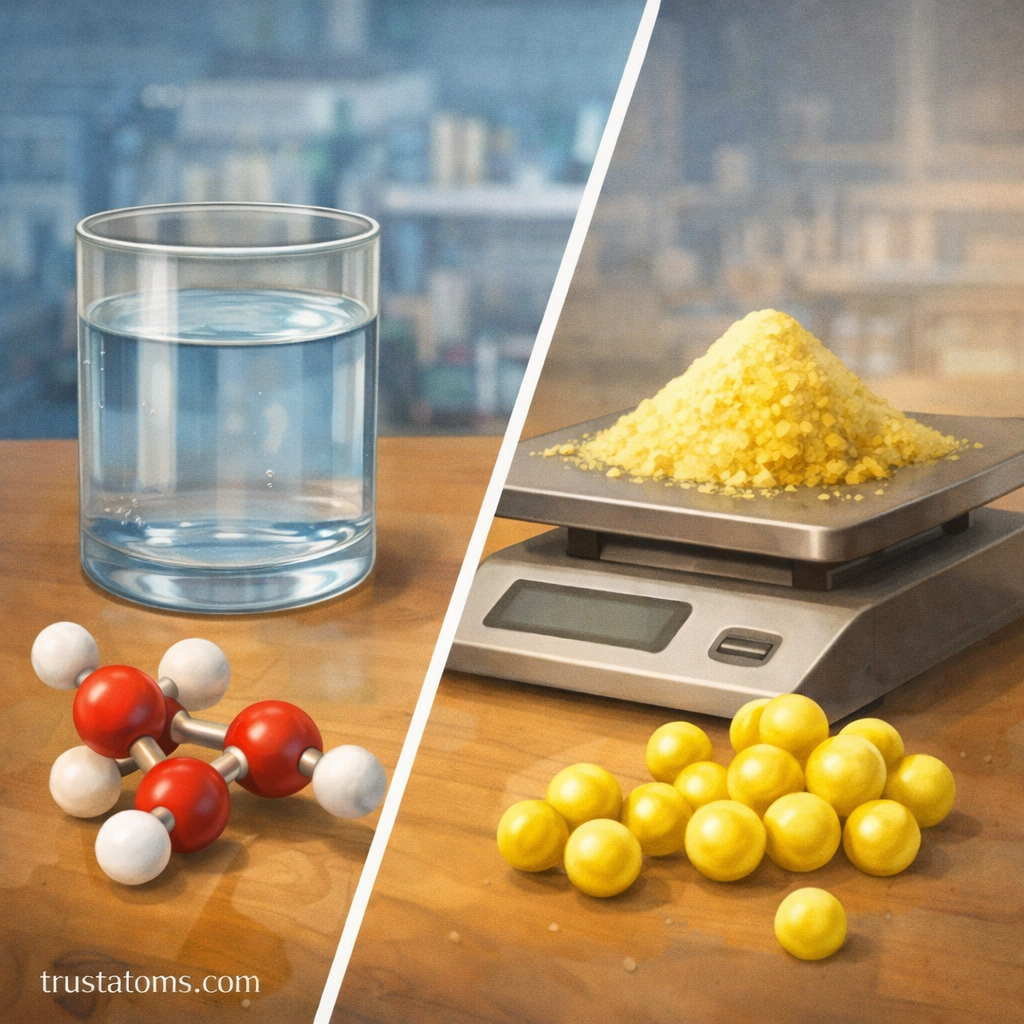
Avogadro’s number allows scientists to convert between:
- Number of particles
- Amount of substance (moles)
- Mass of a substance
This relationship is expressed using the molar mass.
Example: Carbon
Carbon has a molar mass of 12 grams per mole.
This means:
- 12 grams of carbon
- contains 6.022 × 10²³ carbon atoms
If you had 24 grams of carbon, you would have:
- 2 moles of carbon
- 1.204 × 10²⁴ atoms
Example Calculations Using Avogadro’s Number
Example 1: Finding Number of Particles
If you have 2 moles of oxygen molecules (O₂):
- Multiply by Avogadro’s number
- 2 × 6.022 × 10²³
- = 1.204 × 10²⁴ molecules
Example 2: Converting Particles to Moles
Suppose you have 3.011 × 10²³ molecules of nitrogen (N₂).
- Divide by Avogadro’s number
- 3.011 × 10²³ ÷ 6.022 × 10²³
- = 0.5 moles
The History Behind Avogadro’s Number
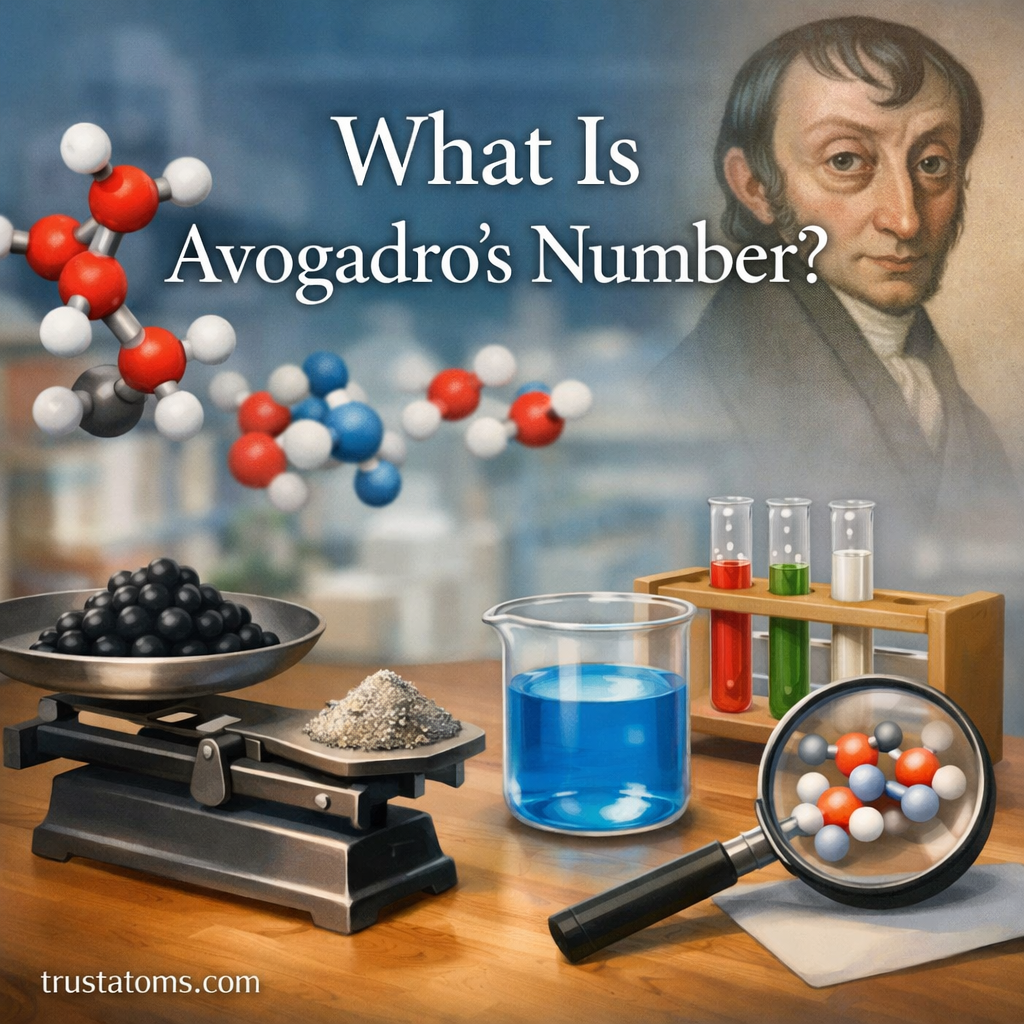
Avogadro’s number is named after Amedeo Avogadro, an Italian scientist who made a major contribution to chemistry in the early 1800s.
In 1811, Avogadro proposed a revolutionary idea:
Equal volumes of gases at the same temperature and pressure contain equal numbers of molecules.
This concept became known as Avogadro’s Law.
Although Avogadro did not calculate the exact number himself, later scientists honored his work by naming the constant after him.
Why Avogadro’s Number Is Important in Chemistry
Avogadro’s number is essential for many areas of chemistry and science.
Key Uses
Chemists rely on this constant to:
- Balance chemical equations
- Convert between mass and particles
- Calculate reaction yields
- Determine molecular formulas
- Measure concentrations in solutions
Without Avogadro’s number, it would be extremely difficult to connect atomic-level processes with laboratory measurements.
Avogadro’s Number in Everyday Chemistry
While the number itself is enormous, the concept is used constantly in laboratories and industry.
Applications include:
- Pharmaceutical manufacturing
- Environmental chemistry
- Materials science
- Chemical engineering
- Food chemistry
Any time scientists measure substances at the molecular level, Avogadro’s number is part of the calculation.
Final Thoughts
Avogadro’s number, 6.022 × 10²³, is one of the fundamental constants of chemistry. It provides a practical way to count atoms, molecules, and other particles by relating them to measurable quantities.
By connecting the microscopic world of particles to the macroscopic world of grams and liters, Avogadro’s number allows chemists to analyze reactions, calculate quantities, and understand the structure of matter.
Without this constant, modern chemistry would not be possible.