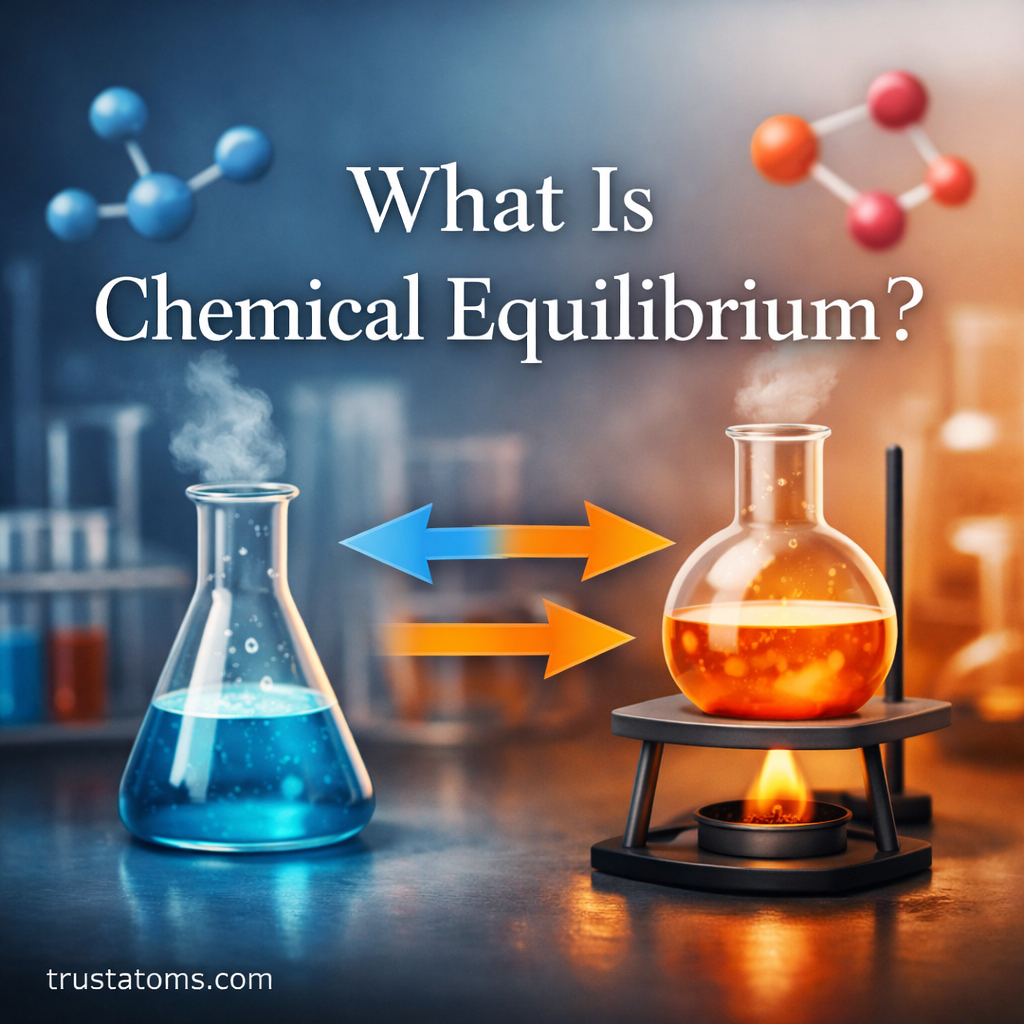
Chemical reactions often seem straightforward: reactants combine, products form, and the reaction ends. However, many reactions behave differently. Instead of stopping completely, they continue in both directions at the same time. This dynamic balance is known as chemical equilibrium.
Understanding chemical equilibrium helps explain everything from industrial chemical production to biological processes in the human body. In chemistry, equilibrium describes a state where reactions appear to stop changing, even though molecular activity continues.
What Is Chemical Equilibrium?
Chemical equilibrium occurs when the rate of the forward reaction equals the rate of the reverse reaction.
At this point:
- Reactants continue turning into products.
- Products simultaneously convert back into reactants.
- The concentrations of reactants and products remain constant over time.
This does not mean the reaction has stopped. Instead, it means the reaction has reached a dynamic balance.
Simple Definition
Chemical equilibrium is the state in a reversible chemical reaction where the forward and reverse reaction rates are equal, resulting in stable concentrations of reactants and products.
Reversible Reactions and Equilibrium
Equilibrium only occurs in reversible reactions, meaning the reaction can proceed in both directions.
A reversible reaction is typically written with a double arrow:
A + B ⇌ C + D
This notation indicates:
- The forward reaction converts A and B into C and D.
- The reverse reaction converts C and D back into A and B.
As the reaction progresses:
- Reactants decrease as products form.
- Products begin accumulating.
- Eventually, products start reacting to form reactants again.
Over time, the rates of both reactions become equal, and equilibrium is established.
Dynamic Nature of Chemical Equilibrium
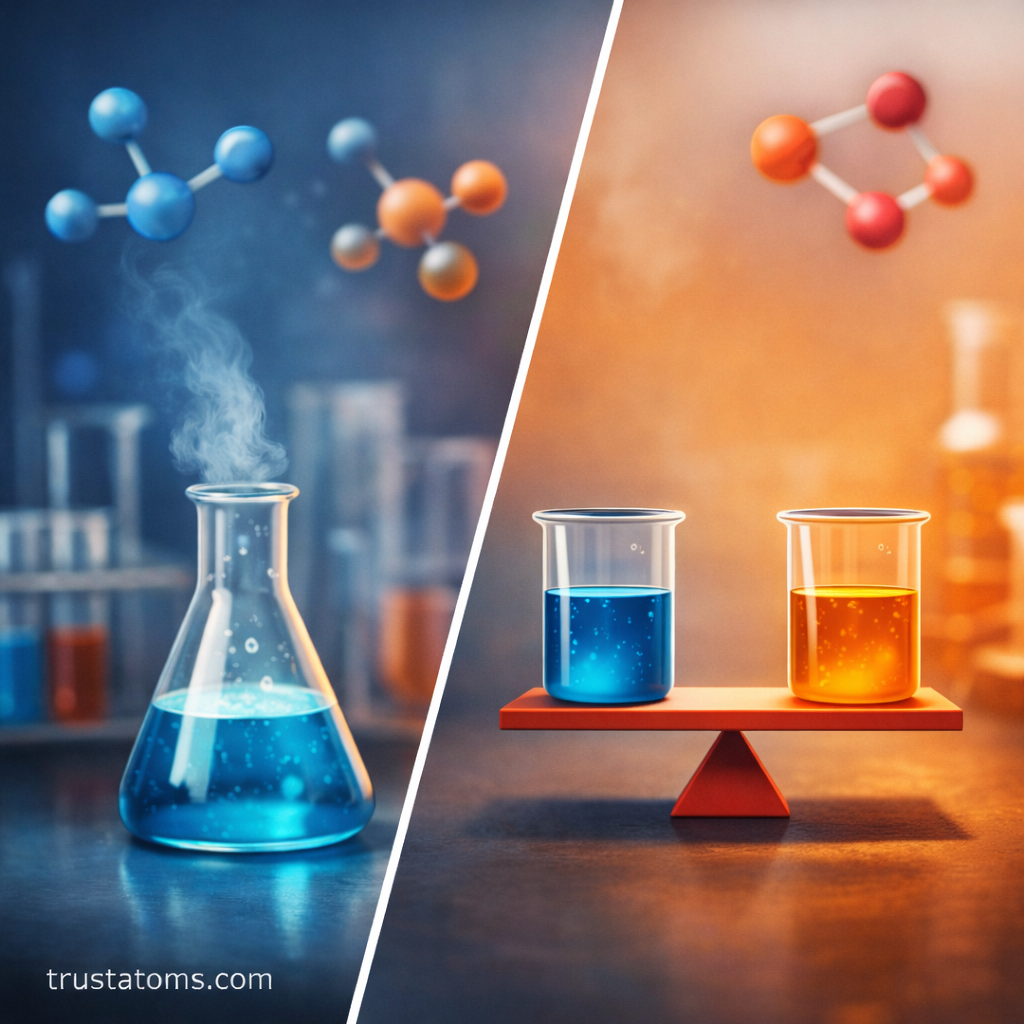
One of the most important ideas in chemistry is that equilibrium is dynamic, not static.
Even when concentrations stay constant:
- Molecules are still reacting.
- Bonds are continuously breaking and forming.
- Both directions of the reaction continue at the same rate.
Think of equilibrium like two people pouring water between two containers at the same speed. The amount of water in each container stays the same, even though water is constantly moving.
The Equilibrium Constant (K)
Chemists describe equilibrium quantitatively using the equilibrium constant, commonly written as K.
The equilibrium constant compares the concentration of products to reactants at equilibrium.
For the reaction:
aA + bB ⇌ cC + dD
The equilibrium expression is:
K = [C]^c [D]^d / [A]^a [B]^b
Where:
- Brackets [ ] represent concentrations
- Exponents correspond to coefficients in the balanced equation
What the Value of K Means
The size of the equilibrium constant tells us which side of the reaction is favored.
If K > 1
- Products are favored at equilibrium.
If K < 1
- Reactants are favored.
If K ≈ 1
- Both reactants and products exist in comparable amounts.
Factors That Affect Chemical Equilibrium
Although equilibrium represents a balanced state, it can shift if conditions change. This behavior is described by Le Chatelier’s Principle.
Le Chatelier’s Principle states that a system at equilibrium will adjust to counteract any disturbance.
1. Changes in Concentration
Adding more reactants or products shifts the reaction.
Examples:
- Adding reactants pushes the reaction toward products.
- Adding products pushes the reaction toward reactants.
2. Temperature Changes
Temperature can strongly affect equilibrium.
- Increasing temperature favors endothermic reactions.
- Decreasing temperature favors exothermic reactions.
Temperature changes can also alter the equilibrium constant itself.
3. Pressure Changes (For Gases)
Pressure changes matter when gases are involved.
- Increasing pressure favors the side with fewer gas molecules.
- Decreasing pressure favors the side with more gas molecules.
4. Catalysts
Catalysts do not change the position of equilibrium.
Instead, they:
- Speed up the forward and reverse reactions equally
- Help the system reach equilibrium faster
Examples of Chemical Equilibrium
Many real-world chemical processes rely on equilibrium.
Industrial Example: The Haber Process
The Haber process produces ammonia for fertilizers.
N₂ + 3H₂ ⇌ 2NH₃
Manufacturers carefully control:
- Temperature
- Pressure
- Reactant concentrations
to maximize ammonia production while maintaining equilibrium.
Biological Example
Chemical equilibrium also occurs in the human body. For example:
- Oxygen binding to hemoglobin
- Carbon dioxide exchange in blood
- Acid–base balance in bodily fluids
These equilibrium processes help maintain stable internal conditions.
Why Chemical Equilibrium Matters
Chemical equilibrium plays a major role in science and engineering.
It helps scientists:
- Predict how reactions behave
- Optimize industrial chemical production
- Understand biological processes
- Design chemical systems efficiently
Without equilibrium principles, many modern technologies—including pharmaceuticals, fertilizers, and materials science—would be far less effective.
Key Takeaways
Chemical equilibrium describes a balanced state in reversible chemical reactions.
Important points to remember:
- Equilibrium occurs when forward and reverse reaction rates are equal.
- Reactant and product concentrations remain constant but not necessarily equal.
- Equilibrium is dynamic, meaning reactions continue in both directions.
- The equilibrium constant (K) indicates which side of a reaction is favored.
- Changes in concentration, temperature, or pressure can shift equilibrium.
Understanding equilibrium provides a foundation for studying chemical reactions in both natural systems and industrial processes.