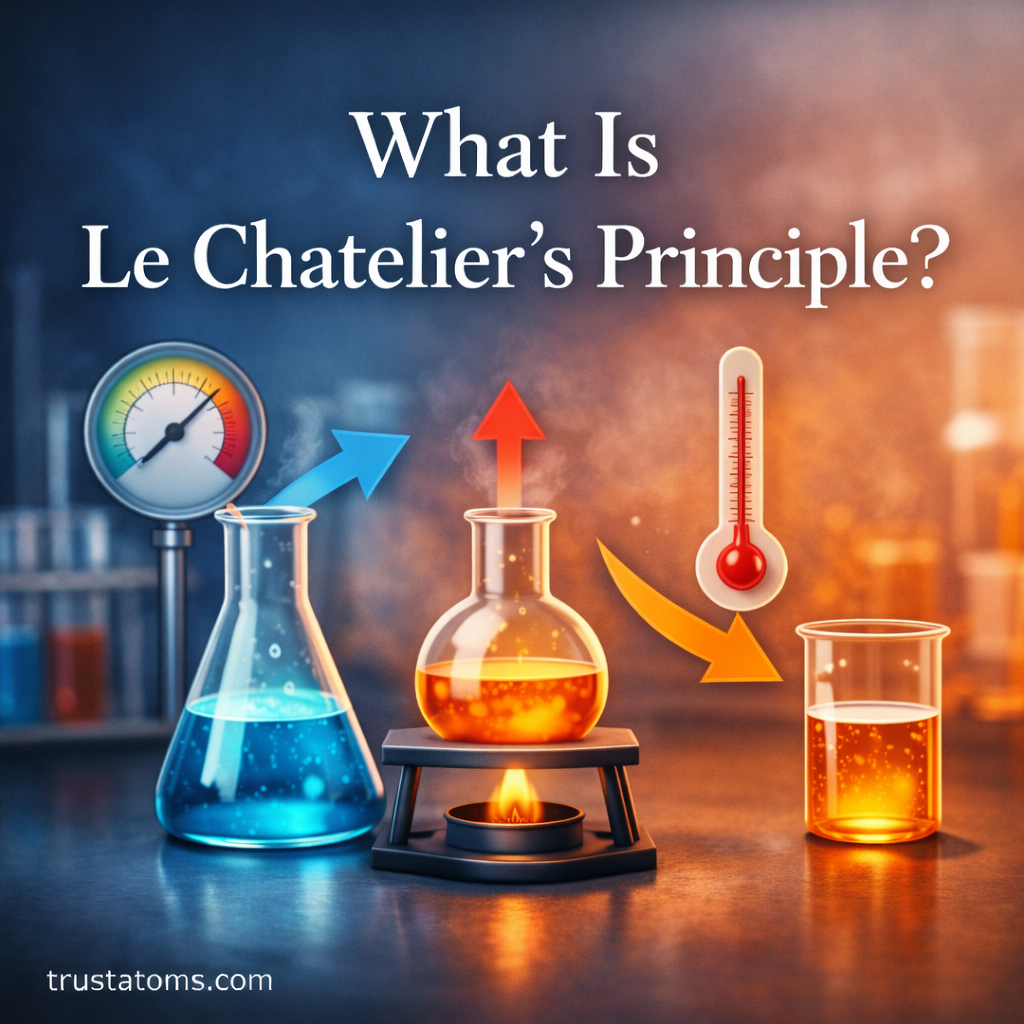
Chemical reactions do not always stay in a fixed state. When conditions change, reactions often shift in response. Le Chatelier’s Principle explains how and why this happens.
In chemistry, many reactions exist in a state of chemical equilibrium, where the forward and reverse reactions occur at the same rate. When a change disturbs that equilibrium, the system adjusts in a way that helps restore balance. This predictable response is described by Le Chatelier’s Principle.
Understanding this principle helps scientists control reactions in laboratories, optimize industrial production, and better understand natural chemical processes.
Definition of Le Chatelier’s Principle
Le Chatelier’s Principle states that:
A system at equilibrium will shift in a direction that counteracts any change imposed on it.
In simpler terms, when a chemical system experiences a disturbance, it responds in a way that reduces the effect of that disturbance and moves toward a new equilibrium.
The principle applies to changes in:
- Concentration
- Temperature
- Pressure (in gas systems)
- Volume
These changes cause the equilibrium position of a reaction to shift either toward reactants or toward products.
Understanding Chemical Equilibrium
Before exploring Le Chatelier’s Principle in detail, it helps to understand equilibrium.
A reaction at equilibrium has two important characteristics:
- The forward reaction rate equals the reverse reaction rate.
- The concentrations of reactants and products remain constant over time.
Even though concentrations stay the same, molecules continue reacting. The system remains dynamic, meaning reactions still occur in both directions.
Le Chatelier’s Principle describes how this balanced system responds when external conditions change.
How Changes in Concentration Affect Equilibrium
Changing the concentration of reactants or products disturbs equilibrium. The system responds by shifting the reaction to restore balance.
Adding More Reactants
When additional reactants are introduced:
- The system shifts toward products.
- More product forms to use up the extra reactants.
Example pattern:
Reactants ⇌ Products
Add reactants → Reaction shifts right.
Adding More Products
When extra products are added:
- The system shifts toward reactants.
- The reaction reverses to consume the additional products.
Example pattern:
Reactants ⇌ Products
Add products → Reaction shifts left.
Removing Substances
Removing a substance has the opposite effect:
- Removing reactants shifts equilibrium toward reactants.
- Removing products shifts equilibrium toward products.
This behavior is commonly used in industrial chemistry to increase product yields.
How Temperature Changes Affect Equilibrium
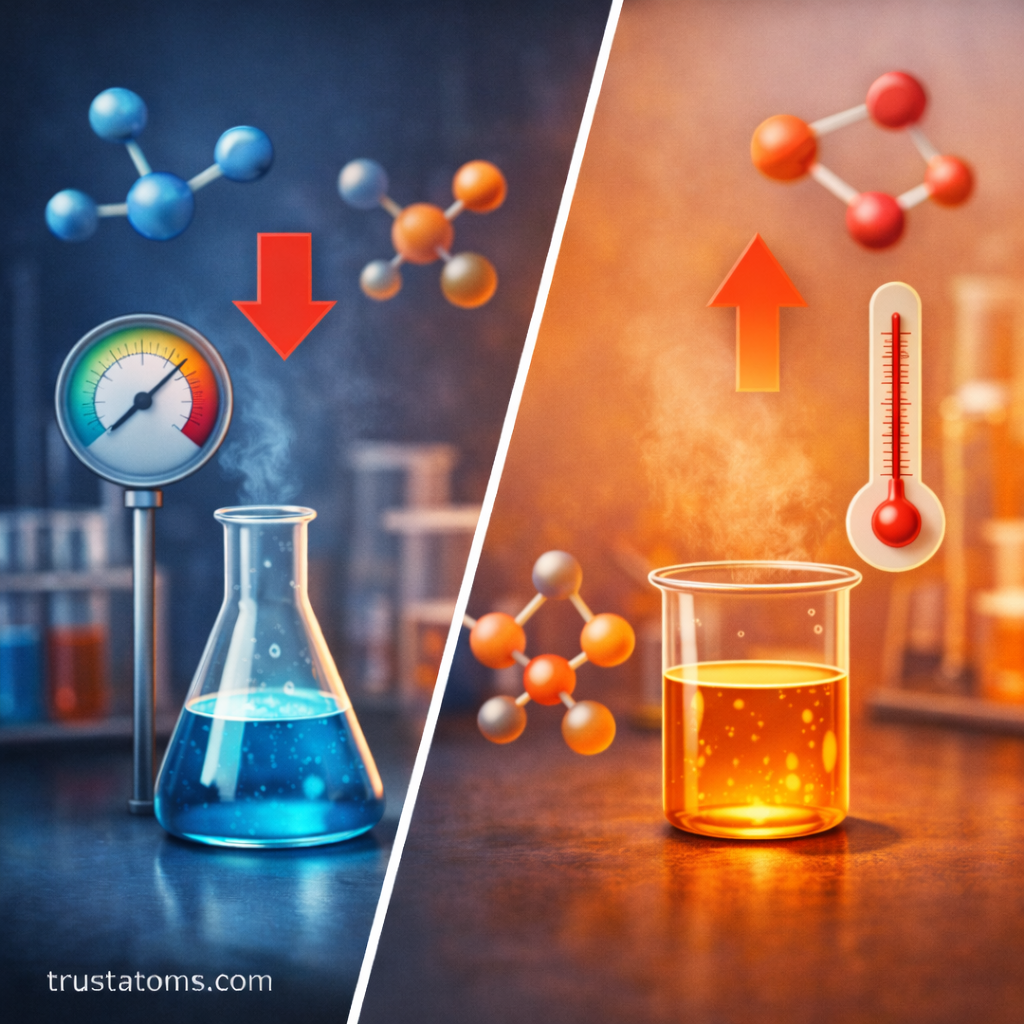
Temperature changes affect reactions because heat can behave like a reactant or product.
Chemical reactions can be either:
- Exothermic – release heat
- Endothermic – absorb heat
Increasing Temperature
If temperature increases:
- Equilibrium shifts toward the endothermic direction.
- The system absorbs heat to offset the temperature rise.
Decreasing Temperature
If temperature decreases:
- Equilibrium shifts toward the exothermic direction.
- The reaction releases heat to compensate for the temperature drop.
Temperature is unique because it can also change the equilibrium constant, not just the position of equilibrium.
How Pressure and Volume Affect Gas Reactions
Pressure changes primarily affect reactions involving gases.
When pressure changes, the system shifts to balance the number of gas molecules.
Increasing Pressure
If pressure increases:
- The system shifts toward the side with fewer gas molecules.
This reduces the total pressure inside the system.
Decreasing Pressure
If pressure decreases:
- The reaction shifts toward the side with more gas molecules.
This increases the number of gas particles to restore balance.
Volume changes produce similar effects because pressure and volume are closely related.
The Role of Catalysts
Catalysts speed up chemical reactions but do not shift equilibrium.
Instead, catalysts:
- Increase the speed of both forward and reverse reactions
- Allow equilibrium to be reached faster
- Do not change the equilibrium position
Because catalysts affect both reaction directions equally, the final concentrations remain unchanged.
Real-World Example: The Haber Process
Le Chatelier’s Principle plays a major role in industrial chemistry.
A famous example is the Haber process, which produces ammonia used in fertilizers.
Nitrogen gas reacts with hydrogen gas to form ammonia. Manufacturers adjust conditions to maximize production.
Key strategies include:
- Increasing pressure to favor fewer gas molecules
- Adjusting temperature to balance reaction speed and yield
- Continuously removing ammonia as it forms
Removing the product shifts equilibrium toward producing even more ammonia.
This application demonstrates how Le Chatelier’s Principle helps optimize large-scale chemical manufacturing.
Why Le Chatelier’s Principle Matters
Le Chatelier’s Principle is important because it allows scientists to predict how chemical systems will respond to changes.
This understanding helps in many areas:
- Designing efficient chemical manufacturing processes
- Improving product yields in industrial reactions
- Understanding biological chemical balance
- Predicting environmental chemical changes
By recognizing how equilibrium systems respond to disturbances, chemists can control reactions more effectively.
Key Takeaways
Le Chatelier’s Principle describes how systems at equilibrium respond to changes.
Important points include:
- Equilibrium systems adjust to counteract disturbances.
- Changing concentration, temperature, or pressure can shift equilibrium.
- Temperature shifts reactions toward endothermic or exothermic directions.
- Pressure changes affect reactions involving gases.
- Catalysts speed up reactions without changing equilibrium position.
This principle provides a powerful framework for predicting and controlling chemical reactions.