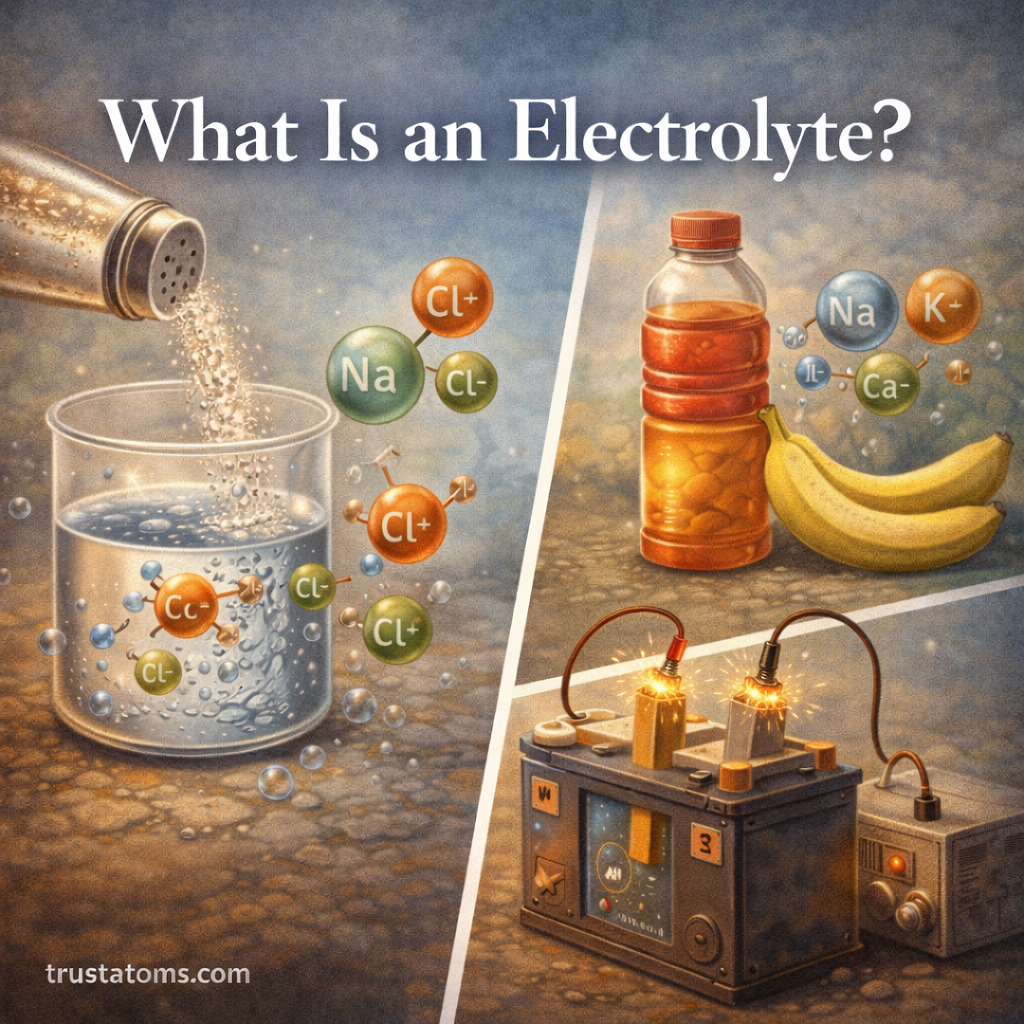
An electrolyte is a substance that produces ions when dissolved in water or melted, allowing it to conduct electricity. Electrolytes play an essential role in chemistry, biology, and many modern technologies because they enable the movement of electrical charge through liquids or solutions.
From powering batteries to supporting nerve signals in the human body, electrolytes are involved in many chemical and biological processes. Understanding how electrolytes work helps explain how energy flows through chemical systems and living organisms.
The Basic Definition of an Electrolyte
In chemistry, an electrolyte is a substance that dissociates into charged particles called ions when dissolved in a solvent, typically water.
These ions allow the solution to conduct electricity.
Common electrolytes include:
- Salts
- Acids
- Bases
When dissolved, these substances separate into positive and negative ions that move freely in the solution.
How Electrolytes Conduct Electricity
Electricity flows through electrolytes because ions can move within the liquid.
The process works like this:
- The electrolyte dissolves in water.
- The substance separates into positive and negative ions.
- These ions move through the solution when an electric field is present.
- Their movement carries electrical charge.
Unlike metals, where electricity flows through electrons, electrolyte solutions conduct electricity through moving ions.
Strong vs Weak Electrolytes
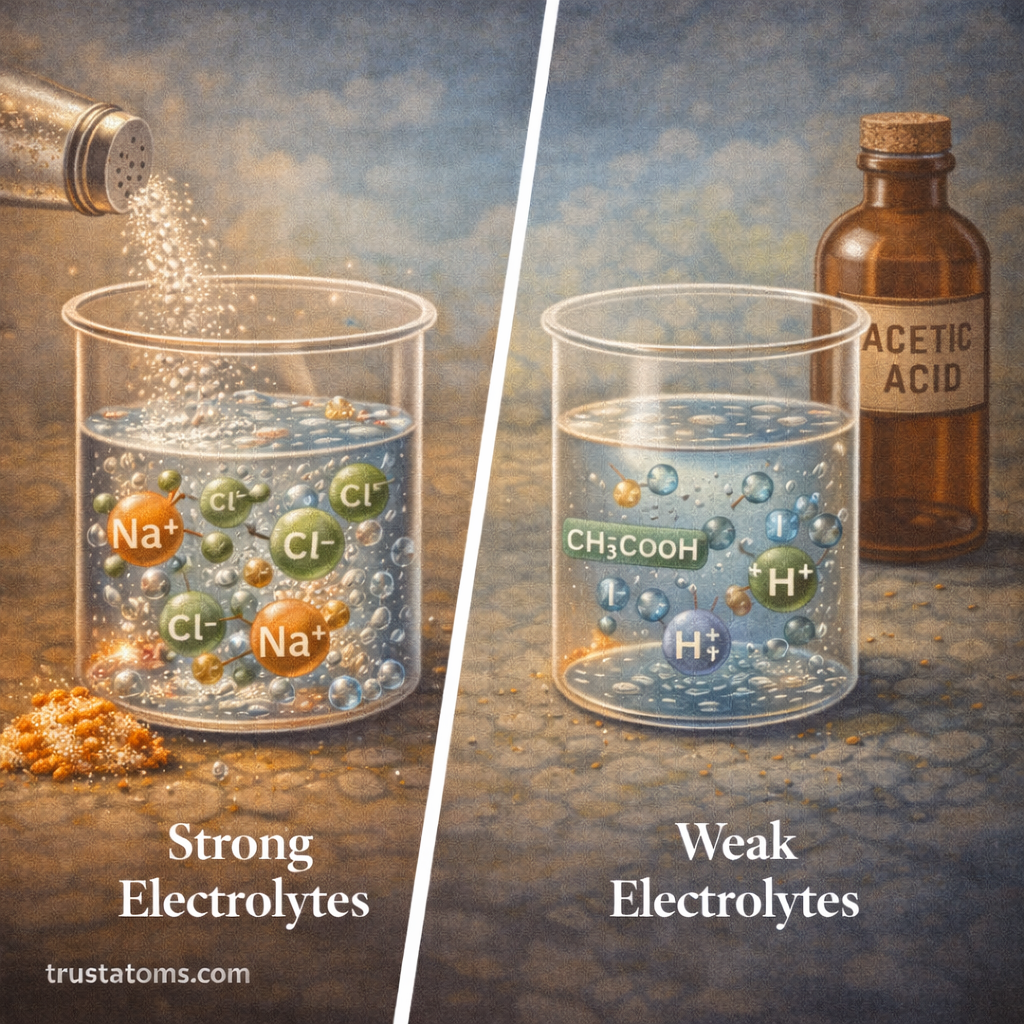
Electrolytes are often classified based on how completely they break apart into ions in water.
Strong Electrolytes
Strong electrolytes completely dissociate into ions when dissolved.
Examples include:
- Sodium chloride (table salt)
- Potassium chloride
- Hydrochloric acid
- Sodium hydroxide
Because they produce many ions, strong electrolytes conduct electricity very efficiently.
Weak Electrolytes
Weak electrolytes only partially dissociate into ions.
Examples include:
- Acetic acid
- Ammonia
- Carbonic acid
Since fewer ions are present in solution, weak electrolytes conduct electricity less effectively.
Common Types of Electrolytes
Electrolytes can be grouped into three major chemical categories.
Salts
Salts form when acids and bases react.
When dissolved in water, salts typically separate into metal ions and nonmetal ions.
Examples include:
- Sodium chloride (NaCl)
- Calcium chloride (CaCl₂)
- Potassium nitrate (KNO₃)
Acids
Acids release hydrogen ions when dissolved in water.
Examples include:
- Hydrochloric acid
- Sulfuric acid
- Nitric acid
These ions increase the electrical conductivity of the solution.
Bases
Bases produce hydroxide ions when dissolved in water.
Examples include:
- Sodium hydroxide
- Potassium hydroxide
- Calcium hydroxide
Like acids, bases contribute charged particles that allow electricity to flow.
Electrolytes in Electrochemical Systems
Electrolytes are essential components of electrochemical devices.
They allow ions to move between electrodes and maintain electrical balance in the system.
Common electrochemical systems that rely on electrolytes include:
- Batteries
- Fuel cells
- Electrolysis systems
- Corrosion processes
In these systems, electrolytes enable chemical reactions to continue by allowing charge to move through the solution.
Electrolytes in the Human Body
Electrolytes are also crucial for biological functions.
Important electrolytes in the body include:
- Sodium
- Potassium
- Calcium
- Magnesium
- Chloride
These ions help regulate:
- Nerve signals
- Muscle contractions
- Fluid balance
- Heart function
Electrolytes in body fluids allow electrical signals to travel through nerves and muscles.
Everyday Examples of Electrolytes
Electrolytes appear in many familiar products and processes.
Examples include:
- Sports drinks that replace lost electrolytes
- Battery acid used in car batteries
- Saltwater solutions used in chemical experiments
- Electroplating processes used in manufacturing
Even simple salt dissolved in water becomes an electrolyte solution capable of conducting electricity.
Factors That Affect Electrolyte Conductivity
Several factors influence how well an electrolyte conducts electricity.
Ion Concentration
More ions in a solution generally increase conductivity.
Temperature
Higher temperatures allow ions to move more freely, improving conductivity.
Type of Electrolyte
Strong electrolytes conduct electricity better than weak electrolytes because they produce more ions.
Key Takeaways
Electrolytes are substances that produce ions when dissolved in water, allowing solutions to conduct electricity.
Important points to remember include:
- Electrolytes separate into charged ions in solution
- Electricity flows through electrolyte solutions via ion movement
- Electrolytes can be strong or weak depending on ion formation
- Common electrolytes include salts, acids, and bases
- Electrolytes are essential in batteries, electrochemistry, and biological systems
Because they enable electrical charge to move through liquids, electrolytes are a fundamental concept in both chemistry and life sciences.