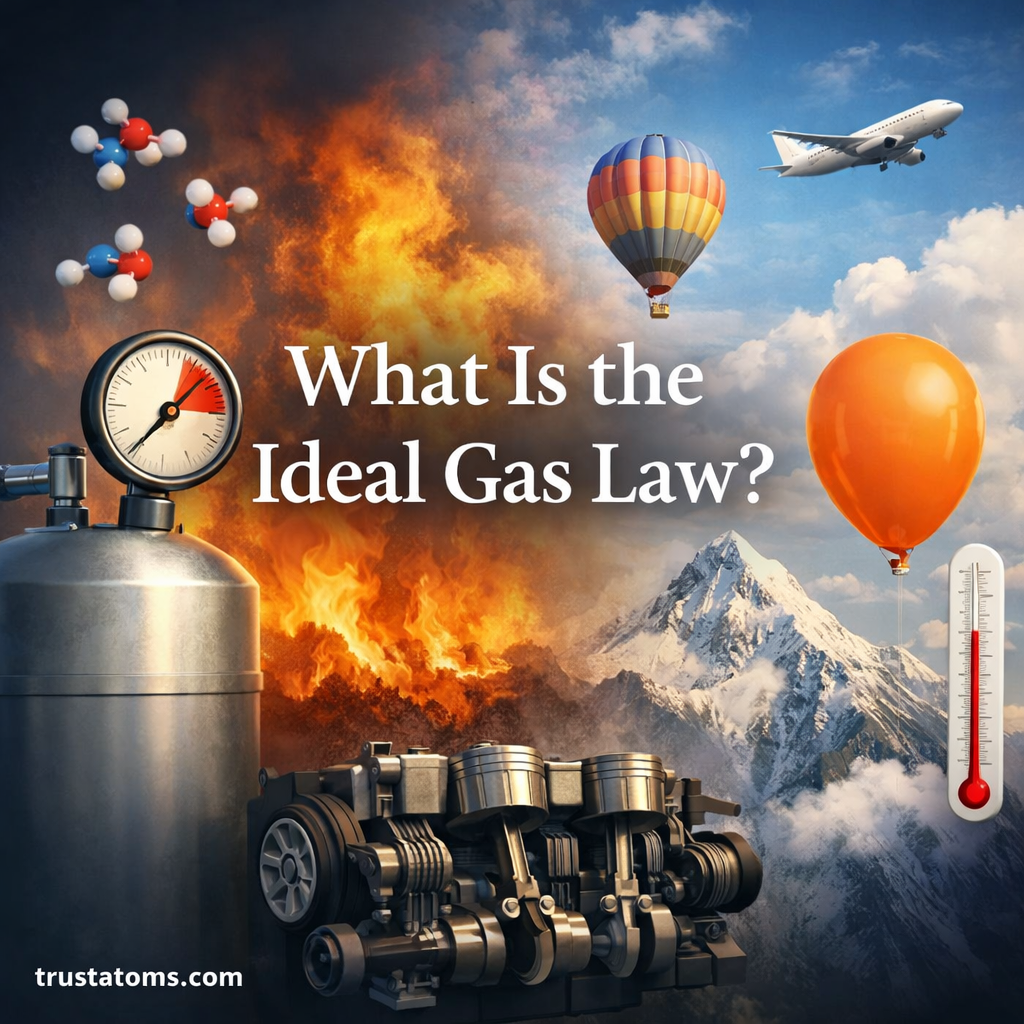
The Ideal Gas Law is one of the most important relationships in chemistry and physics. It explains how gases behave by linking four key properties: pressure, volume, temperature, and the number of gas particles.
By combining several earlier gas laws into a single equation, the Ideal Gas Law allows scientists to predict how gases will react when conditions change. It is widely used in chemistry, engineering, meteorology, and many everyday applications involving air and other gases.
The Ideal Gas Law Explained
The Ideal Gas Law describes the relationship between pressure, volume, temperature, and the amount of gas.
The equation is commonly written as:
PV = nRT
Each symbol represents an important property of a gas:
- P = Pressure of the gas
- V = Volume the gas occupies
- n = Number of moles of gas particles
- R = Ideal gas constant
- T = Temperature (measured in Kelvin)
This equation shows that if one variable changes, at least one of the others must also change for the equation to remain balanced.
For example:
- Increasing temperature may increase pressure if volume stays constant.
- Increasing volume may reduce pressure if temperature stays the same.
Because of this relationship, the Ideal Gas Law helps explain many physical behaviors of gases.
Where the Ideal Gas Law Comes From
The Ideal Gas Law combines several earlier gas laws discovered by scientists in the 17th–19th centuries. Each of these laws describes how two variables of a gas interact.
The main laws combined into the Ideal Gas Law include:
Boyle’s Law
Boyle’s Law describes the relationship between pressure and volume.
- When volume decreases, pressure increases.
- When volume increases, pressure decreases.
This relationship occurs when temperature stays constant.
Charles’s Law
Charles’s Law explains the relationship between temperature and volume.
- When temperature increases, gas volume expands.
- When temperature decreases, gas volume contracts.
This occurs when pressure remains constant.
Avogadro’s Law
Avogadro’s Law focuses on the number of gas particles.
- Increasing the number of gas molecules increases the volume of the gas.
- Decreasing the number of molecules reduces volume.
These laws together form the foundation of the Ideal Gas Law equation.
What Makes a Gas “Ideal”?
An ideal gas is a simplified model used in science. In this model, gas particles follow a few basic assumptions:
- Gas particles are extremely small compared to the space they occupy.
- Particles move in constant random motion.
- Collisions between particles are perfectly elastic (no energy loss).
- There are no attractive or repulsive forces between particles.
Real gases do not behave perfectly like this, but many gases behave close enough under normal conditions that the Ideal Gas Law works very well for predictions.
Why Temperature Must Be Measured in Kelvin
Temperature in the Ideal Gas Law must always be measured in Kelvin, not Celsius or Fahrenheit.
The Kelvin scale starts at absolute zero, the point where molecular motion theoretically stops. Because the Ideal Gas Law depends on particle motion, the Kelvin scale provides the correct physical reference point.
To convert Celsius to Kelvin:
Kelvin = Celsius + 273.15
For example:
- 25°C = 298 K
- 0°C = 273 K
Using the Kelvin scale ensures accurate calculations when applying the Ideal Gas Law.
Common Applications of the Ideal Gas Law
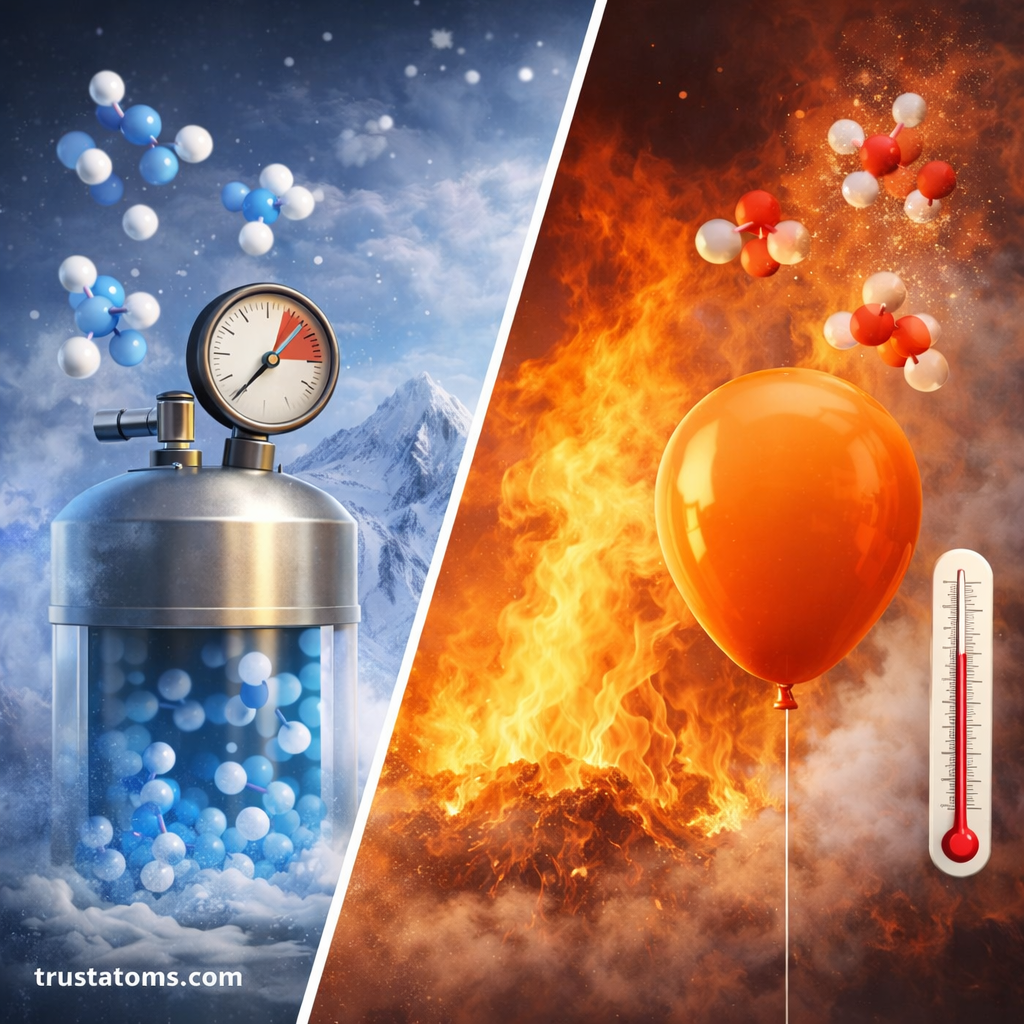
The Ideal Gas Law helps scientists and engineers understand many real-world systems involving gases.
Examples include:
Weather and Atmospheric Science
Meteorologists use gas relationships to understand air pressure, temperature changes, and atmospheric behavior.
Scuba Diving and Aviation
Changes in pressure at different depths or altitudes affect gas volumes in equipment and breathing systems.
Engines and Combustion
Gas expansion inside engines helps produce mechanical power.
Industrial Chemistry
Chemical reactions involving gases often require predictions about pressure and volume changes.
Balloons and Airbags
Gas expansion explains why balloons expand when heated and why airbags inflate rapidly during a collision.
Example of the Ideal Gas Law in Action
Imagine a sealed container holding a gas.
If the temperature increases while the container’s volume stays the same, gas particles move faster and collide with the walls more often. This increases pressure.
Similarly:
- If volume expands while temperature stays constant, pressure decreases.
- If more gas is added to the container, pressure increases.
The Ideal Gas Law allows scientists to calculate exactly how these variables change.
Limitations of the Ideal Gas Law
Although very useful, the Ideal Gas Law is an approximation.
Real gases begin to deviate from ideal behavior under certain conditions:
- Extremely high pressures
- Very low temperatures
- Situations where gas particles interact strongly
Under these conditions, more advanced models such as real gas equations are used to describe behavior more accurately.
Why the Ideal Gas Law Matters
The Ideal Gas Law provides a simple yet powerful way to understand how gases behave. By connecting pressure, volume, temperature, and particle quantity in a single equation, it allows scientists to make accurate predictions about gas systems.
From predicting weather patterns to designing engines and studying chemical reactions, the Ideal Gas Law remains one of the most widely used tools in chemistry and physics.
Key Takeaways
- The Ideal Gas Law relates pressure, volume, temperature, and gas quantity.
- The equation is written as PV = nRT.
- It combines Boyle’s Law, Charles’s Law, and Avogadro’s Law.
- Temperature must be measured in Kelvin for correct calculations.
- The law works best under normal conditions where gases behave nearly ideally.
Understanding the Ideal Gas Law provides a foundation for studying chemistry, physics, and many natural processes involving gases.