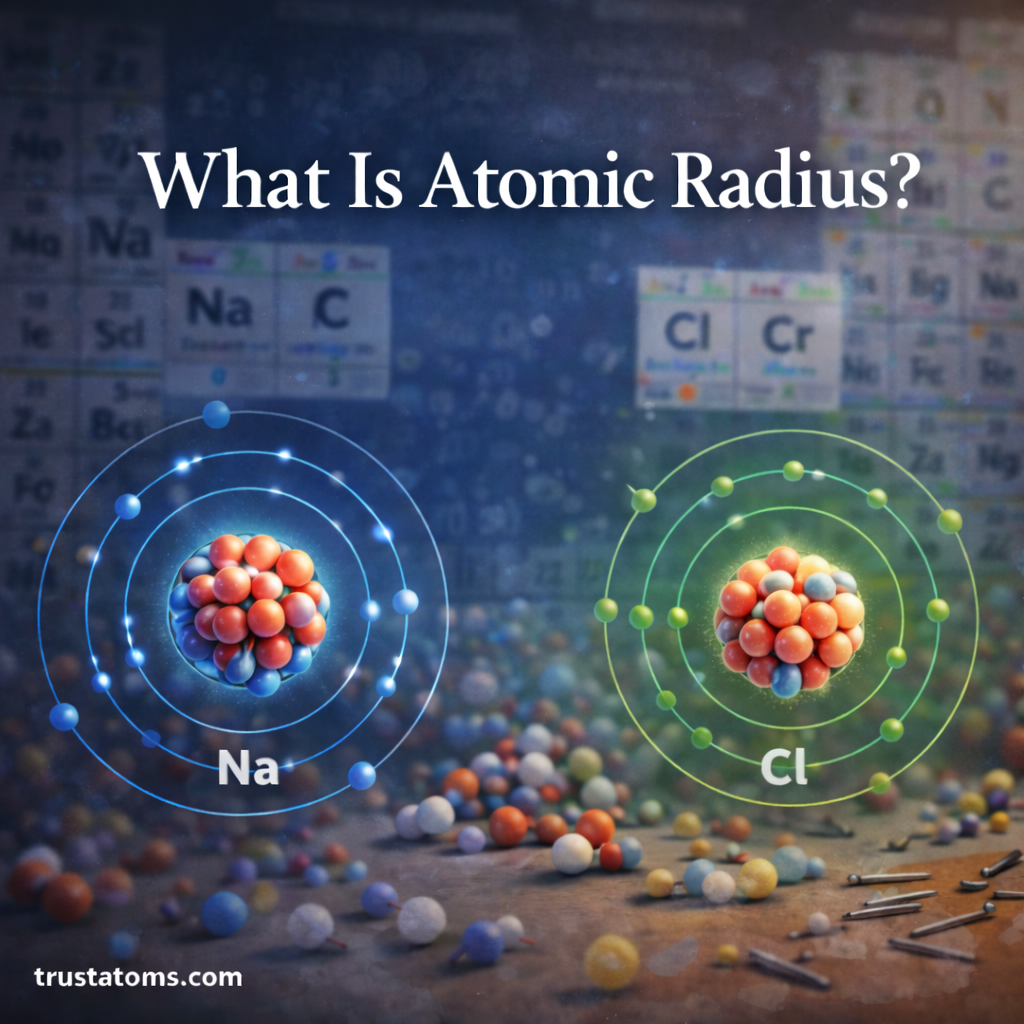
Atomic radius is a fundamental concept in chemistry that describes the size of an atom. Although atoms are incredibly small and cannot be seen directly with ordinary microscopes, scientists can estimate how large they are by measuring the distance between atomic nuclei in bonded atoms.
Understanding atomic radius helps chemists explain patterns in the periodic table, predict chemical behavior, and understand how atoms interact with one another during chemical reactions.
Understanding Atomic Radius
Atomic radius refers to the distance from the center of an atom’s nucleus to the outer edge of its electron cloud.
However, atoms do not have perfectly defined boundaries. Instead, electrons move within regions of probability called orbitals. Because of this, scientists define atomic radius using measurements between atoms.
The most common definition is:
Atomic radius = half the distance between the nuclei of two identical bonded atoms.
This method provides a consistent way to compare the relative sizes of atoms.
Why Atomic Radius Matters
Atomic radius plays a major role in determining how atoms behave chemically. The size of an atom influences how easily it can gain, lose, or share electrons.
Atomic size affects:
- Chemical bonding
- Ion formation
- Reactivity of elements
- Periodic trends across the periodic table
- Physical properties of materials
Larger atoms tend to hold their outer electrons more loosely, while smaller atoms hold them more tightly.
Types of Atomic Radius
Chemists use several related measurements to describe atomic size depending on the context.
Covalent Radius
The covalent radius is measured when two atoms share electrons in a covalent bond.
It is defined as:
Half the distance between the nuclei of two identical atoms bonded together.
This measurement is commonly used for elements that form covalent bonds, such as carbon, oxygen, and hydrogen.
Metallic Radius
The metallic radius describes atoms within metallic structures.
In metals, atoms are packed together in a lattice and share a “sea of electrons.” The metallic radius is measured as half the distance between nuclei of adjacent metal atoms.
Van der Waals Radius
The van der Waals radius applies when atoms are close together but not bonded.
This measurement is typically larger than covalent radius because it represents the distance between atoms that are only weakly interacting.
Periodic Trends in Atomic Radius

Atomic radius follows clear patterns across the periodic table.
Understanding these trends helps predict the size of elements without direct measurement.
Atomic Radius Across a Period (Left to Right)
As you move from left to right across a period, atomic radius generally decreases.
This happens because:
- The number of protons in the nucleus increases.
- Electrons are added to the same energy level.
- The stronger positive charge pulls electrons closer to the nucleus.
As a result, atoms become smaller across a period.
Atomic Radius Down a Group (Top to Bottom)
As you move down a group, atomic radius increases.
This occurs because:
- Additional electron shells are added.
- Electrons are located farther from the nucleus.
- Inner electrons shield outer electrons from the nucleus’s pull.
This makes atoms larger as you move down the periodic table.
Factors That Influence Atomic Radius
Several factors affect how large an atom appears.
Nuclear Charge
The number of protons in the nucleus creates an attractive force pulling electrons inward.
Higher nuclear charge typically reduces atomic radius.
Electron Shielding
Inner electrons can block some of the attractive force from the nucleus.
This shielding effect allows outer electrons to stay farther from the nucleus, increasing atomic size.
Energy Levels
Each additional electron shell increases the distance between electrons and the nucleus.
Elements with more energy levels have larger atomic radii.
Atomic Radius vs Ionic Radius
Atoms often gain or lose electrons to form ions, which changes their size.
Cations (Positive Ions)
When an atom loses electrons, it becomes a cation.
Cations are usually smaller than the original atom because:
- The electron cloud shrinks
- Remaining electrons feel stronger attraction to the nucleus
Anions (Negative Ions)
When an atom gains electrons, it becomes an anion.
Anions are generally larger than the original atom because:
- Additional electrons increase repulsion
- The electron cloud expands
Real-World Importance of Atomic Radius
Atomic radius helps explain many properties observed in chemistry and materials science.
Examples include:
- Why certain elements react more easily than others
- How atoms fit together in crystals and metals
- Differences in bond length between molecules
- The behavior of elements in chemical reactions
By understanding atomic size, scientists can predict how substances will interact at the atomic level.
Key Takeaways
- Atomic radius measures the size of an atom from its nucleus to its outer electron cloud.
- It is typically defined as half the distance between nuclei of bonded atoms.
- Atomic radius decreases across a period and increases down a group in the periodic table.
- Nuclear charge, electron shielding, and energy levels all influence atomic size.
- Ions have different sizes than their neutral atoms due to electron gain or loss.
Atomic radius is one of the key periodic trends that helps chemists understand how elements behave and interact within the periodic table.