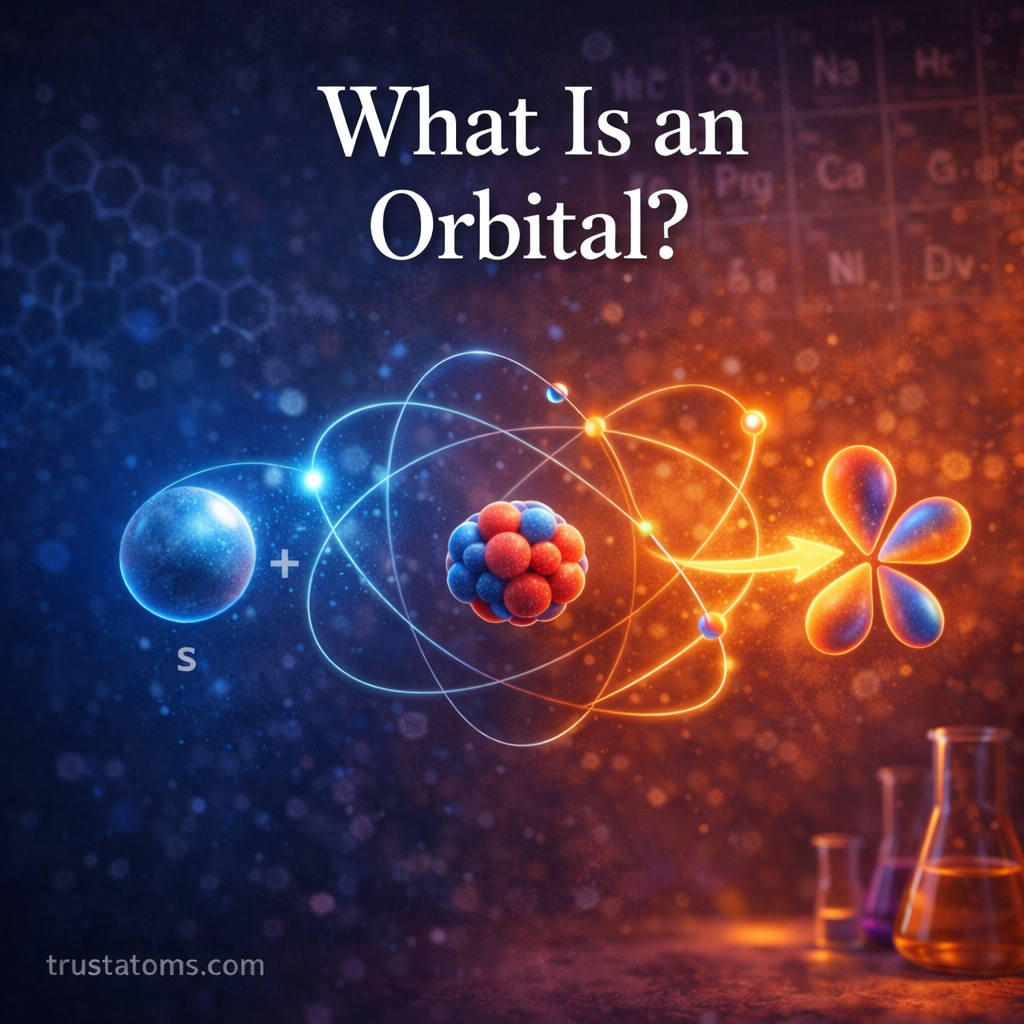
In chemistry and physics, an orbital describes the region around an atom’s nucleus where an electron is most likely to be found. Orbitals are a fundamental part of atomic theory and help scientists understand how atoms bond, react, and form molecules.
Rather than moving in fixed circular paths, electrons exist in areas of probability called orbitals. These regions represent where electrons are most likely to appear at any given time.
Understanding orbitals helps explain the structure of atoms, the behavior of electrons, and the patterns seen in the periodic table.
Understanding Atomic Orbitals
An orbital is a three-dimensional region around the nucleus of an atom where there is a high probability of finding an electron.
Electrons do not orbit the nucleus like planets around the sun. Instead, they behave according to the principles of quantum mechanics, meaning their exact position cannot be known with certainty.
Instead of a precise path, orbitals describe probability clouds where electrons are most likely located.
Key characteristics of orbitals include:
- Each orbital can hold a maximum of two electrons
- Electrons in the same orbital must have opposite spins
- Orbitals exist at different energy levels
These properties help determine how atoms interact with one another.
Energy Levels and Orbitals
Orbitals are organized into energy levels that surround the atomic nucleus. These energy levels are sometimes called electron shells.
As electrons move farther from the nucleus, their energy increases.
Each energy level contains one or more orbitals.
For example:
- The first energy level contains one orbital
- The second energy level contains four orbitals
- The third energy level contains nine orbitals
Electrons fill lower-energy orbitals first before occupying higher-energy orbitals.
Types of Atomic Orbitals
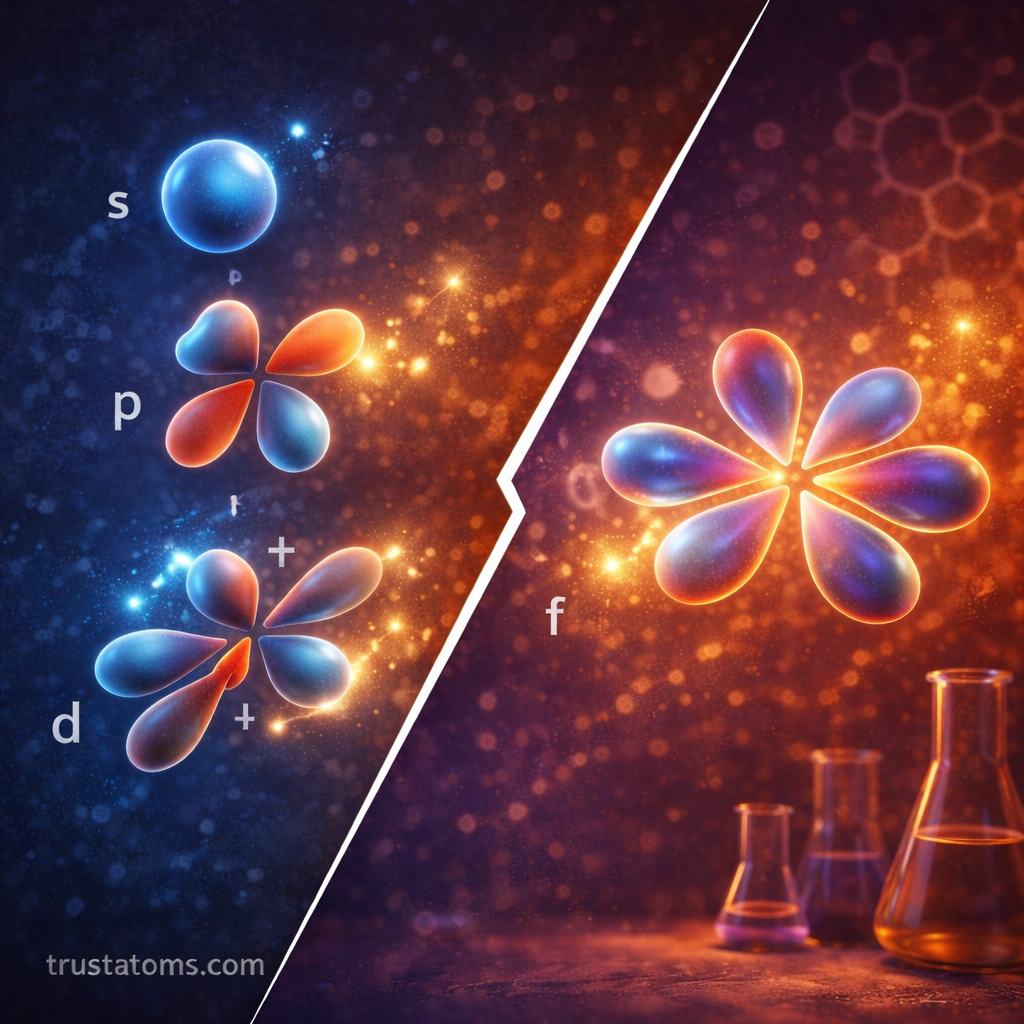
There are several types of orbitals, each with a unique shape and energy level. The most common types are s, p, d, and f orbitals.
s Orbitals
The s orbital is the simplest type.
Characteristics include:
- Spherical shape
- Found in every energy level
- Can hold up to two electrons
Because of their symmetrical shape, s orbitals surround the nucleus evenly in all directions.
p Orbitals
The p orbital has a different structure.
Characteristics include:
- Dumbbell-shaped
- Found starting at the second energy level
- Three orientations in space
The three p orbitals are positioned along the:
- x-axis
- y-axis
- z-axis
Together, these orbitals can hold up to six electrons.
d Orbitals
The d orbitals are more complex in shape.
Key features include:
- Cloverleaf or multi-lobed shapes
- Found starting in the third energy level
- Five different orientations
All five d orbitals together can hold up to ten electrons.
These orbitals are especially important in transition metals.
f Orbitals
The f orbitals are the most complex type of atomic orbital.
Characteristics include:
- Highly complex shapes
- Found starting in the fourth energy level
- Seven orientations
Together, the seven f orbitals can hold up to fourteen electrons.
These orbitals are associated with elements such as the lanthanides and actinides.
How Orbitals Determine Electron Arrangement
Orbitals play a central role in determining how electrons are arranged in an atom.
Electrons fill orbitals according to three important rules:
1. Aufbau Principle
Electrons fill orbitals starting with the lowest energy level first.
Lower-energy orbitals fill before higher-energy ones.
2. Pauli Exclusion Principle
Each orbital can hold no more than two electrons, and those electrons must have opposite spins.
This rule prevents electrons from occupying identical quantum states.
3. Hund’s Rule
When multiple orbitals have the same energy level, electrons fill them one at a time before pairing up.
This arrangement minimizes electron repulsion and increases stability.
Orbitals and Chemical Bonding
Orbitals are essential for understanding chemical bonding.
When atoms form bonds, their orbitals overlap to share electrons. This overlap creates chemical bonds that hold molecules together.
Two common types of orbital interactions include:
- Sigma bonds formed by direct orbital overlap
- Pi bonds formed by side-by-side orbital overlap
These interactions determine the strength and structure of molecules.
Why Orbitals Are Important in Chemistry
Orbitals provide a deeper understanding of how atoms behave and interact.
They help explain:
- The structure of the periodic table
- Chemical reactivity of elements
- The formation of molecules
- The shapes of compounds
- The behavior of electrons in atoms
Without orbitals, it would be difficult to explain why atoms form certain bonds or why molecules have specific shapes.
Orbitals in Modern Science
Orbitals are not just theoretical concepts. They are supported by modern experimental methods and quantum mechanical calculations.
Scientists use orbital theory in many areas of research, including:
- Materials science
- Molecular chemistry
- Nanotechnology
- Semiconductor design
- Pharmaceutical development
These fields rely on orbital interactions to understand and design new materials and compounds.
Final Thoughts
An orbital is a region around an atom’s nucleus where an electron is most likely to be found. Rather than following fixed paths, electrons exist in probability clouds described by quantum mechanics.
Different types of orbitals—such as s, p, d, and f—have unique shapes and energy levels that determine how electrons are arranged in atoms.
By understanding orbitals, scientists gain insight into atomic structure, chemical bonding, and the behavior of matter at the smallest scale.