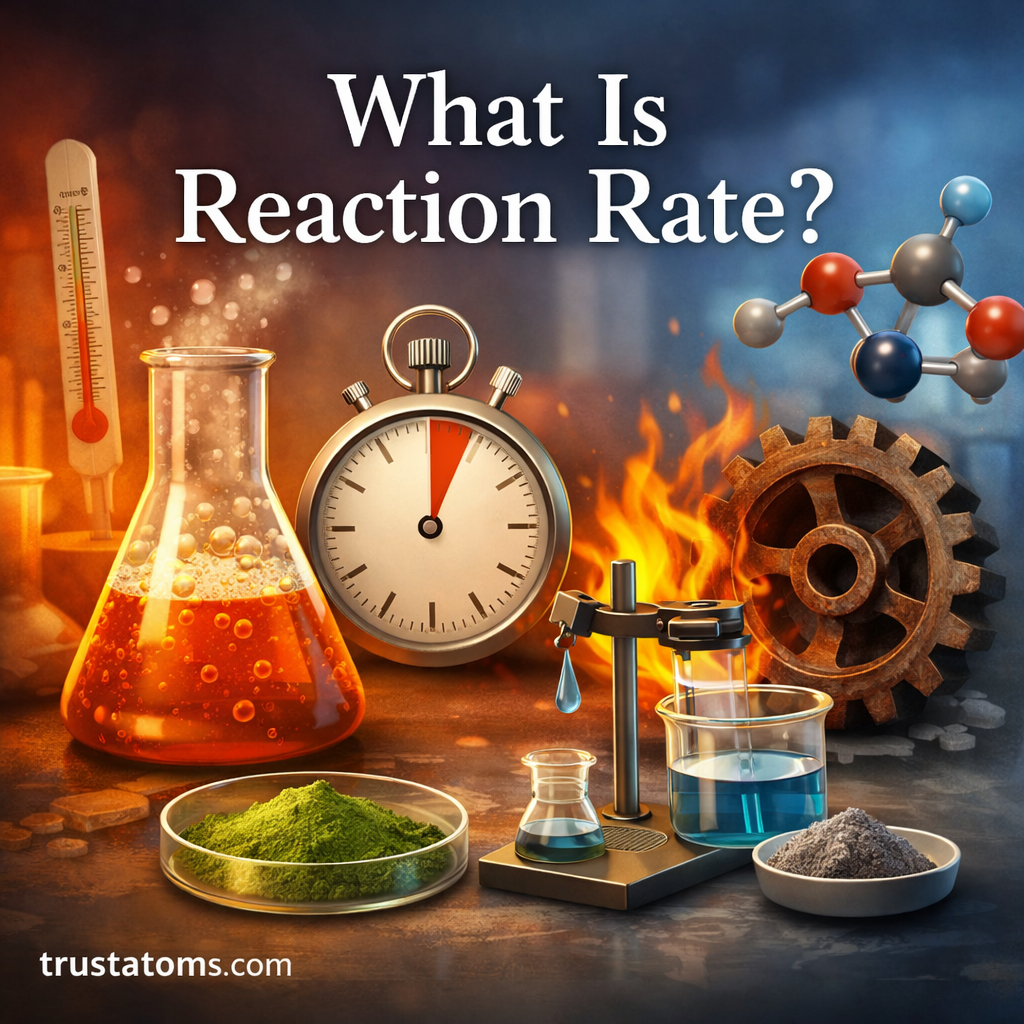
Reaction rate is a fundamental concept in chemistry that describes how fast a chemical reaction occurs. Some reactions happen almost instantly—like fireworks exploding—while others occur very slowly, such as the rusting of iron or the formation of sedimentary rock.
Understanding reaction rates helps chemists control reactions in laboratories, optimize industrial processes, and predict how chemical systems behave in real-world environments.
In simple terms, the reaction rate tells us how quickly reactants are converted into products over time.
Understanding Reaction Rate in Simple Terms
A chemical reaction occurs when atoms or molecules collide and rearrange to form new substances. The reaction rate measures the speed at which this transformation happens.
It can be described as:
- How fast reactants disappear
- How fast products form
- How quickly concentration changes during a reaction
Chemists often monitor reaction rates to determine whether a process is slow, moderate, or extremely fast.
For example:
- Burning gasoline happens rapidly.
- Cooking food occurs at a moderate rate.
- Rust forming on metal happens very slowly.
How Reaction Rate Is Measured
Reaction rate is usually measured by observing how the concentration of a substance changes over time.
Chemists track measurable changes such as:
- Color changes
- Gas production
- Temperature shifts
- Formation of solid precipitates
- Changes in acidity (pH)
Common measurement approaches include:
- Measuring how quickly a gas is produced.
- Tracking how fast a reactant disappears.
- Monitoring how fast a product forms.
The rate may be described as change in concentration per unit of time.
For example, if a reactant concentration decreases steadily during a reaction, chemists can calculate how quickly the reaction is proceeding.
Factors That Affect Reaction Rate
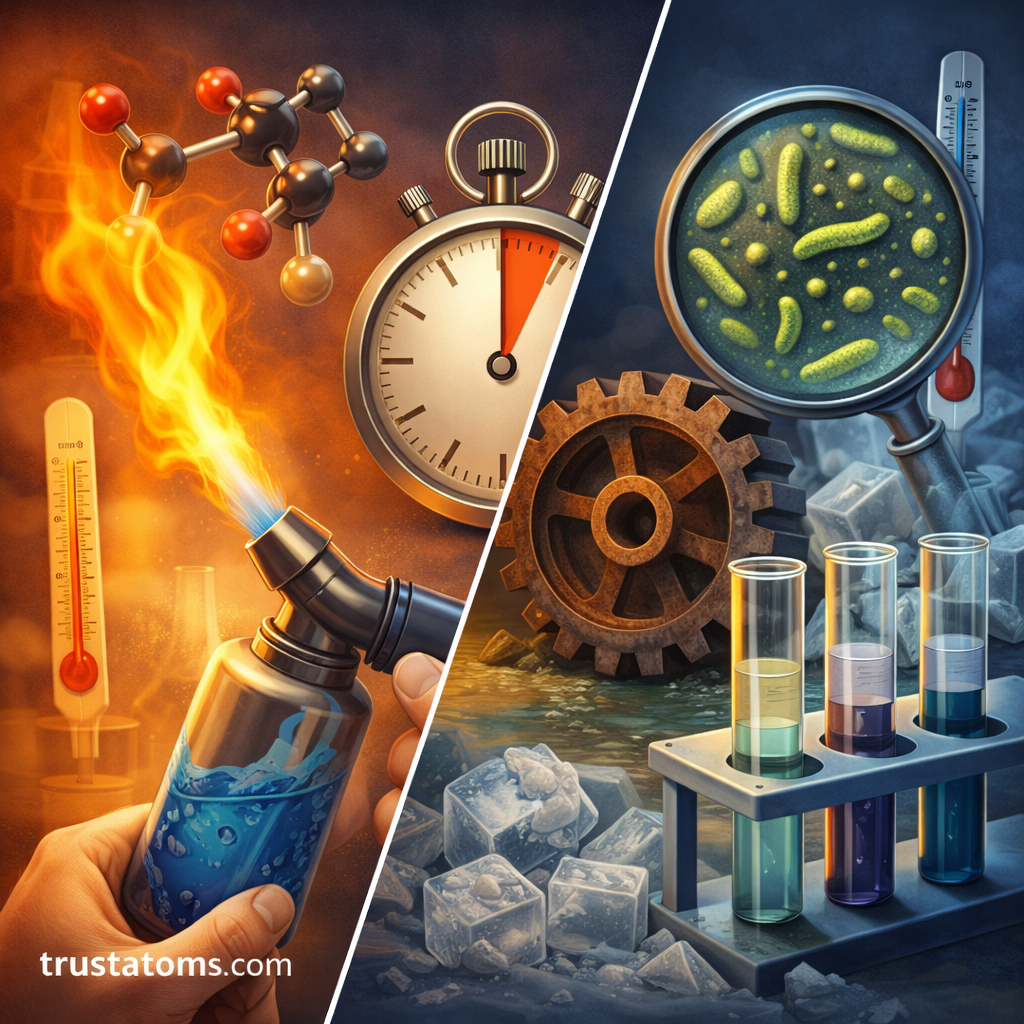
Not all reactions occur at the same speed. Several key factors influence how quickly a chemical reaction takes place.
Temperature
Temperature has a major impact on reaction speed.
Higher temperatures cause molecules to move faster, increasing the chances of effective collisions between particles.
As a result:
- Most reactions occur faster at higher temperatures
- Lower temperatures generally slow reactions down
This is why food spoils more slowly when refrigerated.
Concentration of Reactants
The concentration of reactants determines how many particles are available to collide.
Higher concentration means:
- More frequent particle collisions
- Faster reaction rates
Lower concentration usually results in fewer collisions and slower reactions.
Surface Area
When solids are involved in a reaction, surface area matters.
A substance that is broken into smaller pieces exposes more surface for reactions to occur.
For example:
- Powdered sugar dissolves faster than a sugar cube.
- Crushed tablets react faster than whole tablets.
Catalysts
A catalyst is a substance that speeds up a chemical reaction without being consumed.
Catalysts work by lowering the energy required for a reaction to occur.
They are widely used in:
- Industrial chemical production
- Biological systems (enzymes)
- Environmental processes
Catalysts can dramatically increase reaction speed.
Reaction Rate and Collision Theory
Collision theory explains why reactions occur at different speeds.
According to this theory, for a reaction to happen:
- Particles must collide.
- Collisions must occur with enough energy.
- Collisions must have the correct orientation.
If these conditions are not met, the particles simply bounce apart without reacting.
The more successful collisions that occur per second, the faster the reaction rate.
Real-World Examples of Reaction Rates
Reaction rates play an important role in everyday life and industry.
Common examples include:
- Cooking food – Heat speeds up chemical reactions that change flavor and texture.
- Combustion engines – Fuel burns rapidly to produce energy.
- Corrosion – Metals slowly react with oxygen to form rust.
- Food preservation – Lower temperatures slow chemical reactions that cause spoilage.
- Medicine – Reaction rates influence how drugs interact in the body.
Controlling reaction rates is essential for efficiency, safety, and product quality.
Why Reaction Rate Matters in Chemistry
Studying reaction rates allows chemists to understand how reactions proceed and how they can be controlled.
This knowledge is important for:
- Designing safer industrial reactions
- Developing pharmaceuticals
- Improving energy production
- Creating new materials
- Predicting environmental chemical changes
By understanding reaction rates, scientists can optimize processes to make reactions faster, safer, or more efficient depending on the goal.
Final Thoughts
Reaction rate describes how quickly a chemical reaction occurs. It depends on factors such as temperature, concentration, surface area, and catalysts.
By studying reaction rates, chemists gain valuable insight into how reactions work and how they can be controlled in both laboratory and real-world settings.
From cooking and medicine to manufacturing and environmental science, reaction rates influence many aspects of the world around us.