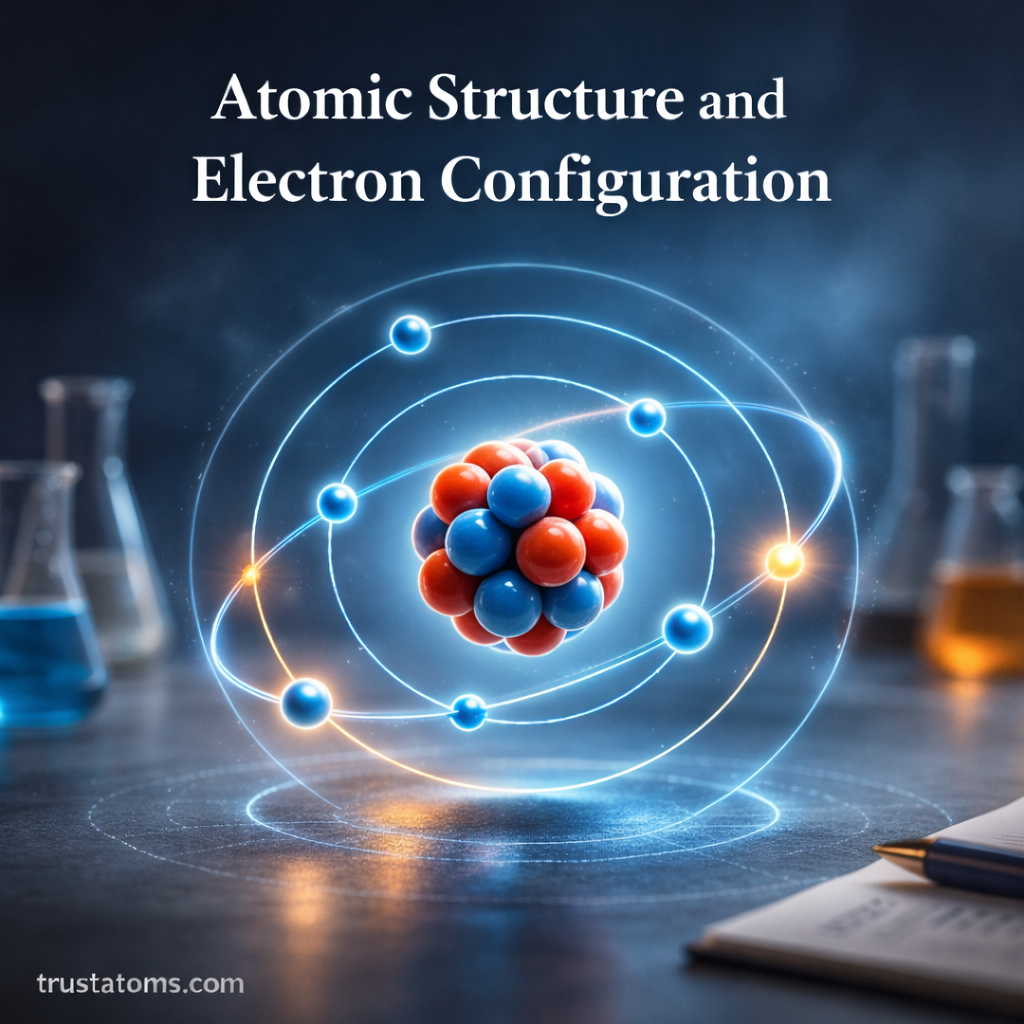
Atomic structure describes how atoms are organized and how their particles are arranged. Every atom contains a nucleus made of protons and neutrons, surrounded by electrons that move in regions called energy levels.
Electron configuration refers to the way electrons are arranged around the nucleus of an atom. This arrangement determines many chemical properties, including how atoms bond and interact with other elements.
Understanding atomic structure and electron configuration is essential in chemistry because it explains why elements behave differently and how chemical reactions occur.
The Basic Structure of an Atom
Atoms are the fundamental building blocks of matter. Although extremely small, they contain several important subatomic particles.
The three main components of an atom are:
- Protons
- Neutrons
- Electrons
Protons
Protons are positively charged particles located in the nucleus at the center of the atom.
Key characteristics of protons include:
- Positive electric charge
- Relatively large mass compared to electrons
- Determining the atomic number of an element
The number of protons in an atom identifies the element.
Neutrons
Neutrons are neutral particles that also reside in the nucleus.
Their main roles include:
- Adding mass to the atom
- Helping stabilize the nucleus
- Contributing to different isotopes of elements
Neutrons have a similar mass to protons but carry no electrical charge.
Electrons
Electrons are negatively charged particles that move around the nucleus.
Important characteristics include:
- Very small mass compared to protons and neutrons
- Occupying specific energy levels
- Participating in chemical bonding
Electrons are responsible for most chemical behavior.
Energy Levels and Electron Shells
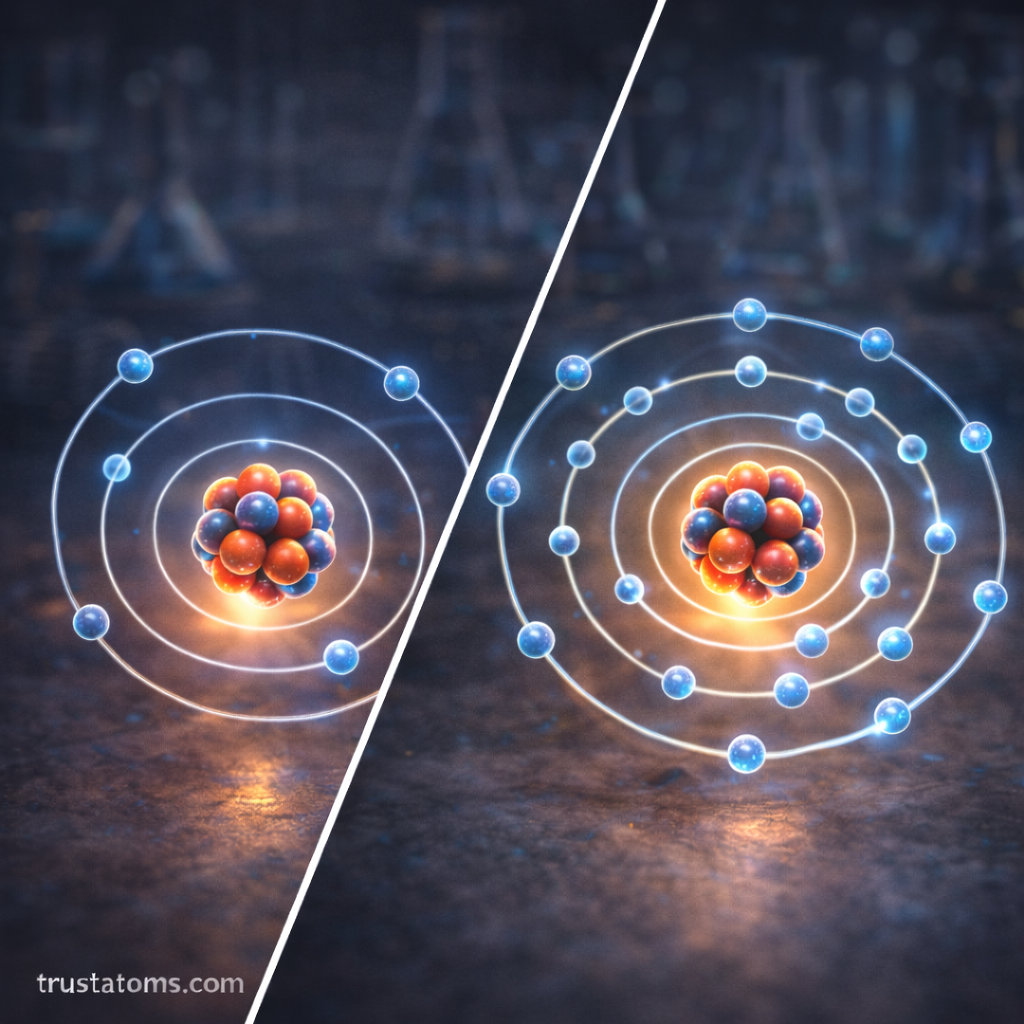
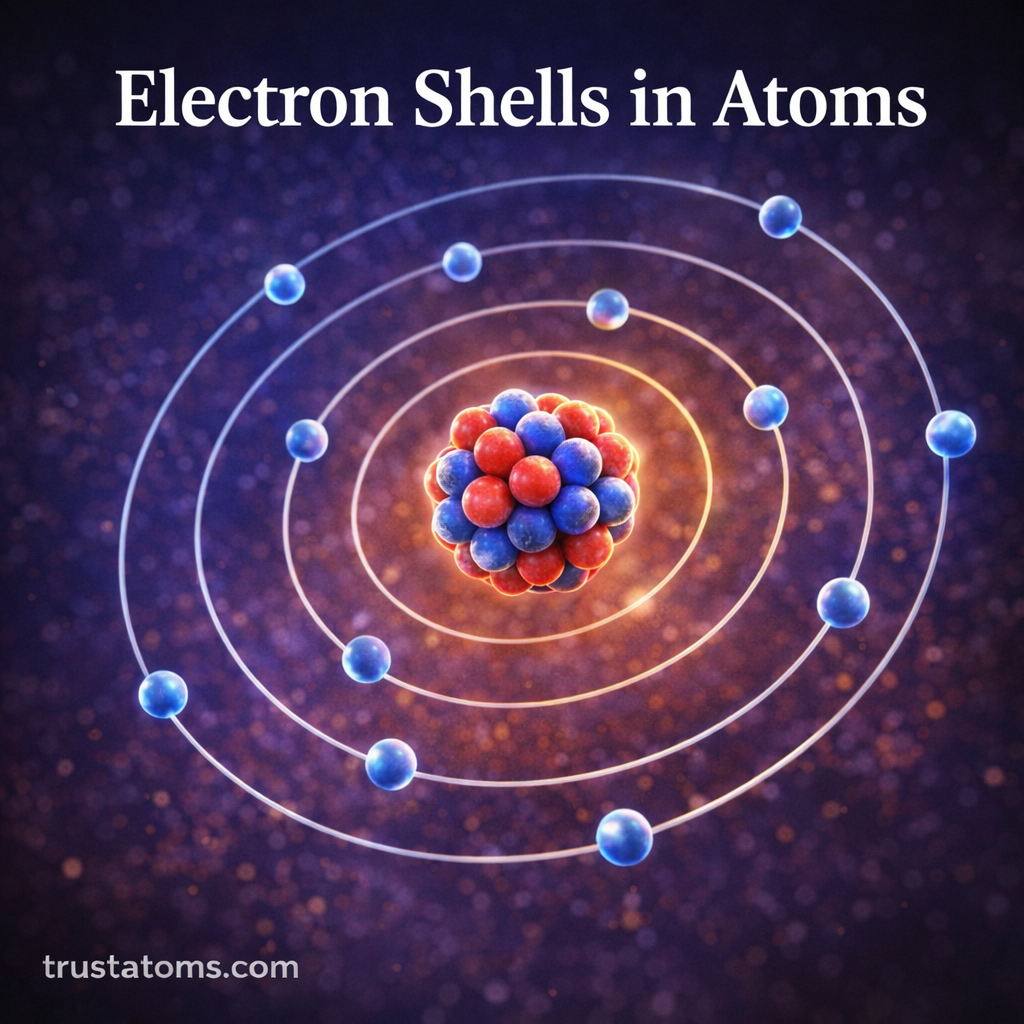
Electrons do not move randomly around the nucleus. Instead, they occupy specific regions called energy levels, also known as electron shells.
Each energy level can hold a certain maximum number of electrons.
The first few shells typically hold:
- First shell: up to 2 electrons
- Second shell: up to 8 electrons
- Third shell: up to 18 electrons
Electrons fill the lowest available energy levels first before occupying higher levels.
This arrangement helps atoms achieve greater stability.
What Is Electron Configuration?
Electron configuration describes how electrons are distributed among the different energy levels and orbitals of an atom.
Chemists use electron configuration to show the order in which electrons fill available spaces around the nucleus.
Electron configurations help explain:
- Chemical bonding
- Reactivity of elements
- Periodic table patterns
- Formation of ions
Each element has a unique electron configuration based on its number of electrons.
Orbitals and Sublevels
Within each energy level are smaller regions called orbitals, where electrons are most likely to be found.
These orbitals are grouped into sublevels.
The most common sublevels are:
- s orbitals
- p orbitals
- d orbitals
- f orbitals
Each type of orbital can hold a specific number of electrons.
For example:
- s orbitals hold 2 electrons
- p orbitals hold 6 electrons
- d orbitals hold 10 electrons
- f orbitals hold 14 electrons
These orbitals give atoms their complex electron arrangements.
Rules for Filling Electron Configurations
Electron configurations follow several important rules that determine how electrons fill orbitals.
Aufbau Principle
The Aufbau principle states that electrons fill the lowest energy orbitals first before moving to higher-energy orbitals.
Pauli Exclusion Principle
According to the Pauli exclusion principle, an orbital can hold a maximum of two electrons, and those electrons must have opposite spins.
Hund’s Rule
Hund’s rule explains that electrons fill empty orbitals within the same sublevel before pairing up.
This reduces electron repulsion and creates a more stable arrangement.
Valence Electrons and Chemical Behavior
The electrons in the outermost energy level are called valence electrons.
Valence electrons are extremely important because they determine how atoms interact with other atoms.
These electrons control:
- Chemical bonding
- Reactivity
- Formation of molecules
- Ion formation
Elements in the same group of the periodic table often have similar chemical properties because they have the same number of valence electrons.
Electron Configuration and the Periodic Table
The layout of the periodic table reflects patterns in electron configurations.
For example:
- Elements in the same period have the same number of electron shells.
- Elements in the same group have similar valence electron arrangements.
This structure allows scientists to predict how elements will behave in chemical reactions.
The periodic table is therefore closely linked to atomic structure and electron configuration.
Why Atomic Structure Matters in Chemistry
Atomic structure and electron configuration provide the foundation for understanding many chemical concepts.
They help explain:
- Why elements form chemical bonds
- How molecules are created
- Why some elements are reactive while others are stable
- How chemical reactions occur
Without understanding atomic structure, it would be difficult to explain the behavior of matter at the molecular level.
Final Thoughts
Atomic structure describes the organization of protons, neutrons, and electrons within an atom, while electron configuration explains how electrons are arranged around the nucleus.
These concepts are essential for understanding the behavior of elements, the formation of chemical bonds, and the patterns observed in the periodic table.
By studying atomic structure and electron configuration, scientists gain a deeper understanding of the fundamental principles that govern chemistry and the structure of matter.