Thermochemical equations describe the relationship between chemical reactions and energy changes. These equations show how much heat is released or absorbed during a reaction, making them essential for understanding energy systems in chemistry, engineering, and environmental science.
From fuel combustion in power plants to biochemical reactions in living organisms, thermochemical equations help scientists track energy flow. By combining chemical formulas with heat values, these equations provide insight into how energy is stored, transferred, and transformed during chemical reactions.
What Are Thermochemical Equations?
A thermochemical equation is a balanced chemical equation that includes the heat energy change associated with the reaction.
Unlike ordinary chemical equations, thermochemical equations include a quantity known as enthalpy change (ΔH), which represents the heat absorbed or released.
A general example looks like this:
Reactants → Products ΔH = value
The ΔH value tells us whether energy is released into the surroundings or absorbed from the surroundings during the reaction.
Thermochemical equations therefore connect chemical transformations with energy flow, making them critical for analyzing real-world energy systems.
Understanding Enthalpy (ΔH)
Enthalpy is a thermodynamic quantity that represents the heat content of a system at constant pressure.
In thermochemical equations, the change in enthalpy (ΔH) indicates the amount of heat exchanged during a reaction.
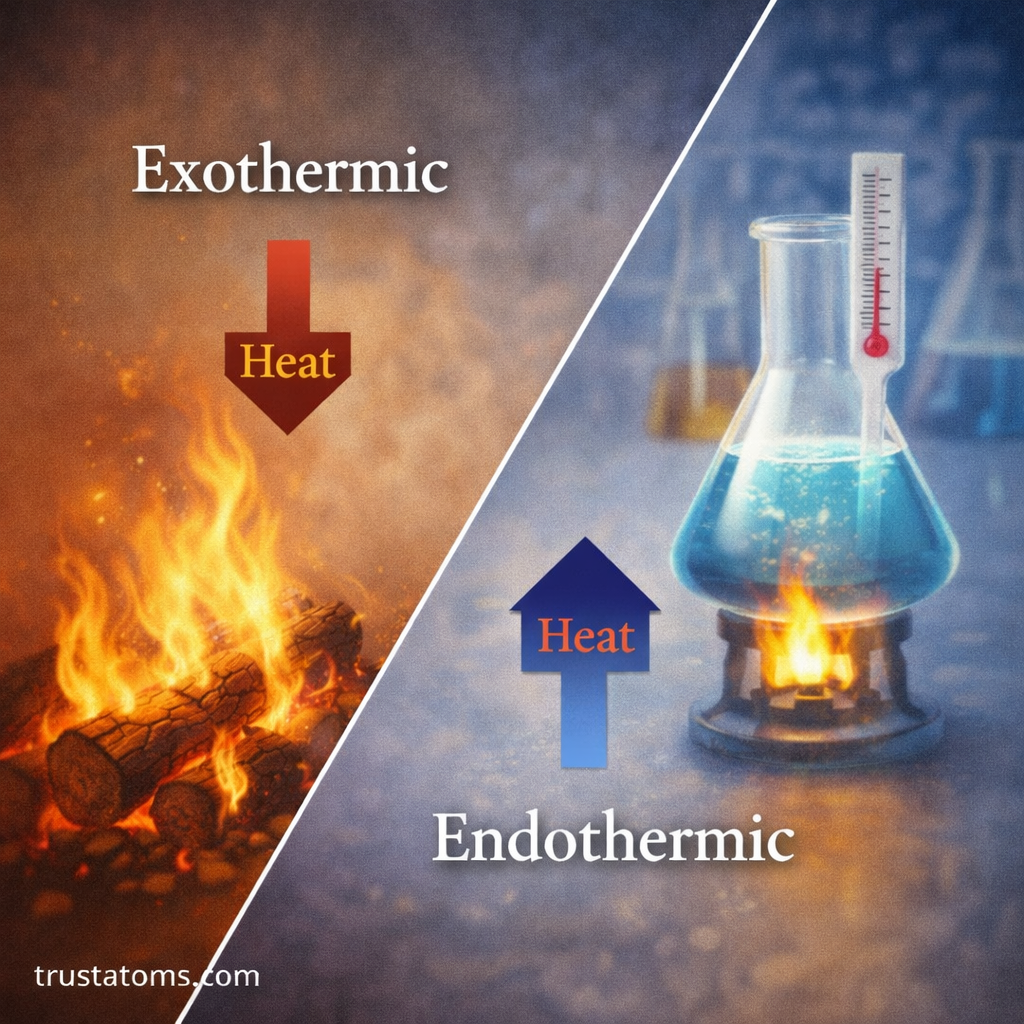
There are two main possibilities:
Exothermic Reactions
Exothermic reactions release heat energy to the surroundings.
Characteristics include:
- ΔH value is negative
- Heat appears as a product in the reaction
- Surroundings become warmer
Common examples include:
- Combustion of fuels
- Many oxidation reactions
- Certain metabolic processes
Endothermic Reactions
Endothermic reactions absorb heat energy from the surroundings.
Characteristics include:
- ΔH value is positive
- Heat is treated as a reactant
- Surroundings may become cooler
Examples include:
- Photosynthesis
- Thermal decomposition reactions
- Certain industrial chemical processes
Understanding whether a reaction is exothermic or endothermic helps scientists design energy-efficient systems.
Why Thermochemical Equations Matter in Energy Systems
Energy systems rely on chemical reactions to produce, store, or convert energy. Thermochemical equations allow scientists and engineers to calculate how much energy is involved in these processes.
They are especially important for:
- Designing efficient power generation systems
- Evaluating fuel energy output
- Understanding battery chemistry
- Studying metabolic energy in biology
- Improving industrial chemical processes
Without thermochemical equations, predicting energy requirements or energy yields from chemical reactions would be far more difficult.
Writing Thermochemical Equations
Creating a thermochemical equation involves several steps that combine chemical balancing with energy information.
1. Write the Balanced Chemical Equation
The first step is to ensure that the chemical reaction is balanced, meaning the same number of each type of atom appears on both sides.
Balancing maintains conservation of matter.
2. Determine the Enthalpy Change
Next, identify the enthalpy change (ΔH) associated with the reaction.
This value is typically measured experimentally or obtained from thermodynamic tables.
3. Include Physical States
Thermochemical equations must show the physical state of each substance.
Common state symbols include:
- (s) solid
- (l) liquid
- (g) gas
- (aq) aqueous solution
The physical state matters because energy changes can vary depending on phase.
4. Add the Energy Term
Finally, include the enthalpy change with the equation.
This can appear:
- As a ΔH value following the equation
- Or as heat written directly among the reactants or products
Both formats communicate how energy changes during the reaction.
Standard Enthalpy Change
Chemists often measure reactions under standard conditions, which include:
- Pressure of 1 atmosphere
- Temperature of 25°C (298 K)
- Standard concentration for solutions
Under these conditions, the enthalpy change is called the standard enthalpy change (ΔH°).
Several types of standard enthalpy values are commonly used:
Standard Enthalpy of Formation
This refers to the energy change when one mole of a compound forms from its elements in their standard states.
Standard Enthalpy of Combustion
This measures the energy released when one mole of a substance burns completely in oxygen.
It is particularly important for evaluating fuel efficiency.
Standard Enthalpy of Reaction
This represents the total energy change for a reaction under standard conditions.
These values allow chemists to compare different reactions and calculate energy changes in complex systems.
Applications in Real-World Energy Systems
Thermochemical equations are used across many scientific and engineering fields.
Power Generation
In fossil fuel power plants, thermochemical equations describe the combustion reactions that release energy used to generate electricity.
Engineers calculate energy output to improve efficiency and reduce waste.
Renewable Energy Research
Researchers use thermochemical data to study reactions involved in:
- Hydrogen fuel production
- Biofuel conversion
- Energy storage technologies
These insights help develop sustainable energy solutions.
Battery Technology
Electrochemical reactions inside batteries involve energy changes that can be described using thermochemical principles.
Understanding these reactions helps scientists design longer-lasting and higher-capacity batteries.
Environmental Chemistry
Thermochemical equations help scientists evaluate how chemical reactions affect the environment.
For example:
- Energy released by fuel combustion
- Heat absorbed in atmospheric reactions
- Energy changes in pollutant breakdown
These calculations are important for climate modeling and pollution control.
Hess’s Law and Energy Calculations
Sometimes the enthalpy change of a reaction cannot be measured directly. In these cases, chemists use Hess’s Law.
Hess’s Law states that:
The total enthalpy change of a reaction is the same regardless of the pathway taken.
This means energy changes can be calculated by adding or subtracting multiple thermochemical equations.
This principle allows scientists to determine energy changes for reactions that are difficult to study experimentally.
Limitations and Considerations
While thermochemical equations provide valuable information, they have certain limitations.
For example, they:
- Usually assume constant pressure conditions
- Do not fully describe reaction rates
- Do not account for kinetic barriers
- May vary depending on temperature and pressure
Despite these limitations, thermochemical equations remain one of the most important tools for understanding energy in chemical reactions.
The Role of Thermochemistry in Modern Science
Thermochemistry connects chemistry with energy science, physics, engineering, and environmental studies.
By describing how energy changes during chemical reactions, thermochemical equations allow scientists to:
- Predict energy requirements for reactions
- Optimize industrial processes
- Evaluate energy sources
- Design new energy technologies
In an era focused on sustainable energy and efficient resource use, thermochemical principles continue to play a central role in scientific innovation.
Final Thoughts
Thermochemical equations provide a powerful way to understand how chemical reactions exchange energy with their surroundings. By combining balanced chemical equations with enthalpy values, scientists can analyze energy flow in everything from combustion engines to biological systems.
Whether studying fuels, renewable energy, or environmental chemistry, thermochemical equations help reveal the fundamental connection between chemical change and energy transformation.