
Acid–base titration is one of the most widely used techniques in analytical chemistry. It allows scientists, students, and laboratory technicians to determine the concentration of an unknown acid or base by reacting it with a solution of known concentration.
This method relies on neutralization reactions—where acids and bases react to form water and a salt. Because the chemistry behind these reactions is predictable and measurable, titration provides a reliable way to quantify chemical solutions in fields ranging from pharmaceuticals and environmental testing to food science and water quality monitoring.
Understanding acid–base titration helps explain how chemists measure chemical composition with precision using relatively simple laboratory tools.
What Is Acid–Base Titration?
Acid–base titration is a quantitative analytical method used to determine the concentration of an acid or base.
The process involves gradually adding a solution of known concentration (called the titrant) to a solution of unknown concentration (called the analyte) until the reaction reaches the neutralization point.
At this stage, the amount of acid equals the amount of base required for the reaction.
Key components of an acid–base titration include:
- A titrant (solution with known concentration)
- An analyte (solution with unknown concentration)
- A burette for controlled liquid delivery
- An indicator or pH meter to detect the endpoint
By measuring how much titrant is required to neutralize the analyte, chemists can calculate the analyte’s concentration.
The Neutralization Reaction
Acid–base titration relies on a predictable chemical reaction between acids and bases.
In a neutralization reaction:
- An acid donates hydrogen ions
- A base accepts hydrogen ions
- The products formed are water and a salt
Because these reactions occur in consistent ratios, chemists can use stoichiometry to determine unknown quantities.
For example, when a strong acid reacts with a strong base, the reaction proceeds in a straightforward and measurable way, making calculations reliable and reproducible.
Key Equipment Used in Titration
A successful titration requires precise laboratory equipment designed to measure and control liquid volumes.
Burette
A burette is a long, graduated glass tube with a valve at the bottom. It allows chemists to add the titrant slowly and measure the volume delivered with high precision.
Erlenmeyer Flask
The analyte is usually placed in an Erlenmeyer flask. Its conical shape allows easy swirling during the titration process without spilling.
Pipette
A pipette is used to measure and transfer a known volume of the analyte into the flask.
Indicator or pH Meter
Indicators change color at specific pH levels, signaling that the reaction has reached its endpoint. Alternatively, pH meters provide precise electronic measurement of pH changes during the titration.
Understanding the Endpoint and Equivalence Point
Two important concepts in titration are the endpoint and the equivalence point.
Equivalence Point
The equivalence point occurs when the amount of acid and base in the reaction are chemically equal according to the reaction’s stoichiometry.
At this moment:
- Neutralization is complete
- Reactants are consumed in exact proportions
Endpoint
The endpoint is the point at which the indicator changes color, signaling that the reaction is complete.
Ideally, the endpoint occurs very close to the equivalence point. Choosing the correct indicator ensures the two points align as closely as possible.
Types of Acid–Base Titrations
Different titration types exist depending on the strengths of the acids and bases involved.
Strong Acid–Strong Base
These titrations produce very sharp pH changes near the equivalence point and are relatively straightforward to analyze.
Weak Acid–Strong Base
The equivalence point occurs at a pH greater than neutral because the resulting salt influences the solution’s acidity.
Weak Base–Strong Acid
In this case, the equivalence point occurs below neutral pH due to the acidic nature of the reaction products.
Weak Acid–Weak Base
These titrations are less common in analytical chemistry because the pH change near the equivalence point is small, making endpoint detection more difficult.
Step-by-Step Titration Procedure
Although procedures vary slightly depending on the experiment, most acid–base titrations follow a standard sequence.
- Measure a known volume of the analyte using a pipette.
- Transfer the analyte into an Erlenmeyer flask.
- Add a few drops of an appropriate indicator.
- Fill the burette with the titrant solution.
- Slowly add the titrant while swirling the flask.
- Watch for the indicator color change that signals the endpoint.
- Record the volume of titrant used.
These measurements allow chemists to calculate the concentration of the unknown solution.
Common Indicators Used in Titration
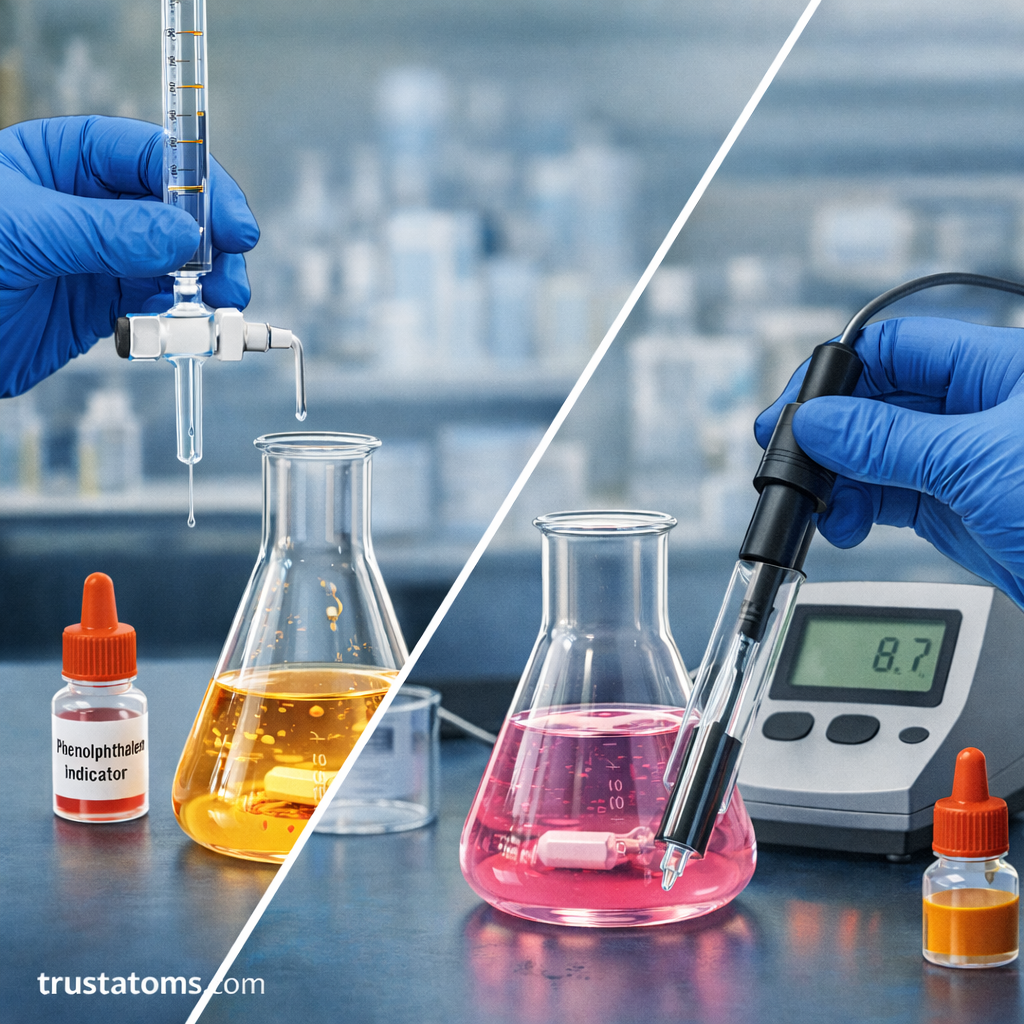
Indicators help chemists visually identify the endpoint of a titration.
Common examples include:
- Phenolphthalein – colorless in acidic solution and pink in basic solution
- Methyl orange – red in acidic solution and yellow in basic solution
- Bromothymol blue – yellow in acidic conditions and blue in basic conditions
The correct indicator depends on the expected pH range at the equivalence point.
Real-World Applications of Acid–Base Titration
Acid–base titration is used in many scientific and industrial settings.
Environmental Testing
Water quality laboratories use titration to measure acidity levels in lakes, rivers, and drinking water.
Pharmaceutical Analysis
Drug manufacturers rely on titration to confirm the concentration and purity of active ingredients in medications.
Food and Beverage Industry
Food chemists measure acidity in products such as juices, wines, and dairy items to maintain quality and consistency.
Industrial Chemistry
Chemical manufacturers use titration to monitor production processes and ensure correct chemical concentrations.
Common Sources of Error in Titration
Even though titration is a reliable technique, small errors can affect accuracy.
Typical issues include:
- Reading the burette incorrectly
- Adding titrant too quickly near the endpoint
- Using the wrong indicator
- Improper calibration of equipment
- Contamination of solutions
Careful technique and repeated trials help reduce these sources of error.
Why Acid–Base Titration Remains Important
Despite advances in modern analytical instruments, acid–base titration remains a foundational technique in chemistry.
It is valued because it is:
- Accurate and reproducible
- Relatively simple to perform
- Cost-effective compared to advanced instruments
- Useful for teaching fundamental chemical principles
For students and professionals alike, titration provides a clear demonstration of how chemical reactions can be used to measure and understand substances quantitatively.
Final Thoughts
Acid–base titration is a cornerstone method in analytical chemistry. By carefully reacting a known solution with an unknown one, chemists can determine concentrations with impressive precision.
From environmental monitoring to pharmaceutical manufacturing, this technique continues to play a crucial role in scientific analysis. Its combination of simplicity, accuracy, and practical application ensures that acid–base titration remains an essential tool in laboratories around the world.