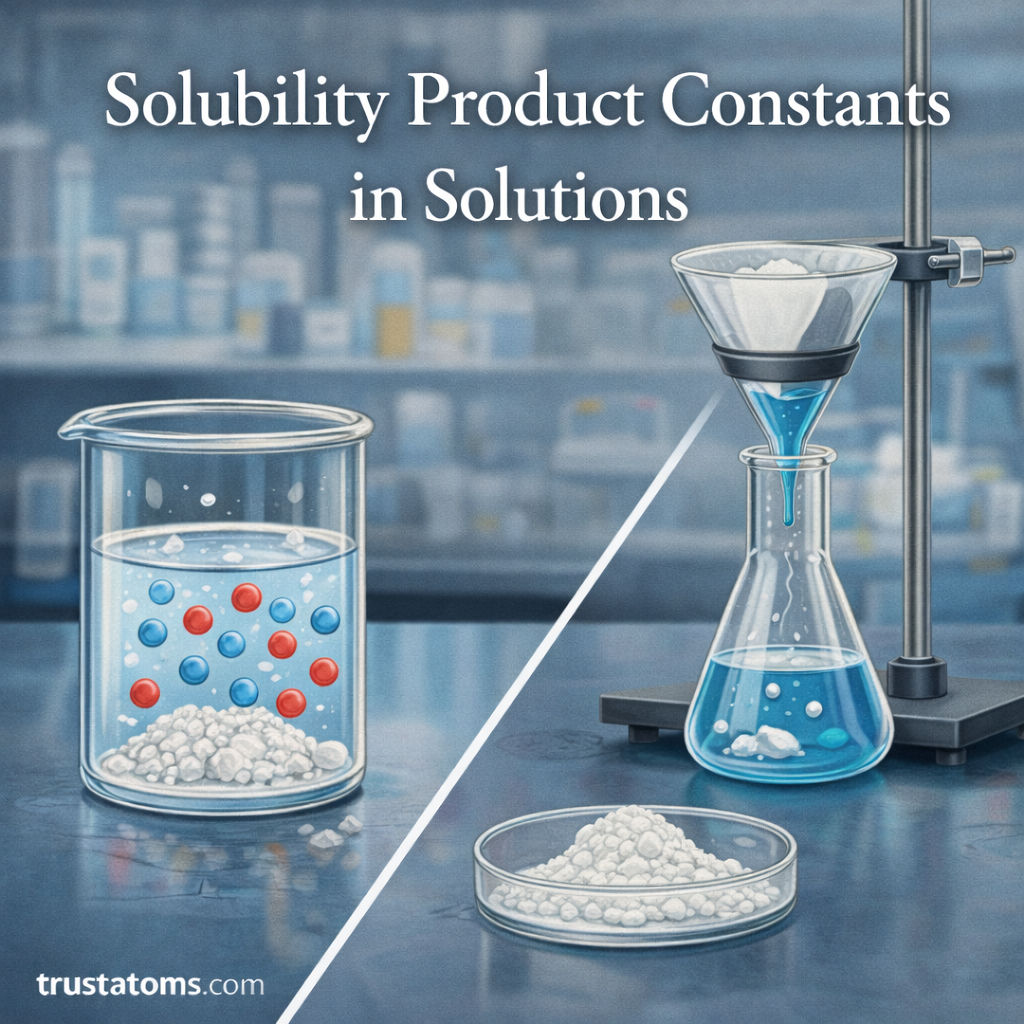
In chemistry, many compounds dissolve easily in water, while others dissolve only slightly or not at all. Understanding how and why substances dissolve is a key part of studying chemical solutions.
One important concept used to describe this behavior is the solubility product constant, commonly abbreviated as Ksp. This value helps chemists predict how much of a slightly soluble compound can dissolve in a solution before equilibrium is reached.
Solubility product constants are widely used in analytical chemistry, environmental science, water treatment, and chemical manufacturing to understand precipitation reactions and solution behavior.
What Is the Solubility Product Constant?
The solubility product constant (Ksp) is an equilibrium constant that describes the balance between a solid compound and the ions it forms when dissolved in water.
When a slightly soluble salt dissolves, it separates into its component ions. Eventually, the system reaches equilibrium where the rate of dissolving equals the rate of precipitation.
At this equilibrium point:
- Some solid remains undissolved
- Dissolved ions exist in the solution
- The concentration of ions becomes constant
The solubility product constant represents this balance.
Chemists use Ksp values to understand how soluble a compound is and to predict whether a precipitation reaction will occur.
Dissolution and Equilibrium in Solutions
When a solid salt is placed in water, it begins to dissolve into its ions. However, for many compounds, only a small amount dissolves before equilibrium is reached.
At equilibrium:
- Dissolved ions remain in the solution
- Undissolved solid remains at the bottom
- Dissolving and recrystallization occur at equal rates
This dynamic equilibrium allows chemists to analyze solution behavior and determine the maximum amount of solute that can remain dissolved.
Why Solubility Product Constants Matter
Solubility product constants provide valuable insight into how chemical substances behave in aqueous solutions.
Chemists rely on Ksp values to:
- Predict whether a solid will precipitate from a solution
- Compare the relative solubility of compounds
- Design separation techniques in analytical chemistry
- Control chemical reactions in industrial processes
- Understand mineral formation in natural environments
Because precipitation reactions are common in chemistry, Ksp plays an essential role in many laboratory and industrial applications.
Understanding Saturated Solutions
A saturated solution occurs when the maximum amount of a substance has dissolved in a solvent at a given temperature.
In this state:
- The solution contains the highest possible concentration of dissolved ions
- Any additional solid will remain undissolved
- Dissolution and precipitation occur at the same rate
Saturated solutions are important when studying solubility because they represent the equilibrium point used to determine solubility product constants.
The Relationship Between Solubility and Ksp
Although Ksp describes equilibrium conditions, it is closely related to the concept of solubility.
Generally speaking:
- A larger Ksp value indicates greater solubility
- A smaller Ksp value indicates lower solubility
However, comparing solubility between compounds requires considering the number of ions produced when the compound dissolves.
Because different salts produce different numbers of ions, their Ksp values cannot always be compared directly without additional calculations.
Factors That Affect Solubility
Several conditions can influence how much of a compound dissolves in water.
Important factors include:
Temperature
Temperature often affects solubility. In many cases, higher temperatures increase the amount of solute that can dissolve in a solution.
Common Ion Effect
If a solution already contains one of the ions produced by the dissolving compound, solubility decreases. This phenomenon is known as the common ion effect.
pH of the Solution
For compounds containing acidic or basic ions, changes in pH can affect solubility by shifting equilibrium conditions.
Presence of Complexing Agents
Some molecules can bind with ions in solution, forming complexes that increase the solubility of otherwise insoluble compounds.
Precipitation Reactions and Ksp
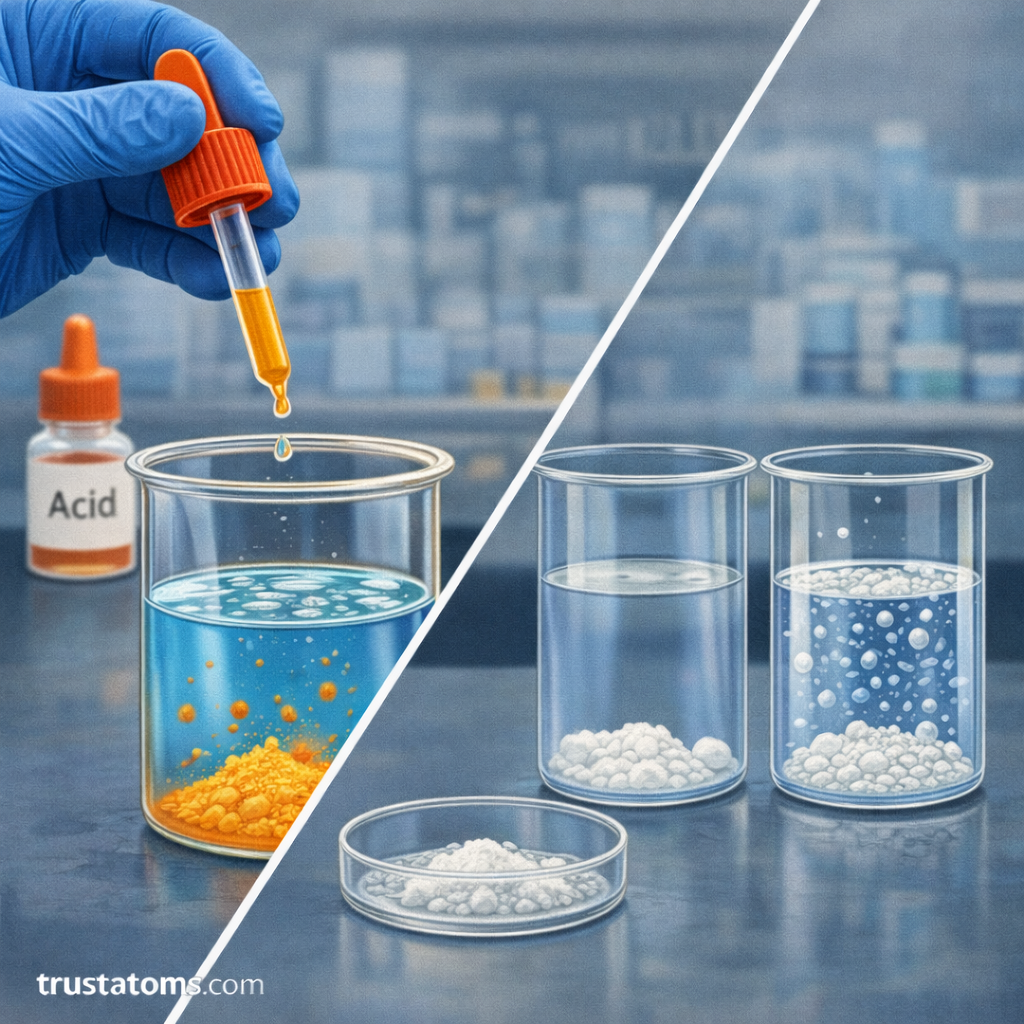
Solubility product constants are especially useful for predicting precipitation reactions.
A precipitate forms when dissolved ions combine to create a solid compound that is not highly soluble.
Chemists determine whether precipitation will occur by comparing two values:
- The ion product in the solution
- The solubility product constant (Ksp)
Three outcomes are possible:
- If the ion product is less than Ksp, the solution is unsaturated and no precipitate forms.
- If the ion product equals Ksp, the solution is at equilibrium.
- If the ion product is greater than Ksp, a precipitate forms.
This principle allows chemists to control reactions and isolate specific substances.
Applications in Analytical Chemistry
Solubility product constants are widely used in analytical chemistry for identifying and separating ions in complex mixtures.
One common technique is selective precipitation, where chemists adjust conditions so only certain ions form insoluble compounds.
This method helps separate substances based on their different solubility properties.
Typical applications include:
- Identifying metal ions in laboratory analysis
- Purifying chemical compounds
- Monitoring water quality
- Studying mineral composition in geology
These techniques rely on predictable solubility behavior guided by Ksp values.
Environmental and Industrial Importance
Solubility equilibria also play a major role outside the laboratory.
Water Treatment
In water purification systems, precipitation reactions help remove unwanted metals and contaminants from drinking water.
Environmental Chemistry
Natural processes such as mineral formation, sedimentation, and groundwater chemistry depend heavily on solubility equilibria.
Chemical Manufacturing
Industrial processes use solubility control to separate products, recover materials, and manage waste streams.
Understanding Ksp allows engineers and chemists to manage these processes efficiently.
Common Misconceptions About Solubility
Several misunderstandings often arise when studying solubility product constants.
Some important clarifications include:
- Ksp does not measure how fast a compound dissolves. It describes equilibrium conditions, not reaction speed.
- Low solubility does not mean zero solubility. Even compounds considered insoluble dissolve slightly.
- Temperature and solution conditions can significantly affect solubility behavior.
Recognizing these distinctions helps chemists interpret solubility data correctly.
Final Thoughts
Solubility product constants provide a powerful way to understand how slightly soluble compounds behave in aqueous solutions. By describing the equilibrium between dissolved ions and solid compounds, Ksp allows chemists to predict precipitation reactions and control solution chemistry.
From analytical laboratories to environmental science and industrial manufacturing, solubility equilibria play a crucial role in chemical regulation. Understanding these principles helps scientists interpret complex solution behavior and apply chemistry effectively in real-world systems.