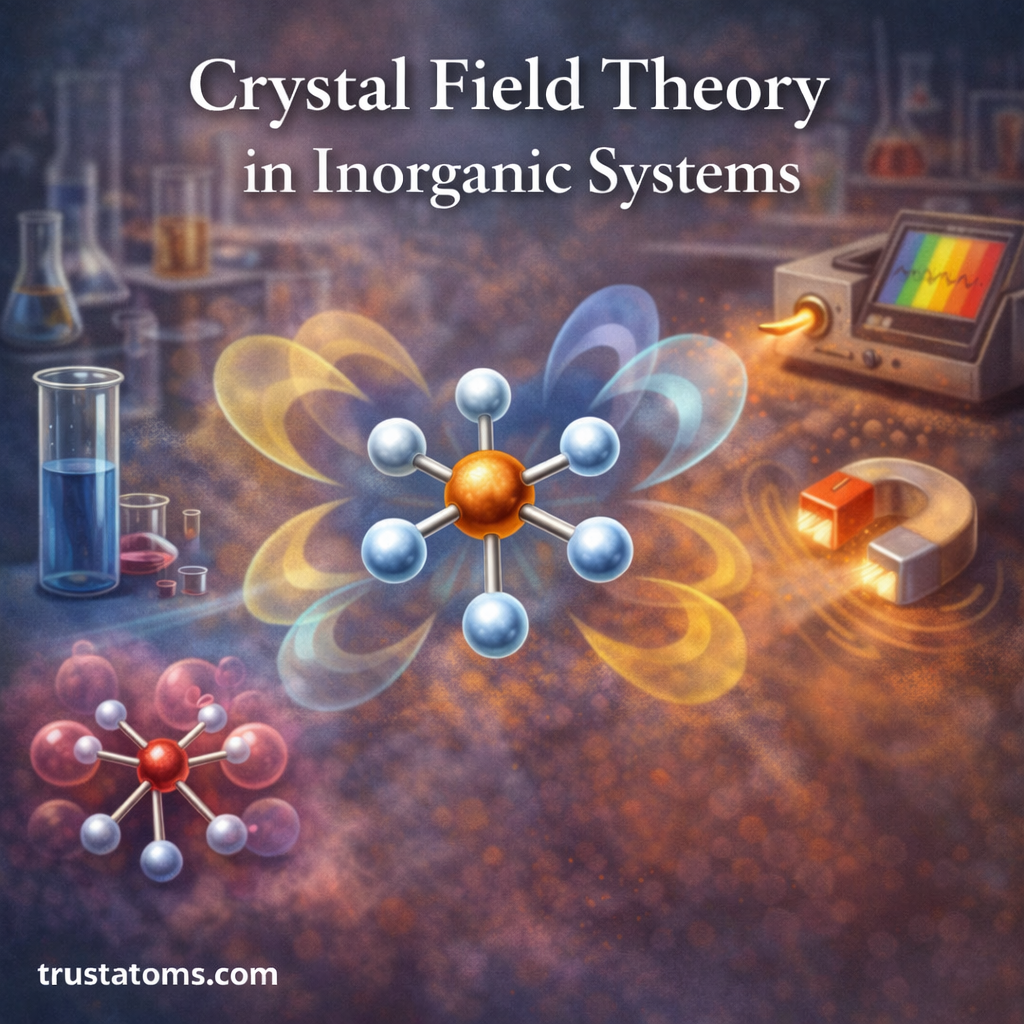
Crystal Field Theory (CFT) is an important concept in inorganic chemistry that explains how transition metal ions interact with surrounding molecules or ions called ligands. The theory helps chemists understand the structure, color, magnetism, and stability of coordination compounds.
By analyzing how ligands influence the energy levels of a metal ion’s d-orbitals, Crystal Field Theory provides insight into the behavior of many inorganic systems. It is widely used to explain the properties of metal complexes found in laboratory chemistry, industrial catalysis, and biological molecules.
Understanding Crystal Field Theory allows scientists to predict how metal complexes will behave in chemical reactions and materials.
What Is Crystal Field Theory?
Crystal Field Theory is a model used to describe how electrostatic interactions between a metal ion and surrounding ligands affect the metal’s electron structure.
In coordination complexes:
- A central metal ion sits at the center
- Ligands surround the metal and donate electron pairs
- The interaction between the metal and ligands changes the energy of the metal’s d-orbitals
When ligands approach the metal ion, they create an electric field, often referred to as a crystal field. This field alters the energy levels of the metal’s orbitals, leading to important chemical and physical effects.
The Role of d-Orbitals in Transition Metals
Transition metals have five d-orbitals that can hold electrons. In an isolated metal ion, these orbitals all have the same energy.
However, when ligands approach the metal ion, the orbitals no longer remain equal in energy.
This process is called d-orbital splitting.
Key outcomes include:
- Some orbitals increase in energy
- Others decrease in energy
- The difference between these energy levels is called crystal field splitting energy
This energy difference affects the electronic behavior of the metal complex.
Orbital Splitting in Octahedral Complexes
One of the most common geometries in coordination chemistry is the octahedral complex, where six ligands surround the metal ion.
When ligands approach along the axes of the metal ion:
- Two orbitals experience greater repulsion
- Three orbitals experience less repulsion
This leads to two groups of orbitals:
- Higher-energy orbitals
- Lower-energy orbitals
The separation between these groups determines how electrons are arranged within the complex.
This arrangement influences many observable properties of the compound.
High-Spin and Low-Spin Complexes
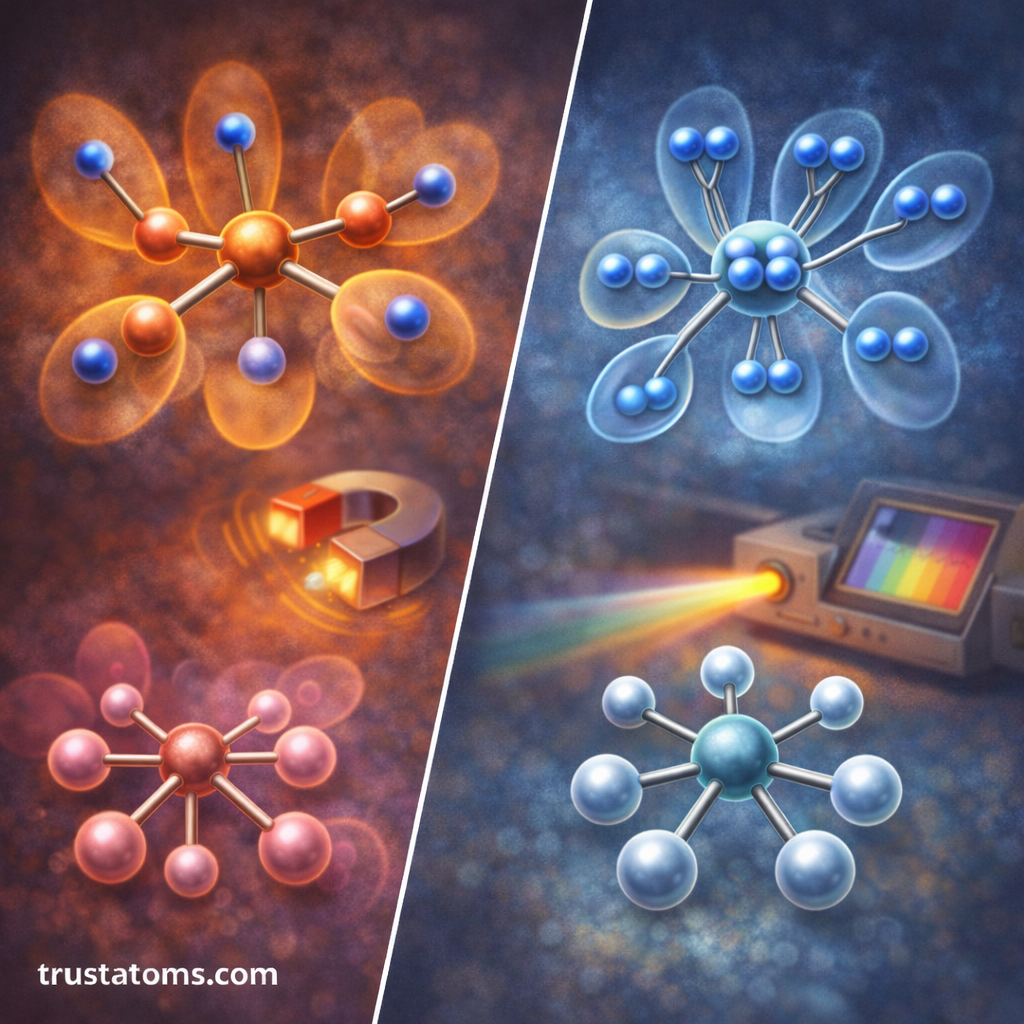
Crystal Field Theory explains how electrons fill the split orbitals in a coordination complex.
Two possibilities may occur depending on ligand strength.
High-Spin Complexes
In high-spin complexes:
- The crystal field splitting energy is relatively small
- Electrons occupy higher orbitals before pairing up
Characteristics include:
- More unpaired electrons
- Stronger magnetic properties
- Often formed with weaker ligands
Examples of weaker ligands include water and halide ions.
Low-Spin Complexes
In low-spin complexes:
- The crystal field splitting energy is large
- Electrons pair in lower orbitals before occupying higher ones
Characteristics include:
- Fewer unpaired electrons
- Reduced magnetic behavior
- Often formed with stronger ligands
Examples of strong ligands include cyanide and carbon monoxide.
Why Transition Metal Complexes Have Color
One of the most noticeable effects explained by Crystal Field Theory is the color of many transition metal compounds.
The process works as follows:
- White light interacts with the metal complex
- Electrons absorb energy and move between split d-orbitals
- Certain wavelengths of light are absorbed
- The remaining reflected wavelengths produce the observed color
Different metal ions and ligands create different splitting energies, which leads to different colors.
For example:
- Copper complexes often appear blue
- Nickel complexes may appear green
- Cobalt complexes may appear pink or purple
These colors are frequently used in chemical analysis to identify metal complexes.
Magnetic Properties of Metal Complexes
Crystal Field Theory also explains why some coordination compounds are magnetic while others are not.
Magnetism depends on the number of unpaired electrons in the metal ion.
Two common magnetic behaviors are:
- Paramagnetism – occurs when unpaired electrons are present
- Diamagnetism – occurs when all electrons are paired
By analyzing the arrangement of electrons in split d-orbitals, chemists can predict the magnetic properties of coordination compounds.
This information is often used to confirm the structure of metal complexes in research and laboratory experiments.
Applications of Crystal Field Theory
Crystal Field Theory plays an important role in many scientific and technological fields.
Key applications include:
- Understanding the structure of coordination compounds
- Designing industrial catalysts
- Interpreting spectroscopic data
- Explaining the color of transition metal complexes
- Predicting magnetic behavior in materials
Researchers use this theory to analyze how metals interact with ligands in chemical systems.
Limitations of Crystal Field Theory
Although Crystal Field Theory is extremely useful, it has some limitations.
The model assumes that metal–ligand interactions are purely electrostatic. In reality, some bonding interactions involve covalent character.
Because of this, chemists sometimes use more advanced theories such as:
- Ligand Field Theory
- Molecular Orbital Theory
These approaches provide a more detailed description of bonding and electronic structure.
However, Crystal Field Theory remains one of the most practical and widely taught models in inorganic chemistry.
Why Crystal Field Theory Matters
Crystal Field Theory provides a framework for understanding how transition metal complexes behave in inorganic systems.
By explaining orbital splitting and electron distribution, the theory helps chemists interpret many properties of metal complexes, including:
- Color
- Magnetism
- Stability
- Reactivity
These insights are essential in fields ranging from materials science to biological chemistry.
As research in inorganic chemistry continues to expand, Crystal Field Theory remains a foundational concept for studying coordination compounds and metal-based reactions.
Final Thoughts
Crystal Field Theory offers a powerful way to understand how ligands influence the electronic structure of transition metal ions. Through the concept of orbital splitting, the theory explains key properties of metal complexes, including their color, magnetic behavior, and chemical reactivity.
Although it is a simplified model, Crystal Field Theory provides valuable insights into inorganic systems and serves as a stepping stone toward more advanced theories of chemical bonding.
For students and researchers alike, mastering Crystal Field Theory is an important step in understanding the behavior of transition metal chemistry.