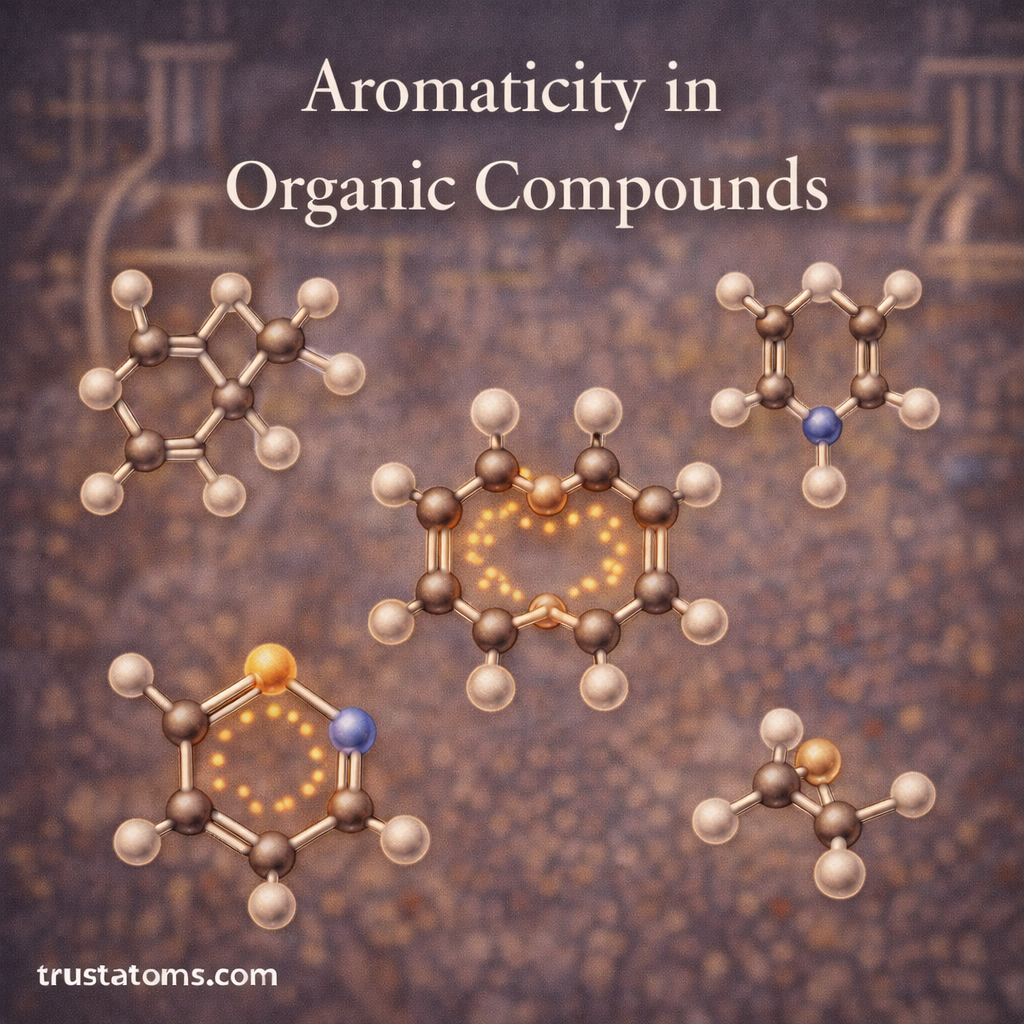
Aromaticity is a fundamental concept in organic chemistry that explains the unusual stability and chemical behavior of certain cyclic molecules. Aromatic compounds contain a special type of electron arrangement that allows electrons to move freely around a ring-shaped structure.
This unique electron distribution creates molecules that are more stable than similar non-aromatic compounds. Aromaticity plays an important role in many areas of chemistry, including pharmaceuticals, materials science, and biological molecules.
Understanding aromaticity helps chemists explain the properties of compounds such as benzene and many other ring-based molecules.
What Is Aromaticity?
Aromaticity refers to a property of cyclic molecules that contain a highly stable arrangement of delocalized electrons. These electrons are not confined between two atoms but instead move across the entire ring structure.
For a compound to be considered aromatic, it must meet several important conditions:
- The molecule must form a ring-shaped structure
- The atoms in the ring must be planar (flat)
- The ring must contain delocalized electrons shared across the structure
- The molecule must follow specific electron-count rules
When these requirements are satisfied, the molecule gains extra stability from aromatic electron delocalization.
The Structure of Aromatic Rings
Aromatic compounds usually contain rings made of carbon atoms connected by alternating single and double bonds. However, the actual electron distribution is not fixed between specific atoms.
Instead, the electrons are shared across the entire ring, creating a system called a delocalized electron cloud.
This delocalization produces several important features:
- Equal bond lengths around the ring
- Increased molecular stability
- Distinct chemical reactivity compared with non-aromatic molecules
The most well-known example of an aromatic compound is benzene.
The Role of Delocalized Electrons
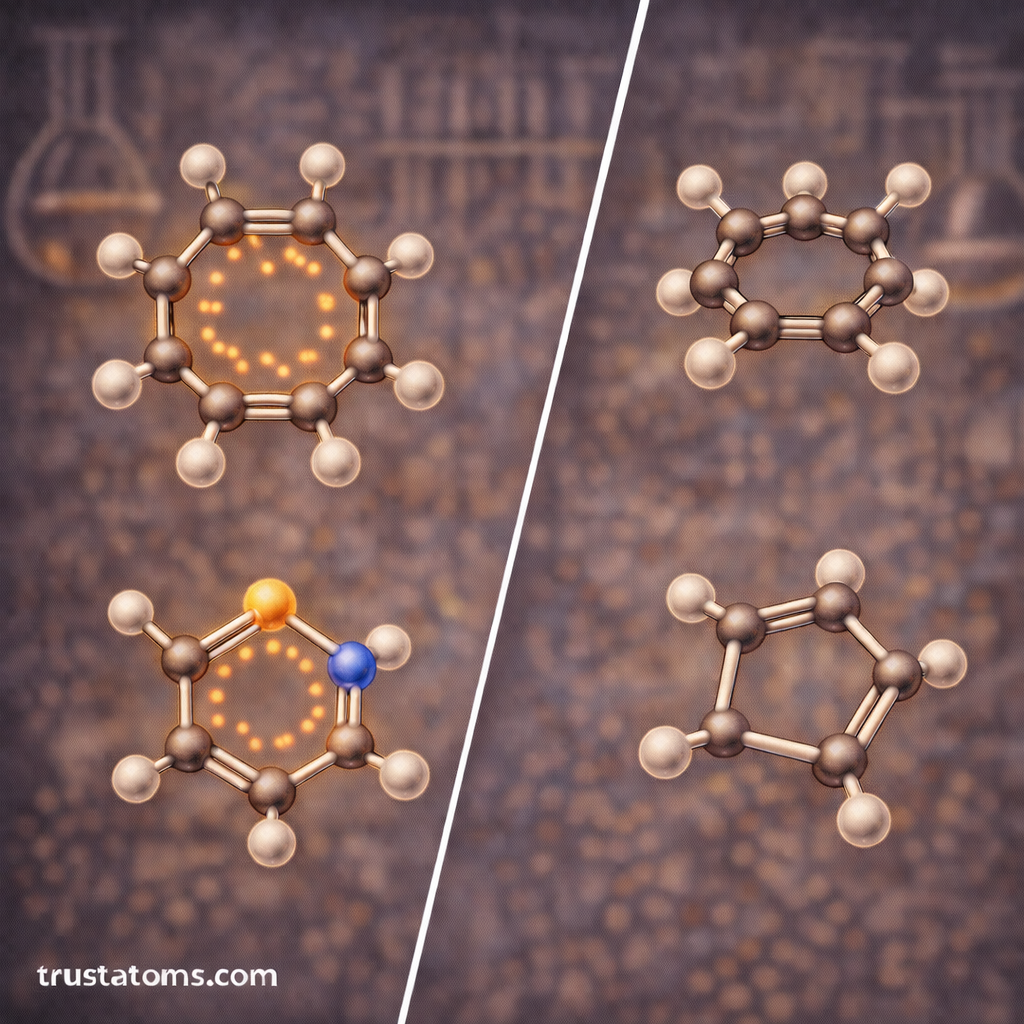
In aromatic molecules, electrons move freely across the ring structure instead of remaining localized in specific bonds.
This behavior is known as electron delocalization.
Delocalized electrons create:
- Enhanced stability
- Unique electrical properties
- Special patterns of chemical reactivity
Because of this electron movement, aromatic compounds often resist reactions that would disrupt the ring’s stability.
The Aromaticity Rule
Chemists use a simple guideline to determine whether a compound is aromatic.
This rule states that aromatic molecules contain a specific number of delocalized electrons within the ring system.
To qualify as aromatic, a molecule must contain:
- A cyclic system
- Continuous overlapping orbitals
- A specific number of electrons that support electron delocalization
When these conditions are met, the molecule gains the stability associated with aromatic systems.
Benzene: The Classic Aromatic Compound
Benzene is the most famous example of an aromatic molecule.
Its structure consists of:
- Six carbon atoms arranged in a ring
- Alternating double bonds
- A shared electron cloud surrounding the ring
Although early models showed alternating single and double bonds, modern understanding recognizes that all carbon–carbon bonds in benzene are equal due to electron delocalization.
This delocalized structure gives benzene exceptional stability compared with similar molecules.
Types of Aromatic Compounds
Aromatic compounds can exist in several different forms depending on their structure and composition.
Simple Aromatic Rings
These molecules contain a single aromatic ring.
Examples include:
- Benzene
- Toluene
- Phenol
These compounds often serve as building blocks in organic chemistry.
Polycyclic Aromatic Compounds
Polycyclic aromatic compounds contain multiple interconnected aromatic rings.
These molecules often appear in:
- Natural organic materials
- Petroleum products
- Synthetic chemical compounds
They can have complex structures with extended delocalized electron systems.
Heteroaromatic Compounds
Some aromatic molecules include atoms other than carbon within the ring.
These atoms may include:
- Nitrogen
- Oxygen
- Sulfur
Such compounds are called heteroaromatic compounds and are common in biological molecules and pharmaceutical chemistry.
Chemical Reactions of Aromatic Compounds
Aromatic compounds behave differently from many other organic molecules due to their stability.
Instead of reactions that break the ring structure, aromatic molecules often undergo substitution reactions.
In substitution reactions:
- One atom or group on the ring is replaced
- The aromatic ring structure remains intact
- The electron system stays stable
These reactions are important for producing many industrial and pharmaceutical compounds.
Importance of Aromaticity in Biology and Industry
Aromatic compounds are widely found in nature and industrial chemistry.
Important applications include:
- Pharmaceutical drug development
- Dye and pigment production
- Polymer and plastic manufacturing
- Agrochemical synthesis
- Natural biological molecules
Many important biological compounds, including certain amino acids and vitamins, contain aromatic rings.
These structures help control molecular interactions in living systems.
Identifying Aromatic Compounds
Chemists use several methods to determine whether a molecule is aromatic.
Common techniques include:
- Spectroscopy methods
- Nuclear magnetic resonance
- Infrared spectroscopy
- Structural analysis
- Studying molecular geometry
- Identifying cyclic electron systems
- Computational chemistry
- Modeling electron distribution
These tools help scientists confirm the presence of aromatic structures and study their properties.
Final Thoughts
Aromaticity explains why certain cyclic molecules possess unusual stability and unique chemical behavior. Through electron delocalization and ring-shaped structures, aromatic compounds gain stability that distinguishes them from other organic molecules.
From benzene to complex biological molecules, aromatic systems play an essential role in chemistry, materials science, and pharmaceutical development. Understanding aromaticity allows chemists to predict molecular behavior and design compounds with specific chemical properties.