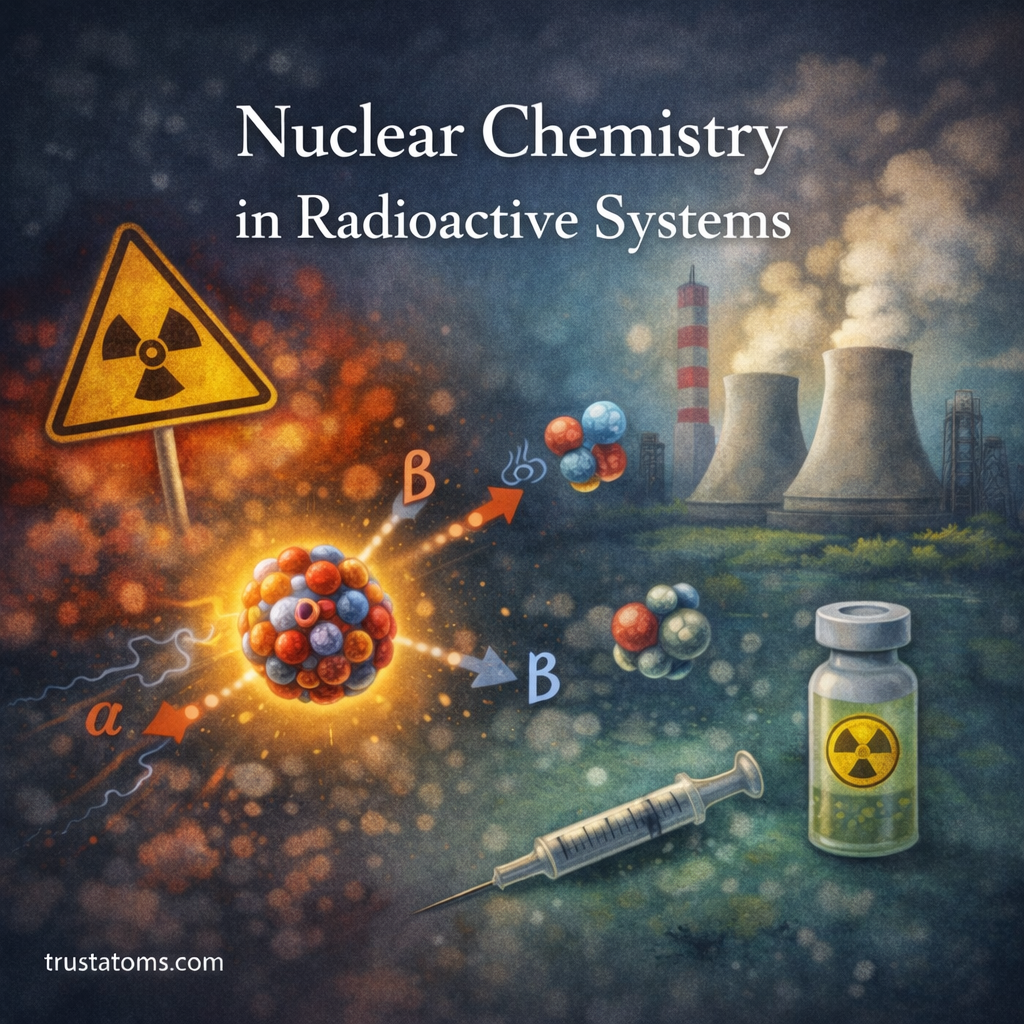
Nuclear chemistry explores chemical and physical processes that occur within the atomic nucleus. While traditional chemistry focuses on interactions between electrons and atoms, nuclear chemistry examines transformations involving protons and neutrons inside the nucleus, particularly in radioactive materials.
Radioactive systems are environments where unstable atomic nuclei undergo spontaneous changes, releasing energy and particles. These processes power technologies ranging from medical imaging and cancer treatment to nuclear energy production.
Understanding nuclear chemistry helps scientists safely handle radioactive materials, predict nuclear reactions, and apply radioactive isotopes in medicine, research, and industry.
What Is Nuclear Chemistry?
Nuclear chemistry is the branch of chemistry that studies radioactivity, nuclear reactions, and changes in atomic nuclei. Unlike ordinary chemical reactions, nuclear reactions involve changes in the number of protons or neutrons in an atom.
These reactions can transform one element into another while releasing large amounts of energy.
Key areas studied in nuclear chemistry include:
- Radioactive decay
- Nuclear fission
- Nuclear fusion
- Isotope production
- Radiation interactions with matter
Because nuclear reactions occur within the nucleus, the energy released is millions of times greater than typical chemical reactions.
Understanding Radioactive Systems
A radioactive system is any environment or material containing unstable atomic nuclei that spontaneously release radiation as they move toward a more stable state.
Radioactive systems can occur naturally or be produced artificially in laboratories and reactors.
Common examples include:
- Uranium and thorium in natural rock
- Medical isotopes used in diagnostic imaging
- Spent nuclear fuel from reactors
- Radioactive tracers used in research
These systems are studied to understand how radiation behaves, how materials change over time, and how energy is released during nuclear transformations.
Atomic Structure and Nuclear Stability
To understand nuclear chemistry, it is essential to examine the structure of the atom.
Atoms consist of three primary components:
- Protons (positively charged particles in the nucleus)
- Neutrons (neutral particles in the nucleus)
- Electrons (negatively charged particles surrounding the nucleus)
The balance between protons and neutrons determines whether a nucleus is stable or unstable.
Stable vs. Unstable Nuclei
Stable nuclei maintain a balance of forces that hold the nucleus together. Unstable nuclei contain too much energy or an unfavorable proton-to-neutron ratio.
When instability occurs, the nucleus releases energy through radioactive decay to reach a more stable configuration.
Types of Radioactive Decay
Radioactive decay is the spontaneous transformation of an unstable nucleus into a more stable one. Several types of decay occur in radioactive systems.
Alpha Decay
In alpha decay, the nucleus emits an alpha particle, which consists of two protons and two neutrons.
Characteristics of alpha decay include:
- Occurs in heavy elements such as uranium
- Produces a new element with a lower atomic number
- Releases relatively low penetration radiation
Example: Uranium-238 decaying into thorium-234.
Beta Decay
Beta decay occurs when a neutron converts into a proton or vice versa.
Two common forms exist:
- Beta-minus decay – a neutron transforms into a proton while emitting an electron.
- Beta-plus decay (positron emission) – a proton converts into a neutron while emitting a positron.
Beta radiation has greater penetration ability than alpha radiation but can still be blocked by thin materials.
Gamma Decay
Gamma decay releases high-energy electromagnetic radiation called gamma rays.
Important characteristics include:
- No change in atomic number or mass
- Occurs when the nucleus releases excess energy
- Highly penetrating radiation
Gamma radiation often accompanies alpha or beta decay.
Nuclear Reactions in Radioactive Systems
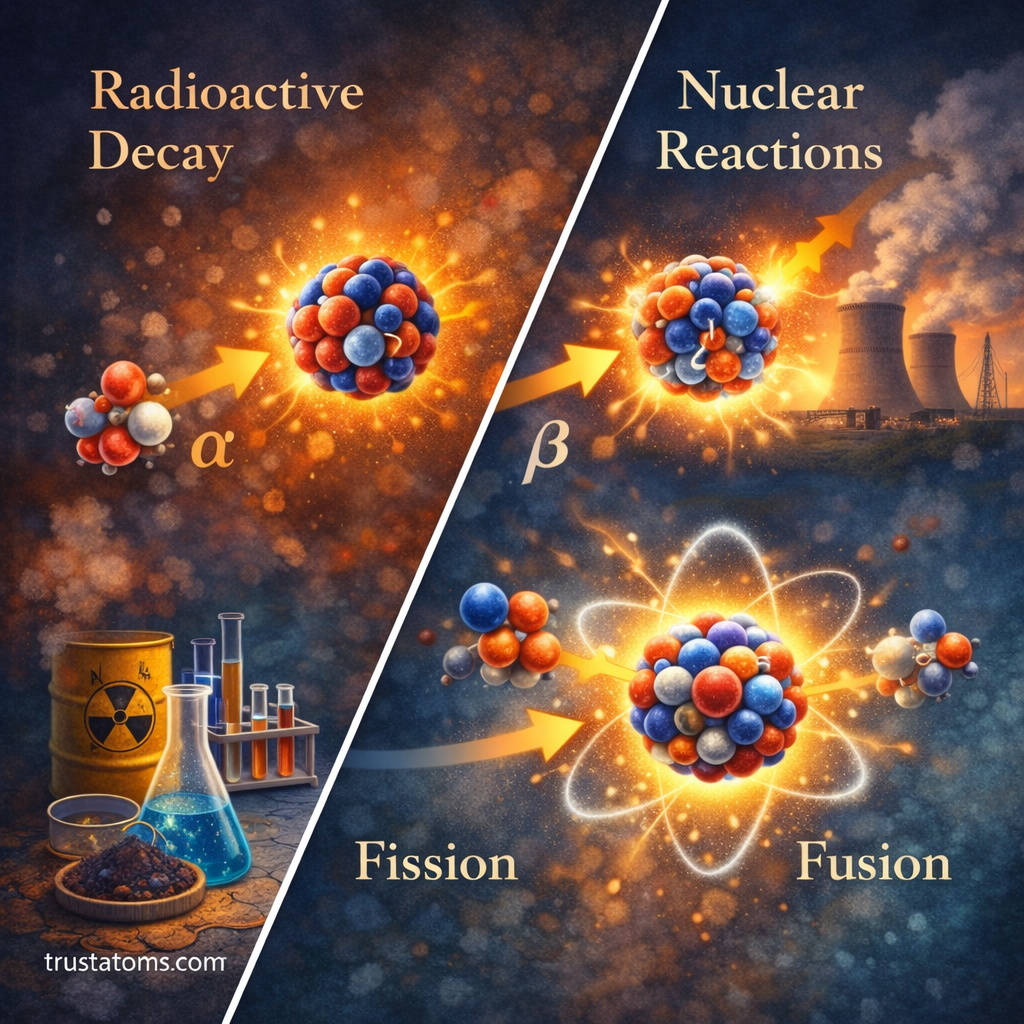
In addition to natural decay, radioactive systems can undergo induced nuclear reactions, where nuclei interact with particles or other nuclei.
Two major nuclear reactions are widely studied.
Nuclear Fission
Nuclear fission occurs when a heavy atomic nucleus splits into smaller nuclei, releasing energy and additional neutrons.
Key features of nuclear fission include:
- Releases large amounts of heat
- Produces radioactive byproducts
- Can trigger chain reactions
Fission reactions are used in nuclear power plants to generate electricity.
Nuclear Fusion
Fusion occurs when two light nuclei combine to form a heavier nucleus.
Important characteristics include:
- Releases enormous amounts of energy
- Powers stars, including the Sun
- Produces fewer radioactive byproducts than fission
Scientists are researching controlled fusion as a potential future energy source.
Half-Life and Radioactive Decay Rates
One of the most important concepts in nuclear chemistry is half-life.
The half-life of a radioactive substance is the amount of time required for half of the atoms in a sample to decay.
Half-life properties include:
- Each radioactive isotope has a specific half-life
- Decay occurs at a predictable statistical rate
- The process is independent of temperature or pressure
Examples of half-lives include:
- Carbon-14: about 5,730 years
- Iodine-131: about 8 days
- Uranium-238: about 4.5 billion years
Understanding half-life allows scientists to estimate the age of materials and predict how long radioactive substances remain hazardous.
Applications of Nuclear Chemistry
Nuclear chemistry has numerous practical applications that impact medicine, science, and technology.
Medical Imaging and Treatment
Radioactive isotopes are widely used in healthcare.
Common applications include:
- PET scans for imaging metabolic activity
- Radiation therapy for cancer treatment
- Diagnostic tracers for monitoring organ function
These techniques allow doctors to detect diseases earlier and treat them more effectively.
Nuclear Power Generation
Nuclear power plants use controlled fission reactions to generate heat, which produces steam to drive turbines and create electricity.
Benefits of nuclear energy include:
- High energy output
- Low greenhouse gas emissions
- Reliable electricity production
However, safe waste management and reactor safety remain important challenges.
Scientific Research
Radioactive tracers help scientists study chemical and biological processes by tracking the movement of atoms through systems.
Researchers use these tracers to investigate:
- Metabolic pathways
- Environmental contamination
- Chemical reaction mechanisms
Radiation Safety in Radioactive Systems
Because radiation can damage biological tissue, careful safety procedures are necessary when working with radioactive materials.
Basic radiation protection principles include:
- Time – minimize exposure duration.
- Distance – maintain safe distance from radiation sources.
- Shielding – use protective materials such as lead or concrete.
Laboratories handling radioactive substances follow strict regulations to ensure safety for workers and the environment.
Environmental Impact of Radioactive Materials
Radioactive materials can persist in the environment for long periods. Monitoring and managing these materials is an important responsibility of nuclear chemists and environmental scientists.
Common environmental concerns include:
- Nuclear waste storage
- Accidental radioactive releases
- Long-term contamination
Modern nuclear systems focus on improved containment, safer reactor designs, and responsible waste management strategies.
Final Thoughts
Nuclear chemistry provides a deeper understanding of how atomic nuclei behave in radioactive systems. By studying radioactive decay, nuclear reactions, and isotope behavior, scientists can harness powerful nuclear processes for medicine, energy production, and scientific discovery.
Although nuclear reactions release immense energy and require careful management, advances in nuclear chemistry continue to improve safety, efficiency, and practical applications across many fields.
As research progresses, nuclear chemistry will remain a key discipline for understanding the fundamental processes that shape both natural and engineered radioactive systems.