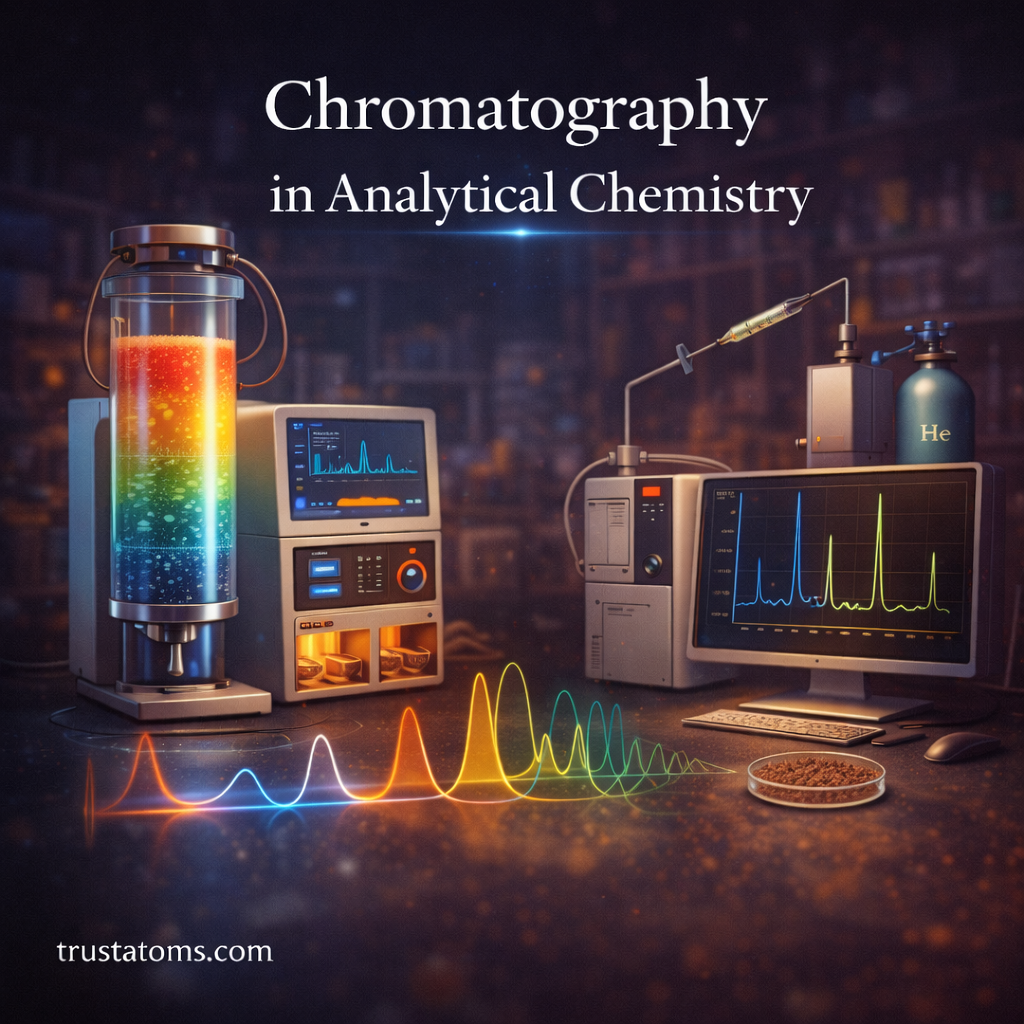
Chromatography is one of the most important techniques used in analytical chemistry to separate, identify, and analyze mixtures of chemical substances. It allows scientists to isolate individual components within complex samples, making it easier to study their properties and concentrations.
From pharmaceutical testing and environmental monitoring to food safety and forensic science, chromatography plays a central role in modern laboratory analysis.
This guide explains how chromatography works, the major types used in analytical chemistry, and why it remains one of the most reliable tools for chemical analysis.
What Is Chromatography?
Chromatography is a laboratory technique used to separate mixtures into their individual components.
The method works by passing a mixture through a system that contains two phases:
- Stationary phase – a solid or liquid material that remains fixed in place
- Mobile phase – a liquid or gas that moves through the stationary phase
Different substances travel through the system at different speeds depending on how strongly they interact with the stationary phase.
As a result, the components of the mixture separate and can be analyzed individually.
How Chromatography Works
Chromatography separates substances based on differences in their physical or chemical properties.
These properties may include:
- Molecular size
- Polarity
- Solubility
- Interaction with the stationary phase
When a mixture is introduced into a chromatographic system, each component moves at a different rate.
This process gradually separates the mixture into distinct bands or peaks that can be detected and measured.
Key Components of a Chromatography System
Most chromatographic techniques share several basic components.
Stationary Phase
The stationary phase is the material that remains fixed inside the chromatography system.
It may be:
- A solid surface
- A liquid coated onto a solid support
The stationary phase interacts with the components of the mixture and influences how quickly they move through the system.
Mobile Phase
The mobile phase carries the mixture through the stationary phase.
It may be:
- A liquid solvent
- A gas
As the mobile phase moves through the system, it transports the components of the mixture at different speeds.
Detector
Modern chromatographic systems often include detectors that identify and measure separated substances.
Detectors can measure properties such as:
- Light absorption
- Electrical conductivity
- Mass signals
The detector output is typically displayed as a chromatogram, which shows peaks representing individual substances.
Common Types of Chromatography
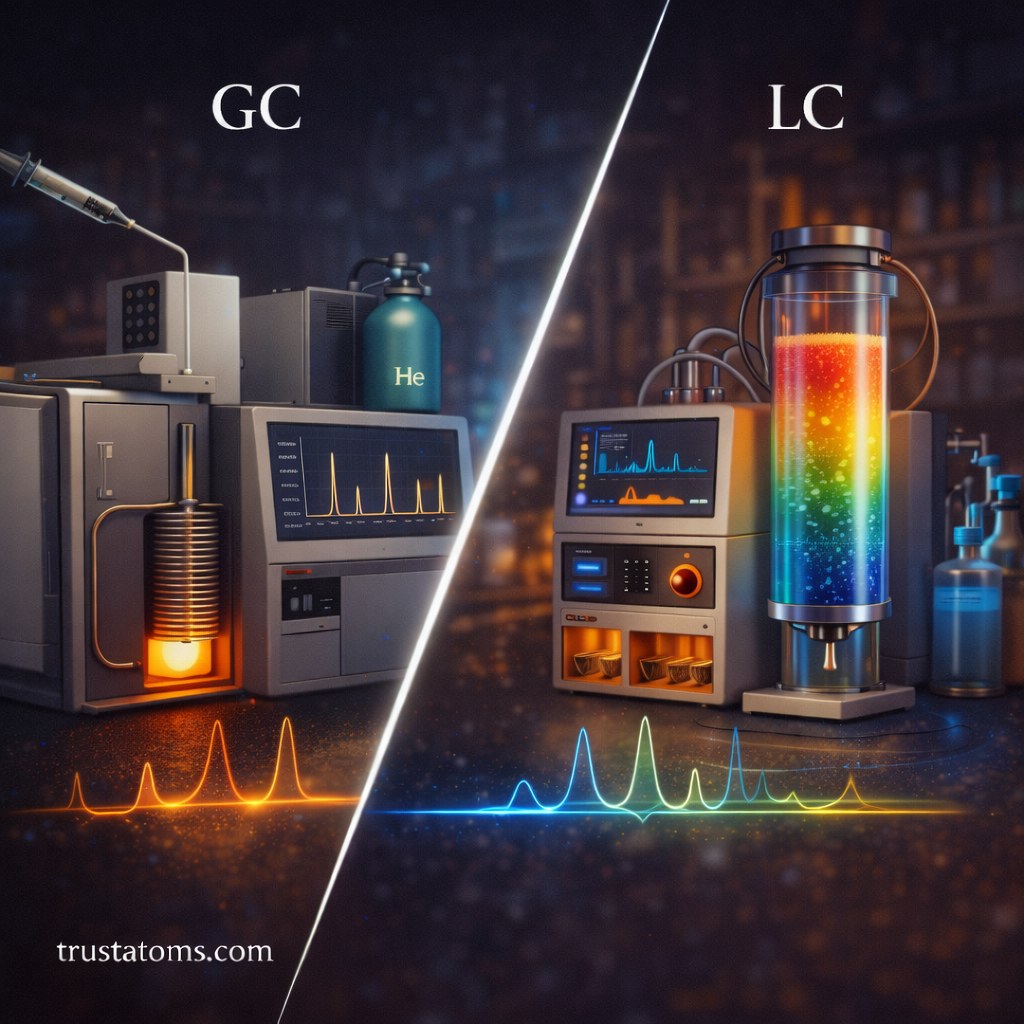
Several forms of chromatography are widely used in analytical chemistry. Each type is designed to separate compounds based on specific characteristics.
Gas Chromatography (GC)
Gas chromatography separates substances that can be vaporized without decomposition.
In GC:
- The mobile phase is an inert gas.
- The stationary phase is typically a liquid coated on a solid column.
Gas chromatography is commonly used to analyze:
- Volatile organic compounds
- Environmental pollutants
- Flavors and fragrances
- Chemical solvents
Because of its high sensitivity, GC is widely used in research and industrial laboratories.
Liquid Chromatography (LC)
Liquid chromatography uses a liquid solvent as the mobile phase.
One of the most advanced forms is High-Performance Liquid Chromatography (HPLC).
HPLC is widely used to analyze:
- Pharmaceutical compounds
- Biological molecules
- Food additives
- Environmental contaminants
HPLC systems use high pressure to push the solvent through tightly packed columns, improving separation efficiency.
Thin-Layer Chromatography (TLC)
Thin-layer chromatography is a simple and fast technique used in many laboratories.
In TLC:
- The stationary phase is a thin layer of solid material on a plate.
- The mobile phase moves upward through the plate by capillary action.
TLC is commonly used for:
- Identifying compounds
- Monitoring chemical reactions
- Checking sample purity
Although it is less precise than other methods, TLC is inexpensive and easy to perform.
Paper Chromatography
Paper chromatography is one of the earliest chromatographic techniques.
In this method:
- Paper acts as the stationary phase
- A liquid solvent moves through the paper
Different substances travel different distances on the paper, allowing them to be separated.
Paper chromatography is often used in educational laboratories to demonstrate separation principles.
Understanding Chromatograms
The results of chromatography are typically presented as a chromatogram.
A chromatogram is a graph that shows how substances separate during the analysis.
Key elements of a chromatogram include:
- Peaks representing individual compounds
- Retention time, which indicates how long a substance takes to travel through the system
- Peak area, which relates to the amount of substance present
By analyzing these features, chemists can identify and quantify the components of a mixture.
Applications of Chromatography
Chromatography is used in many scientific and industrial fields.
Pharmaceutical Industry
Pharmaceutical laboratories rely on chromatography to ensure drug safety and quality.
Common uses include:
- Verifying drug purity
- Detecting impurities
- Monitoring drug stability
- Controlling manufacturing processes
Environmental Analysis
Chromatography helps scientists monitor pollutants in the environment.
Applications include:
- Detecting pesticides in soil
- Measuring air pollutants
- Identifying contaminants in water samples
These analyses help protect ecosystems and public health.
Food Safety Testing
Chromatography is widely used in food science.
It can detect:
- Food additives
- Pesticide residues
- Artificial flavors
- Nutritional compounds
Food regulators often rely on chromatographic testing to ensure food safety standards.
Forensic Science
Forensic laboratories use chromatography to analyze evidence from crime scenes.
Examples include:
- Identifying drugs and toxins
- Analyzing explosive residues
- Detecting chemical traces in biological samples
Chromatography provides reliable results that can support criminal investigations.
Advantages of Chromatography
Chromatography offers several advantages that make it a powerful analytical technique.
Key benefits include:
- High accuracy and sensitivity
- Ability to analyze complex mixtures
- Reliable identification of substances
- Wide range of applications
- Compatibility with advanced detectors
Because of these strengths, chromatography remains a standard method in analytical chemistry.
Limitations of Chromatography
Despite its usefulness, chromatography also has some limitations.
Challenges may include:
- Expensive instrumentation
- Time required for complex analyses
- Need for careful sample preparation
- Specialized training for advanced systems
However, technological improvements continue to increase efficiency and automation in modern chromatography systems.
The Future of Chromatography
Advances in technology are expanding the capabilities of chromatographic analysis.
New developments include:
- Faster and more efficient column materials
- Miniaturized chromatography systems
- Automated sample handling
- Integration with mass spectrometry for detailed molecular analysis
These innovations allow scientists to analyze chemical mixtures with greater speed and precision.
Final Thoughts
Chromatography is one of the most essential tools in analytical chemistry. By separating mixtures into their individual components, it allows scientists to identify substances, measure concentrations, and study chemical properties.
From pharmaceuticals and environmental monitoring to food safety and forensic science, chromatography continues to play a vital role in understanding complex chemical systems.
As technology advances, chromatographic techniques will remain fundamental to scientific research and industrial analysis.