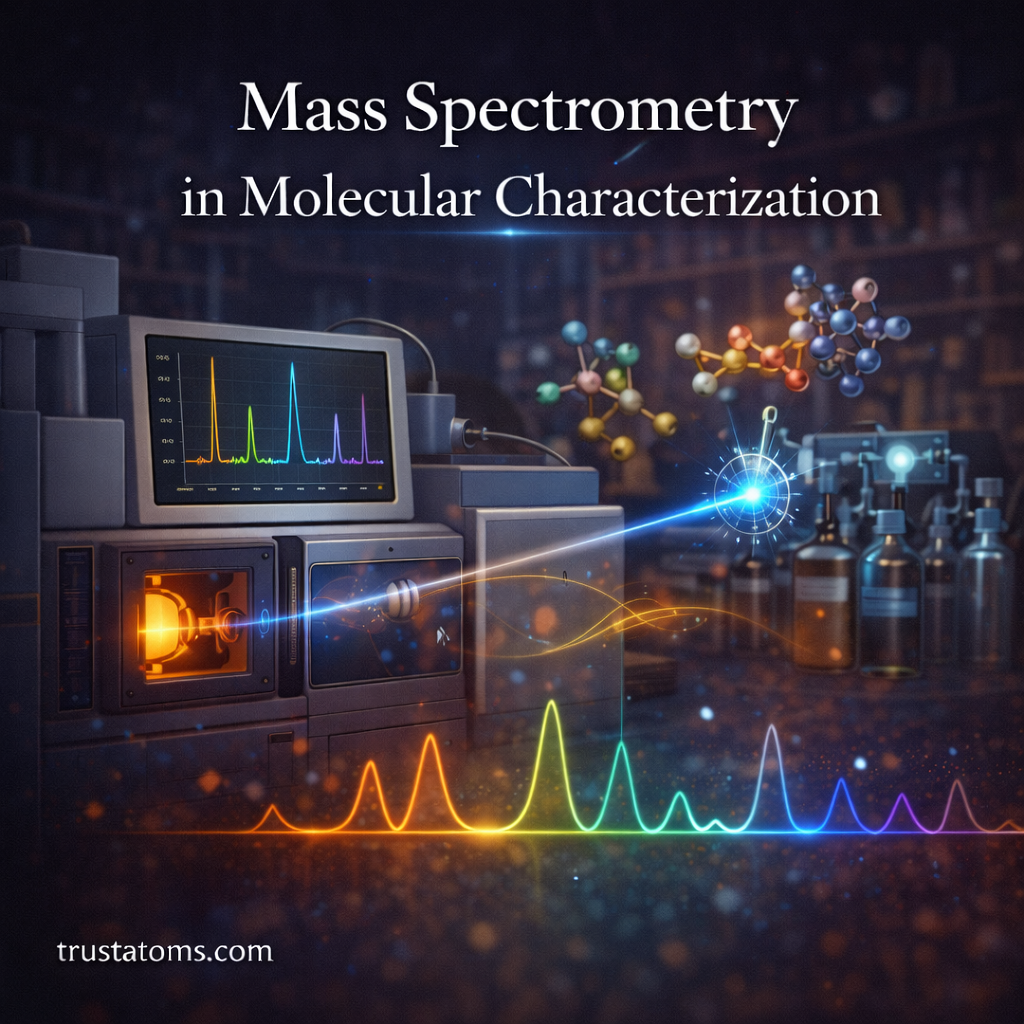
Mass spectrometry is one of the most powerful analytical techniques used in modern chemistry. It allows scientists to identify molecules, determine their mass, and analyze their structure with exceptional precision.
By measuring the mass of ionized particles, mass spectrometry helps researchers identify unknown compounds, study complex mixtures, and characterize molecular structures. This method is widely used in fields such as pharmaceutical research, environmental science, forensic chemistry, and biochemistry.
This guide explains how mass spectrometry works, how it helps characterize molecules, and why it is such a critical tool in analytical chemistry.
What Is Mass Spectrometry?
Mass spectrometry (often abbreviated as MS) is an analytical technique used to measure the mass-to-charge ratio of ionized molecules.
In a mass spectrometer, molecules are converted into charged particles called ions. These ions are then separated and detected based on their mass and electrical charge.
By analyzing these ions, scientists can determine:
- The molecular weight of a compound
- The elemental composition of a molecule
- Structural information about molecular fragments
- The presence of specific compounds within a mixture
The resulting output of a mass spectrometry experiment is called a mass spectrum.
How Mass Spectrometry Works
Mass spectrometry involves several key steps that transform molecules into measurable signals.
1. Ionization
The first step is ionization, where neutral molecules are converted into charged ions.
Several ionization techniques are used depending on the type of sample.
Common ionization methods include:
- Electron ionization (EI)
- Electrospray ionization (ESI)
- Matrix-assisted laser desorption ionization (MALDI)
Ionization causes molecules to either gain or lose electrons, creating positively or negatively charged ions.
2. Ion Acceleration
Once ions are created, they are accelerated using electric fields inside the mass spectrometer.
This acceleration ensures that ions move through the instrument at controlled speeds for accurate measurement.
3. Ion Separation
After acceleration, ions are separated based on their mass-to-charge ratio (m/z).
Lighter ions or ions with higher charge travel differently than heavier ions.
Different types of analyzers are used to perform this separation, including:
- Time-of-flight analyzers
- Quadrupole analyzers
- Ion trap analyzers
4. Ion Detection
Once separated, ions reach a detector that records their arrival.
The detector measures the intensity of each ion signal, which corresponds to how many ions of that mass are present.
These signals are converted into a mass spectrum.
Understanding a Mass Spectrum
A mass spectrum is a graph that displays the detected ions from a sample.
Key features of a mass spectrum include:
- Mass-to-charge ratio (m/z) on the horizontal axis
- Signal intensity on the vertical axis
Each peak in the spectrum represents a group of ions with the same mass-to-charge ratio.
Important peaks often include:
- Molecular ion peak – representing the intact molecule
- Fragment peaks – representing pieces of the molecule that formed during ionization
By interpreting these peaks, chemists can determine the identity and structure of the compound.
Fragmentation Patterns in Mass Spectrometry
During ionization, molecules often break into smaller pieces called fragments.
These fragments provide valuable clues about molecular structure.
Different molecules produce characteristic fragmentation patterns depending on:
- Bond strengths
- Molecular arrangement
- Functional groups present
By analyzing these patterns, scientists can reconstruct the structure of an unknown molecule.
Types of Mass Spectrometers

Several types of mass spectrometers are used in analytical chemistry, each designed for specific types of analysis.
Quadrupole Mass Spectrometers
Quadrupole instruments use electric fields to filter ions based on their mass-to-charge ratio.
They are widely used because they are:
- Reliable
- Relatively compact
- Suitable for routine laboratory analysis
Time-of-Flight (TOF) Mass Spectrometers
Time-of-flight analyzers measure how long ions take to travel through a flight tube.
Because lighter ions move faster than heavier ions, this travel time allows precise mass measurement.
TOF instruments are known for:
- High mass accuracy
- Fast analysis speed
Ion Trap Mass Spectrometers
Ion trap instruments capture ions in an electromagnetic field.
Scientists can isolate specific ions and analyze them in greater detail.
These instruments are useful for studying complex molecular structures.
Combining Mass Spectrometry with Chromatography
Mass spectrometry is often combined with separation techniques such as chromatography.
Two common combinations include:
- Gas chromatography–mass spectrometry (GC-MS)
- Liquid chromatography–mass spectrometry (LC-MS)
These combined systems allow scientists to:
- Separate complex mixtures
- Identify individual compounds
- Perform highly sensitive chemical analysis
This combination is widely used in environmental testing, forensic science, and pharmaceutical research.
Applications of Mass Spectrometry
Mass spectrometry has applications across many scientific disciplines.
Pharmaceutical Development
In drug development, mass spectrometry is used to:
- Confirm molecular structures
- Detect impurities
- Monitor drug metabolism
This helps ensure the safety and effectiveness of medications.
Environmental Monitoring
Mass spectrometry allows scientists to detect extremely small amounts of pollutants in the environment.
Examples include:
- Pesticide detection
- Air pollution analysis
- Water contamination studies
Forensic Science
Forensic laboratories use mass spectrometry to identify unknown substances found at crime scenes.
Common uses include:
- Drug identification
- Toxicology testing
- Chemical residue analysis
Proteomics and Biochemistry
Mass spectrometry is essential in the study of biological molecules such as proteins.
Researchers use it to:
- Identify proteins
- Analyze protein structure
- Study biochemical pathways
This field of study is known as proteomics.
Advantages of Mass Spectrometry
Mass spectrometry offers several advantages that make it one of the most powerful analytical tools available.
Key benefits include:
- Extremely high sensitivity
- Accurate molecular mass determination
- Ability to analyze complex mixtures
- Rapid analysis times
- Compatibility with other analytical techniques
These features make mass spectrometry invaluable in both research and industry.
Limitations of Mass Spectrometry
Despite its power, mass spectrometry does have some limitations.
Challenges may include:
- High equipment cost
- Complex instrument operation
- Requirement for skilled interpretation of spectra
- Sample preparation requirements
However, advances in technology continue to improve accessibility and automation.
The Future of Mass Spectrometry
Mass spectrometry technology continues to evolve rapidly.
New developments include:
- Higher-resolution instruments
- Miniaturized portable systems
- Faster data processing
- AI-assisted spectral analysis
These innovations allow scientists to analyze increasingly complex molecular systems.
Final Thoughts
Mass spectrometry is a cornerstone of modern molecular characterization. By measuring the mass-to-charge ratio of ionized molecules, scientists can determine molecular structures, identify unknown compounds, and analyze complex mixtures.
From pharmaceuticals and environmental science to forensic investigations and biological research, mass spectrometry continues to provide powerful insights into the molecular world.
As analytical technologies advance, mass spectrometry will remain one of the most important tools in chemistry and scientific discovery.