Friction is one of the most important forces in physics. It affects how we walk, drive, write, and even how machines operate.
But friction is not just one single force — it comes in different forms depending on how objects interact.
In this guide, you’ll learn:
- The main types of friction
- How each type works
- Real-world examples
- How they compare to one another
- Why understanding friction matters
What Is Friction?
Friction is a force that resists motion between two surfaces in contact.
It always acts in the opposite direction of movement (or attempted movement).
For example:
- When you push a box and it doesn’t move, friction is resisting you.
- When you slide across ice, low friction allows you to keep moving.
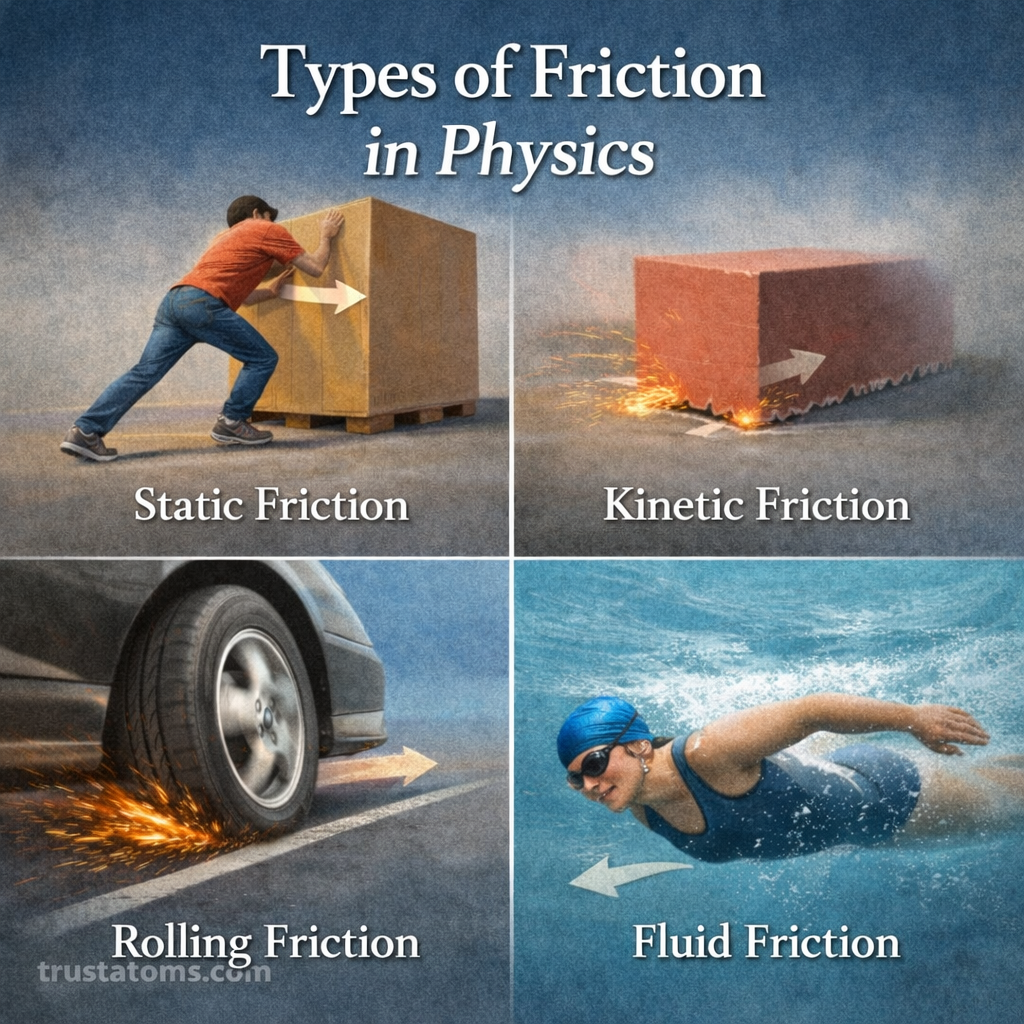
There are four primary types of friction in physics.
1. Static Friction
Static friction acts on objects that are at rest.
It prevents motion from starting.
If you try to push a heavy object and it doesn’t move, static friction is holding it in place.
Key Characteristics of Static Friction
- Acts on stationary objects
- Prevents motion
- Adjusts to match applied force (up to a maximum value)
- Usually stronger than sliding friction
Example
Pushing a couch across the floor:
- At first, it doesn’t move.
- You apply more force.
- Once you exceed static friction, the couch begins to slide.
Static friction is strongest just before motion begins.
2. Kinetic (Sliding) Friction
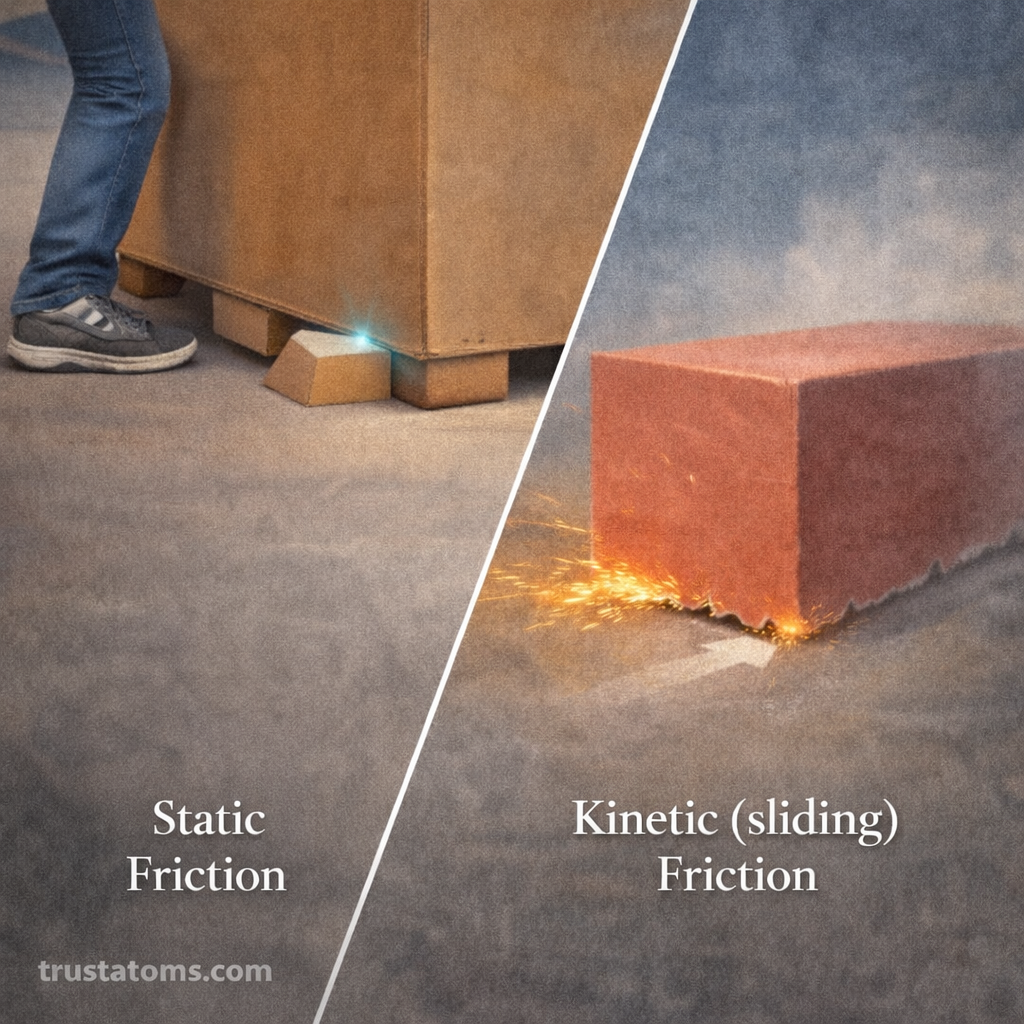
Kinetic friction occurs when two surfaces slide past each other.
Once an object is already moving, static friction is replaced by kinetic friction.
Key Characteristics of Kinetic Friction
- Acts on moving objects
- Opposes sliding motion
- Typically weaker than static friction
- Produces heat
Examples
- A sled sliding down a snowy hill
- A book sliding across a table
- Brakes stopping a car
Because kinetic friction is weaker than static friction, it’s usually harder to start motion than to keep something moving.
3. Rolling Friction
Rolling friction occurs when an object rolls over a surface.
It is much smaller than sliding friction.
That’s why wheels are so important in transportation and machinery.
Key Characteristics of Rolling Friction
- Occurs when objects roll
- Much weaker than sliding friction
- Caused by surface deformation and slight contact resistance
Examples
- Car tires rolling on the road
- A basketball rolling on the court
- A shopping cart moving across a store floor
If wheels didn’t reduce friction, moving heavy objects would require far more energy.
4. Fluid Friction (Drag)
Fluid friction occurs when an object moves through a liquid or gas.
This type of friction is also called drag.
Unlike surface friction, fluid friction depends heavily on speed.
Key Characteristics of Fluid Friction
- Occurs in liquids and gases
- Increases as speed increases
- Affected by shape and surface area
Examples
- Air resistance acting on a moving car
- Water resistance on a swimmer
- Wind slowing down a cyclist
Aerodynamic and streamlined designs are used to reduce fluid friction.
Comparison of the Types of Friction
Here’s a simple breakdown:
- Static Friction – Prevents motion from starting
- Kinetic Friction – Opposes sliding motion
- Rolling Friction – Opposes rolling motion
- Fluid Friction – Resists motion through liquids or gases
In most solid surfaces:
Static friction > Kinetic friction > Rolling friction
Fluid friction depends strongly on speed rather than just surface contact.
Why Understanding Friction Matters
Friction affects nearly every physical system.
It helps us:
- Walk without slipping
- Drive safely
- Grip objects
- Control motion
But friction also:
- Causes wear and tear
- Generates unwanted heat
- Reduces mechanical efficiency
Engineers constantly balance increasing friction (for grip and safety) and reducing friction (for efficiency and longevity).
Common Misconceptions About Friction
1. “Friction always slows things down.”
Not always. Friction allows movement to happen in controlled ways — like walking or driving.
2. “Smooth surfaces have no friction.”
Even very smooth surfaces have microscopic roughness that creates friction.
3. “Bigger surface area means more friction.”
For many solid surfaces, friction depends more on the normal force and material properties than surface area.
Key Takeaways
- There are four main types of friction: static, kinetic, rolling, and fluid.
- Static friction prevents motion from starting.
- Kinetic friction acts during sliding.
- Rolling friction is much smaller than sliding friction.
- Fluid friction depends heavily on speed.
- Friction is essential for both safety and mechanical function.
Understanding the different types of friction helps explain everything from car braking systems to airplane design — and even why it’s easier to push a cart than drag a heavy box.