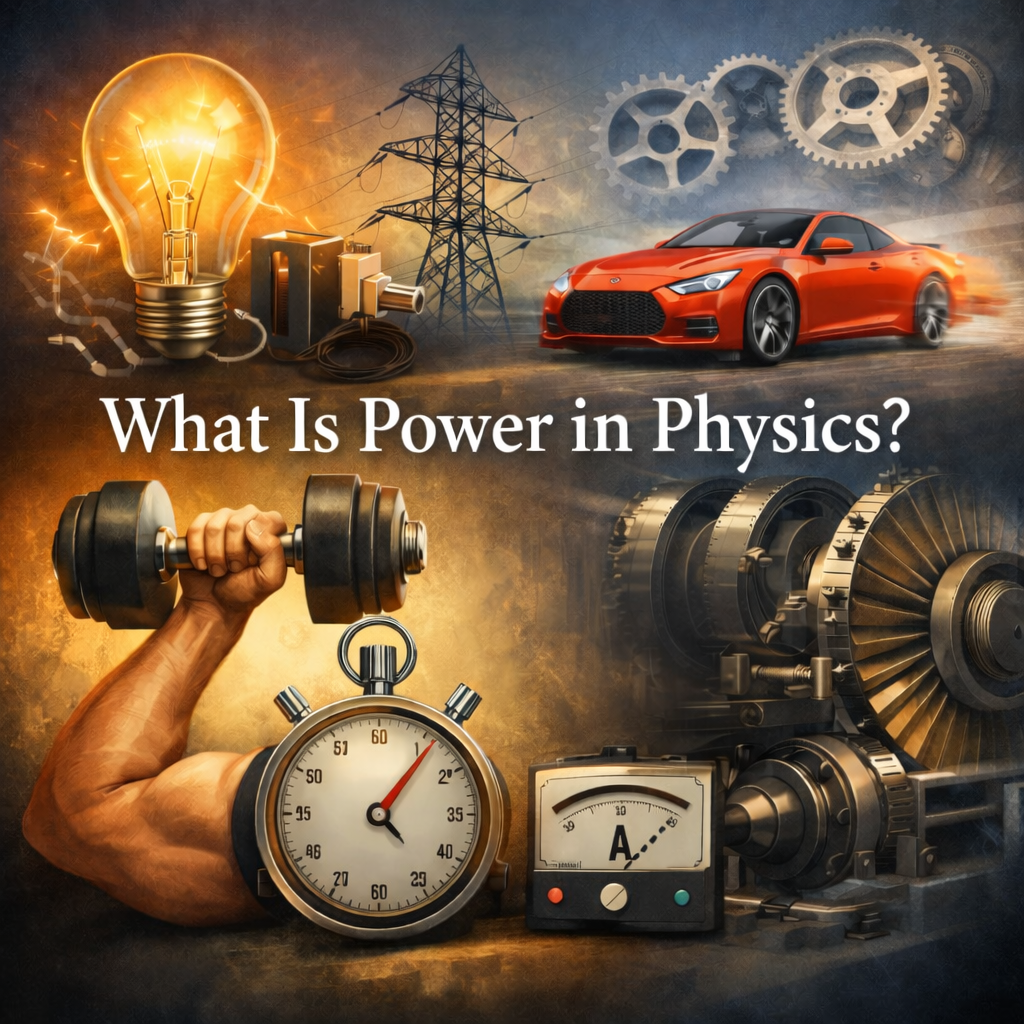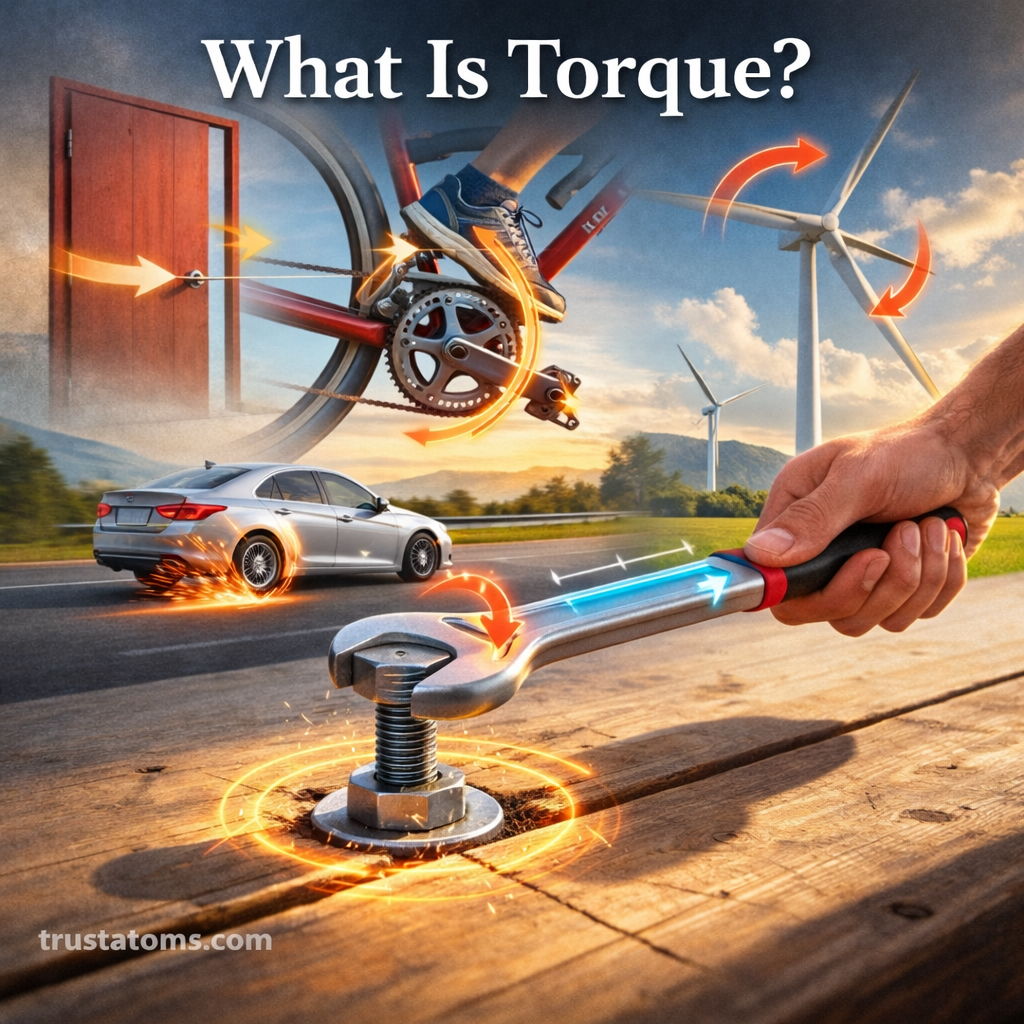
Torque is the rotational equivalent of force.
While force makes objects move in a straight line, torque makes objects rotate. Every time you open a door, turn a wrench, or pedal a bicycle, you are applying torque.
In this guide, you’ll learn:
- What torque is in physics
- The torque formula
- How distance affects torque
- Real-world examples
- Why torque is important in engineering and mechanics
What Is Torque in Physics?
Torque is a force that causes an object to rotate around a pivot point, axis, or hinge.
Instead of pushing something forward, torque causes it to spin or turn.
For example:
- Pushing a door near the handle makes it swing open.
- Tightening a bolt with a wrench turns it.
- A car engine rotates the wheels using torque.
Without torque, rotation would not happen.
The Torque Formula
The basic formula for torque is:
τ = rF sin(θ)
Where:
- τ (tau) = torque
- r = distance from the pivot point (lever arm)
- F = applied force
- θ = angle between the force and lever arm
In many simple cases where force is applied perpendicular to the lever arm:
Torque = Force × Distance
Units of Torque
Torque is measured in:
Newton-meters (N·m)
One newton-meter means:
A force of 1 newton applied 1 meter away from the pivot point.
Why Distance Matters

Distance from the pivot point plays a major role in torque.
The farther from the pivot you apply force, the greater the torque.
This is why:
- Door handles are placed far from hinges
- Long wrenches make tightening bolts easier
- Using a longer crowbar increases leverage
The distance from the pivot is often called the lever arm.
What Is a Pivot Point?
The pivot point (or axis of rotation) is the fixed point around which rotation occurs.
Examples:
- Door hinges
- The center of a wheel
- The axle of a seesaw
- The bolt being tightened
Without a pivot point, torque cannot create rotation.
Real-World Examples of Torque
Torque is everywhere in daily life.
Everyday Examples
- Opening a door
- Turning a steering wheel
- Using a screwdriver
- Pedaling a bicycle
- Tightening a jar lid
Engineering Examples
- Car engines generating wheel rotation
- Electric motors spinning fans
- Wind turbines converting wind energy into rotational motion
In each case, torque is responsible for rotational movement.
Torque vs. Force
Torque and force are related, but they are not the same.
Force:
- Causes linear motion
- Measured in newtons
Torque:
- Causes rotational motion
- Measured in newton-meters
You can apply force without causing rotation — but torque specifically refers to rotational effect.
Clockwise and Counterclockwise Torque
Torque has direction.
It can rotate objects:
- Clockwise
- Counterclockwise
In physics problems, these directions are often assigned positive or negative signs to analyze rotational balance.
Balanced Torque (Rotational Equilibrium)
When opposing torques are equal, rotation does not occur.
This is called rotational equilibrium.
Example:
A seesaw balanced in the middle.
If two people of equal weight sit at equal distances from the center, the torques cancel out.
No rotation happens.
Factors That Affect Torque
Torque depends on three main factors:
- The amount of force applied
- The distance from the pivot point
- The angle at which the force is applied
Maximum torque occurs when force is applied perpendicular to the lever arm.
Why Torque Is Important
Torque is essential in:
- Mechanical systems
- Engines and motors
- Robotics
- Construction tools
- Structural engineering
Without torque, machines that rely on rotation would not function.
Understanding torque helps engineers design:
- Efficient engines
- Stable structures
- Safe mechanical systems
Common Misconceptions About Torque
1. “More force always means more rotation.”
Not necessarily. If force is applied close to the pivot point, torque may still be small.
2. “Torque and force are interchangeable.”
They are related but describe different types of motion.
3. “Torque only applies to machines.”
Torque applies anytime rotation occurs — even opening a simple door.
Key Takeaways
- Torque is a force that causes rotation.
- It depends on force, distance from the pivot, and angle.
- The formula is τ = rF sin(θ).
- Torque is measured in newton-meters.
- Greater distance from the pivot increases torque.
- Torque is essential for engines, tools, and everyday motion.
From turning a wrench to powering a turbine, torque is one of the most fundamental concepts in physics.
Understanding torque helps explain how rotational motion works — and why leverage makes tasks easier.