In many chemical reactions, the substances involved are not interacting in isolation. Instead, they are surrounded by another substance known as the solvent. The solvent provides the environment in which reactants dissolve, move, and interact.
Solvents play a crucial role in determining how quickly reactions occur, what products form, and how stable certain molecules remain during a reaction. These influences are known collectively as solvent effects.
Understanding solvent effects allows chemists to control reaction outcomes, improve reaction efficiency, and design better industrial and laboratory processes.
What Is a Solvent?
A solvent is a substance that dissolves other materials to form a solution. The dissolved substances are called solutes.
In chemical reactions, solvents often:
- Dissolve reactants so they can interact
- Stabilize ions or intermediate species
- Influence reaction rates
- Affect reaction pathways
Many reactions occur in liquid solvents, although some reactions occur in gases or solid environments.
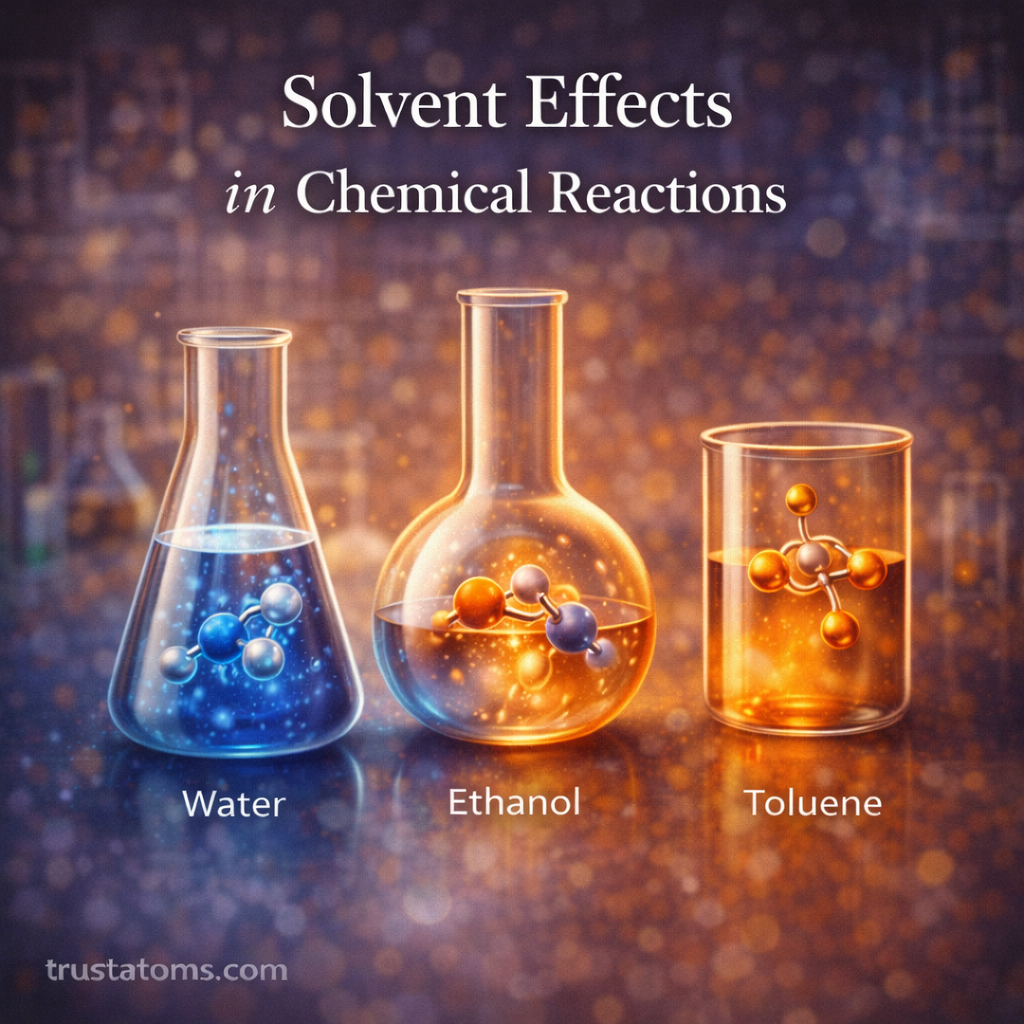
Common solvents used in chemistry include:
- Water
- Ethanol
- Acetone
- Toluene
- Acetonitrile
Each solvent has unique physical and chemical properties that influence how reactions proceed.
How Solvents Influence Chemical Reactions
Solvents affect reactions in several ways by altering the environment surrounding molecules.
Important solvent influences include:
- Stabilizing charged species
- Changing reaction speed
- Altering equilibrium positions
- Affecting molecular orientation
Because solvents surround reactants at the molecular level, they can strongly influence how molecules approach each other and form new bonds.
Polar and Nonpolar Solvents
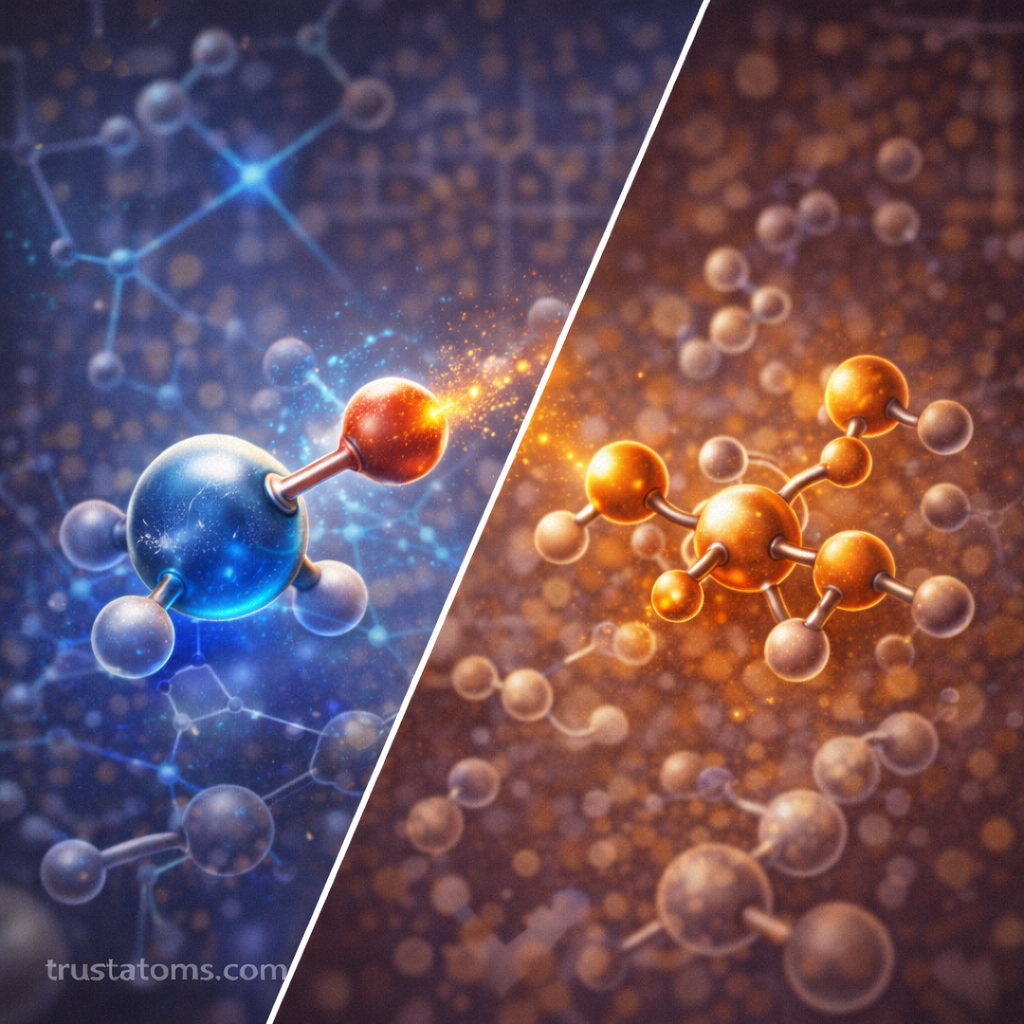
One of the most important solvent properties is polarity.
Polarity refers to how electric charge is distributed within a molecule.
Polar Solvents
Polar solvents contain molecules with partial positive and negative charges.
Examples include:
- Water
- Methanol
- Ethanol
- Dimethyl sulfoxide
Polar solvents are especially effective at dissolving:
- Ionic compounds
- Polar molecules
- Charged reaction intermediates
These solvents often stabilize ions formed during chemical reactions.
Nonpolar Solvents
Nonpolar solvents have little or no separation of electrical charge.
Examples include:
- Hexane
- Benzene
- Toluene
- Carbon tetrachloride
Nonpolar solvents tend to dissolve:
- Nonpolar molecules
- Organic compounds
- Hydrocarbons
These solvents are often used in reactions involving neutral or nonpolar species.
Solvent Effects on Reaction Rates
The choice of solvent can significantly influence how quickly a reaction occurs.
Solvents affect reaction rates by:
- Stabilizing or destabilizing transition states
- Influencing molecular collisions
- Changing activation energy requirements
In some reactions, polar solvents speed up reactions involving ions by stabilizing charged intermediates.
In other reactions, nonpolar solvents may allow molecules to react more freely without strong solvent interactions.
Because of these effects, chemists carefully choose solvents when designing reactions.
Solvent Effects on Reaction Mechanisms
The mechanism of a chemical reaction may change depending on the solvent environment.
For example, certain organic reactions proceed differently depending on solvent polarity.
Solvent Stabilization of Intermediates
Solvents can stabilize reaction intermediates such as:
- Carbocations
- Carbanions
- Free radicals
If a solvent stabilizes a particular intermediate strongly, that reaction pathway becomes more favorable.
Solvent Control of Reaction Pathways
In some reactions, different solvents can produce different products.
This occurs because solvents may favor one reaction mechanism over another.
As a result, solvent selection is an important part of reaction design in chemistry.
Protic and Aprotic Solvents
Another important solvent classification is based on whether the solvent can donate hydrogen atoms involved in hydrogen bonding.
Protic Solvents
Protic solvents contain hydrogen atoms that can participate in hydrogen bonding.
Examples include:
- Water
- Alcohols
- Acetic acid
These solvents can stabilize charged species through hydrogen bonding interactions.
Aprotic Solvents
Aprotic solvents do not donate hydrogen atoms for hydrogen bonding.
Examples include:
- Acetone
- Dimethylformamide
- Acetonitrile
Aprotic solvents often allow certain reactions involving charged species to occur more rapidly because they do not strongly bind to the reacting ions.
Solvent Effects on Chemical Equilibrium
Solvents can also influence the position of chemical equilibrium.
They may affect equilibrium by:
- Stabilizing reactants
- Stabilizing products
- Changing solubility conditions
- Altering intermolecular interactions
For example, if a solvent stabilizes the products of a reaction more strongly than the reactants, equilibrium may shift toward product formation.
Because of this, solvent choice can affect the overall yield of a reaction.
Solvent Effects in Industrial and Biological Chemistry
Solvent effects are important in many scientific and industrial applications.
Industrial Chemistry
Chemical manufacturers carefully choose solvents to:
- Increase reaction efficiency
- Improve product selectivity
- Reduce energy requirements
- Control reaction rates
Solvent selection can significantly impact production costs and environmental impact.
Biological Chemistry
In biological systems, water acts as the primary solvent.
Water’s polarity and hydrogen bonding properties influence:
- Enzyme activity
- Protein structure
- Molecular transport in cells
- Metabolic reaction pathways
The solvent environment inside living cells is essential for maintaining biological function.
Why Solvent Effects Matter
Understanding solvent effects helps chemists control chemical reactions more effectively.
Key advantages include:
- Predicting reaction outcomes
- Improving reaction efficiency
- Stabilizing reactive intermediates
- Designing safer and more sustainable chemical processes
By selecting appropriate solvents, chemists can guide reactions toward desired products and optimize reaction conditions.
Final Thoughts
Solvent effects are a fundamental aspect of chemical reactions. Although solvents may seem like passive environments, they actively influence how molecules interact, react, and transform.
Factors such as polarity, hydrogen bonding ability, and molecular interactions allow solvents to shape reaction pathways, rates, and equilibrium positions. For this reason, solvent selection is one of the most important decisions chemists make when designing experiments or industrial processes.
Understanding solvent effects provides deeper insight into how chemical systems operate and how reactions can be controlled in both laboratory and real-world settings.