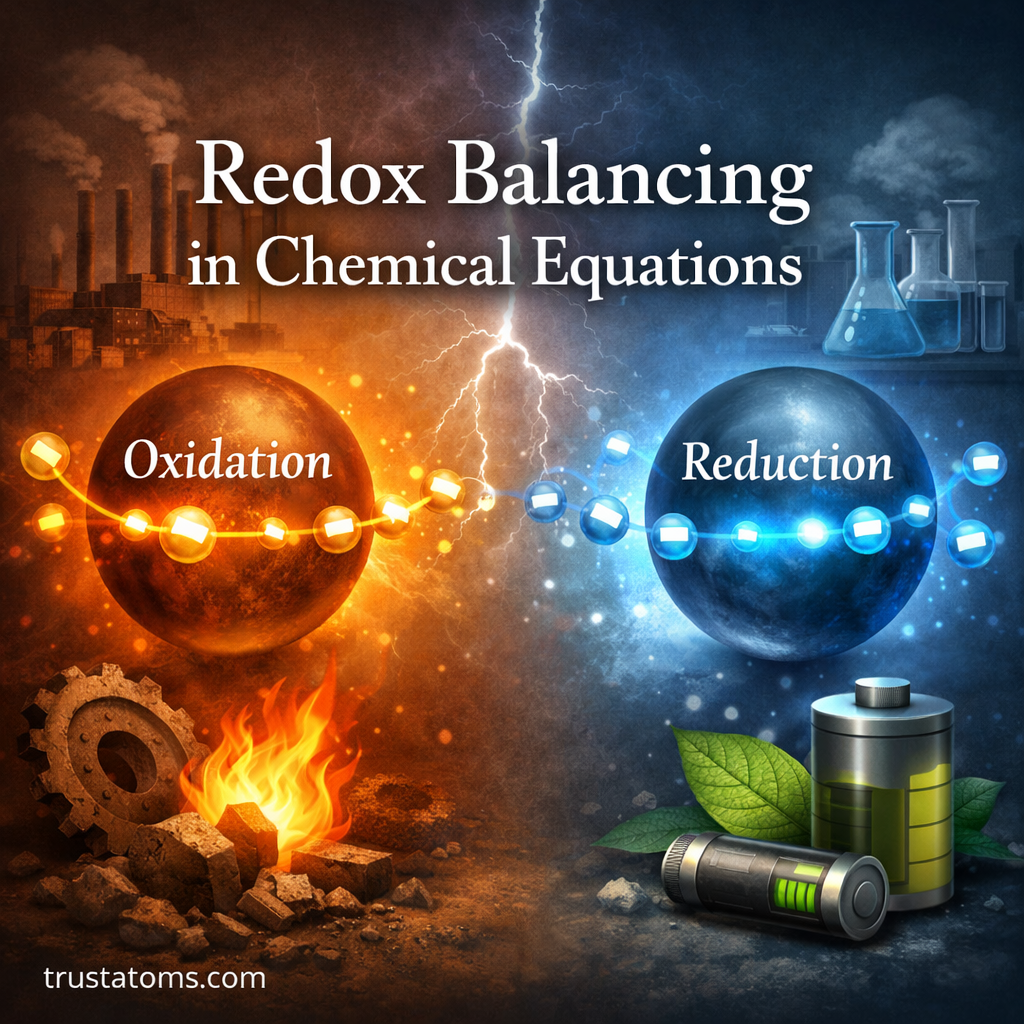
Chemical reactions often involve the transfer of electrons between substances. These reactions, known as oxidation–reduction (redox) reactions, are fundamental to chemistry because they drive processes such as corrosion, combustion, battery operation, and cellular respiration.
Balancing redox equations ensures that both mass and electrical charge are conserved during a chemical reaction. While balancing simple equations can be done by inspection, redox reactions typically require a structured method due to the movement of electrons.
Understanding how to balance redox equations helps chemists analyze reaction mechanisms, predict reaction outcomes, and apply chemistry principles in real-world systems.
What Is a Redox Reaction?
A redox reaction involves two simultaneous processes:
- Oxidation: loss of electrons
- Reduction: gain of electrons
A helpful mnemonic used in chemistry is:
- OIL RIG
- Oxidation Is Loss
- Reduction Is Gain
Since electrons cannot disappear or appear from nowhere, the number of electrons lost during oxidation must equal the number gained during reduction. This requirement is what makes balancing redox equations essential.
Example of a Redox Process
Consider a simple reaction between zinc and copper ions:
Zn + Cu²⁺ → Zn²⁺ + Cu
In this reaction:
- Zinc loses two electrons (oxidation)
- Copper ions gain two electrons (reduction)
Electron transfer links the two processes together, forming a balanced redox reaction.
Why Redox Balancing Is Important
Balancing redox reactions ensures that:
- The number of atoms of each element is conserved
- The electrical charge remains balanced
- Electron transfer between species is correctly represented
Accurate redox balancing is critical in many fields of chemistry, including:
- Electrochemistry and batteries
- Corrosion science
- Environmental chemistry
- Industrial chemical processes
- Biological energy systems
Without proper balancing, chemical equations would not correctly describe real chemical reactions.
Key Terms in Redox Chemistry
Understanding several core terms makes redox balancing easier.
Oxidation Number
The oxidation number (or oxidation state) represents the hypothetical charge an atom would have if electrons were completely transferred.
Examples:
- Sodium in NaCl = +1
- Chlorine in NaCl = −1
- Oxygen in most compounds = −2
Tracking oxidation numbers helps identify which atoms are oxidized or reduced during a reaction.
Oxidizing Agent
The oxidizing agent:
- Causes another substance to lose electrons
- Gains electrons itself
- Is reduced during the reaction
Reducing Agent
The reducing agent:
- Donates electrons to another substance
- Loses electrons itself
- Is oxidized during the reaction
Methods for Balancing Redox Equations
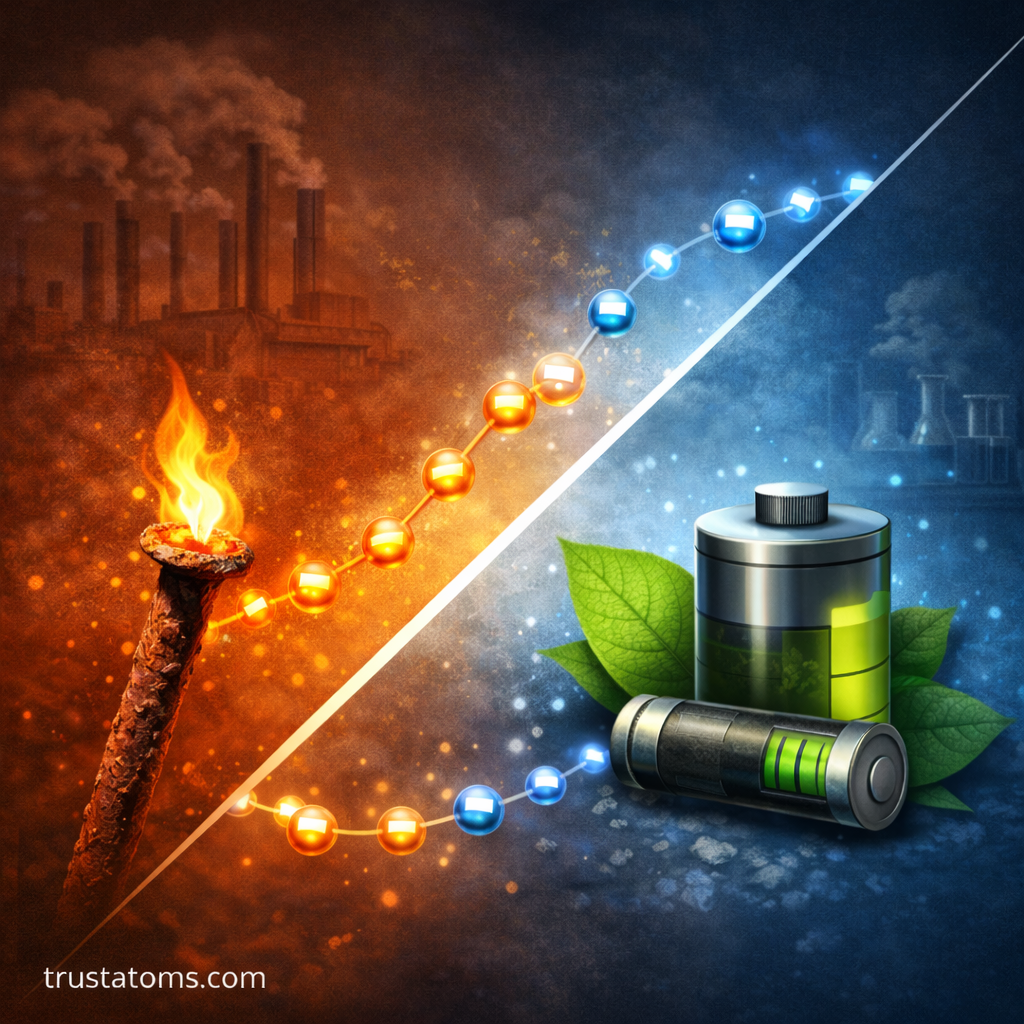
Chemists commonly use two main approaches:
- Oxidation Number Method
- Half-Reaction Method
Each method follows systematic steps to ensure electrons and atoms balance correctly.
The Oxidation Number Method
This method focuses on changes in oxidation states during the reaction.
Step-by-Step Process
- Write the unbalanced equation.
- Assign oxidation numbers to each atom.
- Identify atoms undergoing oxidation and reduction.
- Determine the change in oxidation numbers.
- Balance the electron transfer by adjusting coefficients.
- Balance remaining atoms.
- Verify both mass and charge balance.
Example
Unbalanced reaction:
Fe²⁺ + Cr₂O₇²⁻ → Fe³⁺ + Cr³⁺
In this reaction:
- Iron changes from +2 to +3 (oxidation)
- Chromium changes from +6 to +3 (reduction)
Balancing ensures the total electrons lost by iron equal the electrons gained by chromium.
The Half-Reaction Method
The half-reaction method is widely used because it clearly separates oxidation and reduction processes.
This approach is especially useful in aqueous solutions.
Step-by-Step Method
- Separate the reaction into two half-reactions.
- Balance atoms except hydrogen and oxygen.
- Balance oxygen atoms using water.
- Balance hydrogen atoms using H⁺ ions.
- Balance charge using electrons.
- Multiply half-reactions to equalize electron transfer.
- Add the half-reactions together.
- Cancel identical species on both sides.
Example of Half-Reaction Balancing
Consider a reaction between iron and permanganate ions in acidic solution.
Half-reaction 1 (oxidation):
Fe²⁺ → Fe³⁺ + e⁻
Half-reaction 2 (reduction):
MnO₄⁻ → Mn²⁺
Additional steps add water, hydrogen ions, and electrons to balance the equation.
The final balanced equation correctly accounts for both atoms and charge.
Redox Balancing in Acidic vs Basic Solutions
Balancing redox reactions depends on whether the solution is acidic or basic.
Acidic Solution
In acidic environments:
- Hydrogen ions (H⁺) are used to balance hydrogen
- Water (H₂O) balances oxygen
This approach is common in laboratory chemistry and electrochemistry.
Basic Solution
In basic environments:
- Hydroxide ions (OH⁻) are used
- Any hydrogen ions are neutralized by adding OH⁻ to both sides
- Water may be formed as a product
These additional steps ensure charge neutrality in alkaline conditions.
Common Mistakes When Balancing Redox Equations
Students often encounter several challenges when learning redox balancing.
Frequent Errors
- Forgetting to balance charge as well as atoms
- Misidentifying which species is oxidized or reduced
- Ignoring the reaction environment (acidic vs basic)
- Failing to equalize electron transfer between half-reactions
- Leaving electrons in the final balanced equation
Careful step-by-step verification helps prevent these mistakes.
Applications of Redox Reactions in Real Life
Redox reactions appear throughout science and technology.
Everyday Examples
- Batteries generating electrical energy
- Rust forming on iron surfaces
- Combustion of fuels
- Photosynthesis in plants
- Cellular respiration in living organisms
Balancing these reactions allows chemists to model and predict how energy and matter move through chemical systems.
Final Thoughts
Redox balancing is a core skill in chemistry that reveals how electrons move during chemical reactions. By carefully tracking oxidation states and ensuring electrons lost equal electrons gained, chemists can accurately represent complex chemical processes.
Whether studying corrosion, electrochemistry, environmental systems, or biological metabolism, balanced redox equations provide a clear and consistent way to understand how chemical transformations occur.
Mastering the oxidation number method and the half-reaction method equips students and scientists with essential tools for analyzing chemical reactions and applying chemistry principles to real-world challenges.