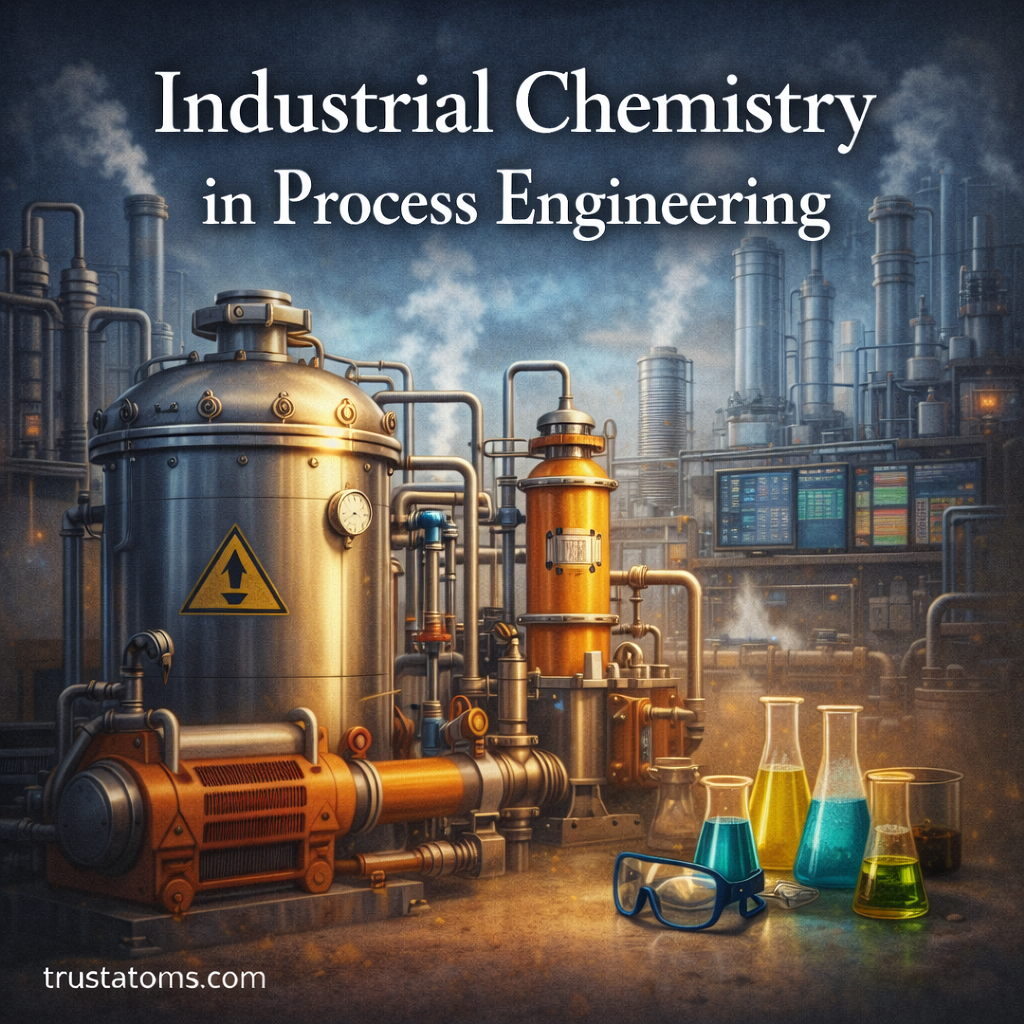
Industrial chemistry plays a critical role in modern manufacturing and production systems. It focuses on transforming raw materials into useful products through controlled chemical processes. In large-scale industries such as pharmaceuticals, energy, agriculture, and materials production, chemical reactions must be carefully managed to ensure efficiency, safety, and economic viability.
Process engineering bridges the gap between laboratory chemistry and full-scale industrial production. It applies chemistry, physics, and engineering principles to design systems that can safely produce chemicals at large volumes while maintaining consistent quality.
Understanding industrial chemistry within process engineering helps explain how everyday products—from fuels and plastics to fertilizers and medicines—are manufactured on a massive scale.
What Is Industrial Chemistry?
Industrial chemistry is the application of chemical principles to large-scale production processes. Unlike laboratory chemistry, which focuses on small experiments, industrial chemistry involves continuous operations that produce chemicals in high quantities.
These operations require careful control of factors such as:
- Temperature
- Pressure
- Reaction time
- Catalyst use
- Material flow rates
Industrial chemists work closely with engineers to design processes that maximize efficiency while minimizing waste and environmental impact.
The Role of Process Engineering
Process engineering focuses on designing, optimizing, and managing chemical production systems.
While chemists understand the reactions themselves, process engineers determine how those reactions can be carried out safely and efficiently on an industrial scale.
Key Responsibilities of Process Engineers
Process engineers typically work on:
- Designing production systems
- Scaling up laboratory reactions
- Optimizing reaction conditions
- Managing energy usage
- Improving production efficiency
- Maintaining safety and environmental standards
Their work ensures that chemical processes run smoothly and economically in manufacturing environments.
Scaling Up Chemical Reactions
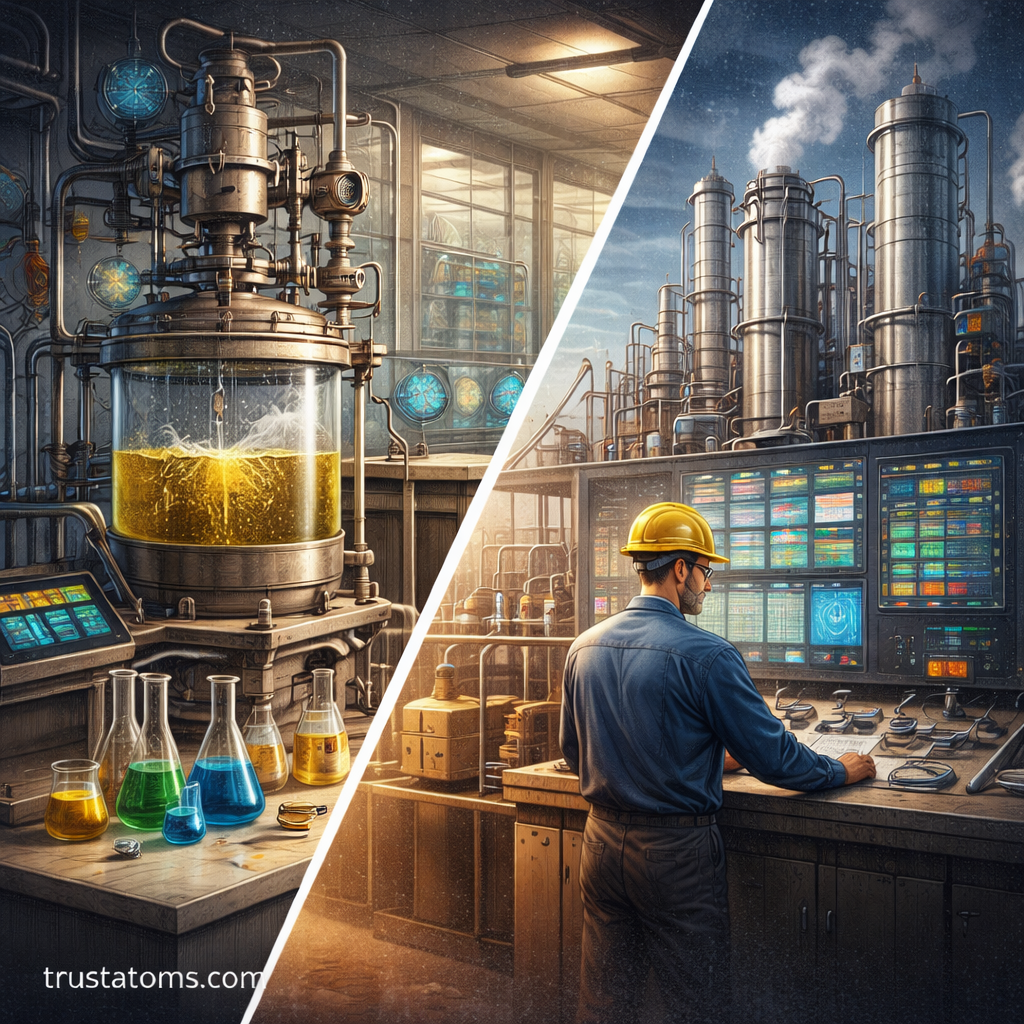
One of the biggest challenges in industrial chemistry is scaling up reactions from laboratory experiments to industrial production.
A reaction that works well in a small flask may behave differently when performed in large reactors containing thousands of liters of material.
Factors That Change During Scale-Up
Several factors must be carefully managed when scaling reactions:
- Heat generation during reactions
- Mixing efficiency
- Reaction kinetics
- Pressure changes
- Material transfer limitations
Process engineers conduct pilot testing and simulations to predict how reactions will behave under industrial conditions.
Chemical Reactors in Industrial Systems
Chemical reactors are the central equipment used in industrial chemical production. These systems provide the controlled environment necessary for chemical reactions to occur.
Common Types of Chemical Reactors
Several reactor designs are used depending on the process requirements.
Batch Reactors
Batch reactors operate in cycles where reactants are loaded, processed, and then removed.
Characteristics include:
- Flexible production
- Useful for pharmaceuticals and specialty chemicals
- Easy to control reaction time
Continuous Flow Reactors
Continuous reactors allow reactants to flow steadily through the system.
Advantages include:
- High efficiency
- Consistent product quality
- Suitable for large-scale production
These reactors are commonly used in petrochemical and chemical manufacturing industries.
Catalytic Reactors
Catalytic reactors use catalysts to accelerate chemical reactions without being consumed.
Benefits include:
- Faster reaction rates
- Lower energy requirements
- Increased product yield
Catalysts play a major role in industrial chemistry, especially in petroleum refining and chemical synthesis.
Separation and Purification Processes
After chemical reactions occur, products must often be separated and purified. Industrial process engineering includes several techniques to achieve this.
Common Separation Methods
- Distillation
- Filtration
- Crystallization
- Extraction
- Membrane separation
Each method depends on differences in properties such as boiling point, solubility, particle size, or chemical affinity.
For example, distillation is widely used in oil refining to separate crude oil into useful fractions like gasoline, diesel, and jet fuel.
Energy Efficiency in Industrial Chemistry
Large-scale chemical production consumes significant energy. Improving energy efficiency is therefore a major focus in process engineering.
Engineers aim to design systems that reduce energy consumption while maintaining production output.
Strategies for Energy Efficiency
Common strategies include:
- Heat recovery systems
- Process optimization
- Improved catalyst performance
- Efficient reactor design
- Waste heat recycling
These improvements reduce operating costs and environmental impact.
Environmental Considerations
Industrial chemistry can affect air, water, and soil if processes are not properly controlled. Environmental protection has become an important aspect of process engineering.
Modern industrial systems include safeguards to reduce emissions and waste.
Environmental Protection Strategies
Industries often implement:
- Waste treatment systems
- Emission control technologies
- Recycling of chemical byproducts
- Green chemistry practices
- Sustainable resource management
These efforts help reduce the environmental footprint of chemical manufacturing.
Automation and Process Control
Modern chemical plants rely heavily on automated control systems to manage complex processes.
Sensors, computers, and monitoring systems track critical variables in real time.
Important Process Variables
Automated systems monitor:
- Temperature
- Pressure
- Flow rates
- Chemical concentrations
- Reaction times
Control systems automatically adjust operating conditions to maintain stable production and prevent unsafe conditions.
Automation also improves product consistency and operational efficiency.
Safety in Industrial Chemical Processes
Because industrial chemical systems involve large quantities of reactive materials, safety is a top priority.
Process engineers design systems with multiple layers of protection.
Safety Measures in Chemical Plants
Common safety practices include:
- Pressure relief systems
- Emergency shutdown procedures
- Hazard monitoring systems
- Proper chemical storage
- Worker safety training
Careful system design helps prevent accidents and protects both workers and surrounding communities.
Real-World Applications of Industrial Chemistry
Industrial chemistry supports a wide range of industries that provide essential products used every day.
Major Industrial Applications
Examples include:
- Fuel production in petroleum refining
- Fertilizer manufacturing for agriculture
- Pharmaceutical drug production
- Plastic and polymer manufacturing
- Food processing and preservation
- Water treatment and purification
These industries rely on process engineering to produce chemicals efficiently and at a scale that meets global demand.
Final Thoughts
Industrial chemistry and process engineering work together to transform laboratory discoveries into large-scale production systems. By combining chemical knowledge with engineering design, industries can manufacture essential products safely, efficiently, and sustainably.
Through innovations in reactor design, energy efficiency, environmental protection, and automation, process engineering continues to improve the way chemicals are produced around the world.
Understanding the principles behind industrial chemistry provides insight into the systems that support modern technology, infrastructure, and everyday life.