Modern materials science increasingly relies on complex inorganic structures that provide unique physical, chemical, and mechanical properties. Among these structures, advanced inorganic frameworks have become essential for designing materials with precise functions at the molecular and atomic scale.
These frameworks consist of metal atoms or clusters connected through inorganic or organic linkers to form extended networks. The resulting structures can create highly ordered architectures with tunable properties.
Advanced inorganic frameworks are now widely studied in fields such as catalysis, energy storage, environmental science, and nanotechnology. Their ability to control molecular interactions and structural stability makes them a powerful tool in modern materials engineering.
What Are Inorganic Frameworks?
Inorganic frameworks are three-dimensional networks of atoms or ions connected by strong chemical bonds, forming stable and often porous structures.
These frameworks are typically built from:
- Metal ions or metal clusters
- Inorganic or organic linking molecules
- Repeating structural units forming extended lattices
The arrangement of these components creates materials with predictable structures and properties.
Key characteristics of inorganic frameworks include:
- Structural stability
- Tunable pore size
- High surface area
- Chemical versatility
These features make them highly useful in advanced technological applications.
Structural Design of Inorganic Frameworks
The design of inorganic frameworks relies on careful selection of building blocks and bonding patterns.
Scientists often design frameworks using two main components:
Metal Nodes
Metal ions or metal clusters act as connection points within the framework.
Common metals used include:
- Zinc
- Copper
- Iron
- Aluminum
- Titanium
These metals can coordinate with multiple ligands, allowing the formation of complex three-dimensional structures.
Linking Units
Linkers connect metal nodes together to create the framework network.
Linkers may be:
- Organic molecules
- Inorganic ligands
- Hybrid compounds
The length and geometry of these linkers influence the shape, porosity, and stability of the resulting material.
Types of Advanced Inorganic Frameworks
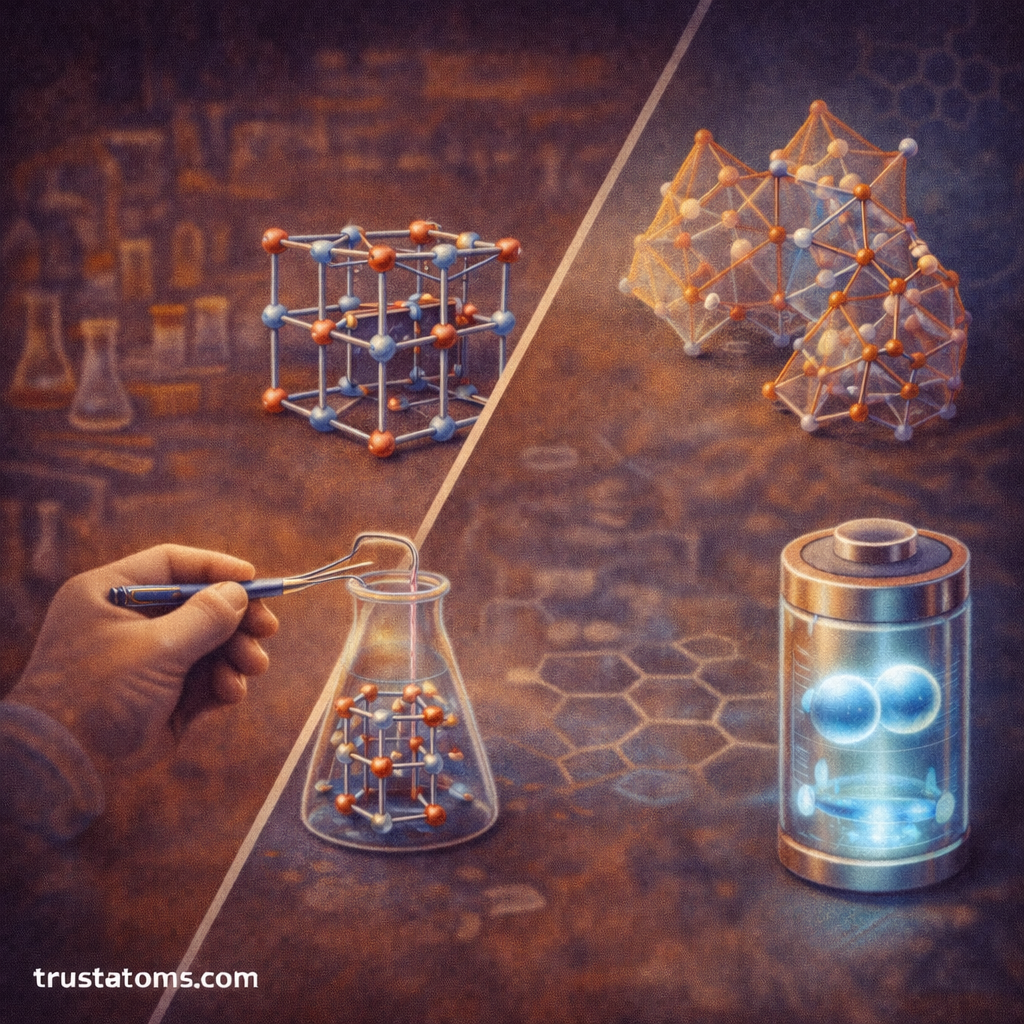
Several major classes of inorganic frameworks are widely studied in materials science.
Metal-Organic Frameworks (MOFs)
Metal-organic frameworks are porous crystalline materials composed of metal ions connected by organic linkers.
MOFs are known for:
- Extremely high surface areas
- Adjustable pore sizes
- Tunable chemical functionality
Because of these properties, MOFs are used for gas storage, catalysis, and chemical sensing.
Zeolites
Zeolites are crystalline aluminosilicate frameworks composed primarily of silicon, aluminum, and oxygen atoms.
These materials form rigid structures with uniform pores.
Important characteristics include:
- High thermal stability
- Strong adsorption capacity
- Shape-selective catalytic activity
Zeolites are widely used in petroleum refining and chemical separation processes.
Covalent Organic Frameworks (COFs)
Covalent organic frameworks are crystalline materials formed through strong covalent bonds between organic molecules.
Although primarily organic in composition, COFs often incorporate inorganic components or hybrid bonding interactions.
These frameworks provide:
- Lightweight structures
- Highly ordered pore systems
- Chemical flexibility
COFs are studied for applications in energy storage, catalysis, and filtration technologies.
Coordination Polymers
Coordination polymers consist of repeating metal-ligand units that extend into one-, two-, or three-dimensional structures.
Unlike some porous frameworks, coordination polymers may form dense crystalline structures with specialized electronic or magnetic properties.
These materials are used in areas such as:
- Molecular electronics
- Magnetic materials
- Optical devices
Properties of Advanced Inorganic Frameworks
Advanced inorganic frameworks exhibit several unique properties that make them valuable for materials science applications.
High Surface Area
Many framework materials contain internal cavities and channels that create extremely high surface areas.
This property allows them to interact efficiently with gases, liquids, and other molecules.
Tunable Porosity
Scientists can control pore size and shape by adjusting the metal nodes and linkers used during synthesis.
Tunable porosity allows frameworks to selectively capture or filter specific molecules.
Chemical Stability
Inorganic frameworks are often highly stable under demanding conditions, including:
- High temperatures
- Chemical exposure
- Mechanical stress
This stability makes them useful in industrial and environmental systems.
Functional Customization
The chemical composition of frameworks can be modified to introduce specific functional groups.
This allows scientists to tailor materials for particular uses such as catalysis or sensing.
Applications in Modern Materials Science
Advanced inorganic frameworks support a wide range of technological applications.
Gas Storage and Separation
Porous frameworks can store gases such as hydrogen, methane, or carbon dioxide within their internal cavities.
This capability is important for:
- Clean energy storage
- Carbon capture technologies
- Industrial gas separation
Catalysis
Framework materials often serve as catalysts or catalyst supports.
Their porous structures allow reactant molecules to enter the framework and interact with active sites.
Applications include:
- Chemical manufacturing
- Fuel production
- Environmental remediation
Energy Storage
Advanced frameworks are being explored for energy technologies such as:
- Battery materials
- Supercapacitors
- Hydrogen storage systems
Their structured networks help control ion movement and energy transfer.
Environmental Applications
Inorganic frameworks are increasingly used for environmental protection.
These materials can help:
- Remove pollutants from water
- Capture greenhouse gases
- Filter toxic chemicals
Their high surface area and tunable chemistry make them effective for environmental cleanup technologies.
Synthesis of Inorganic Framework Materials
Creating advanced inorganic frameworks requires precise chemical synthesis methods.
Common synthesis approaches include:
- Solvothermal synthesis
- Hydrothermal synthesis
- Self-assembly techniques
- Template-assisted growth
These processes allow scientists to control crystal growth and structural organization.
Careful adjustment of reaction conditions such as temperature, solvent, and concentration helps produce frameworks with specific properties.
Challenges in Framework Development
Despite their advantages, advanced inorganic frameworks also present several challenges.
Some current research challenges include:
- Improving long-term stability
- Scaling up industrial production
- Controlling defects in crystal structures
- Enhancing mechanical durability
Researchers continue to develop improved synthesis methods and structural designs to overcome these limitations.
The Future of Inorganic Framework Materials
Advanced inorganic frameworks are expected to play an increasingly important role in next-generation technologies.
Future research directions may include:
- Smart materials with responsive properties
- Advanced catalysts for sustainable chemistry
- High-efficiency energy storage systems
- Improved carbon capture materials
As materials science continues to evolve, inorganic frameworks will remain central to the development of innovative materials with tailored functions.
Final Thoughts
Advanced inorganic frameworks represent one of the most exciting areas of modern materials science. Their highly ordered structures, tunable properties, and wide range of applications make them powerful tools for addressing technological challenges.
By designing frameworks at the molecular level, scientists can create materials capable of storing energy, catalyzing reactions, filtering pollutants, and supporting new technologies. Continued research in this field will help unlock even more possibilities for advanced materials in the future.