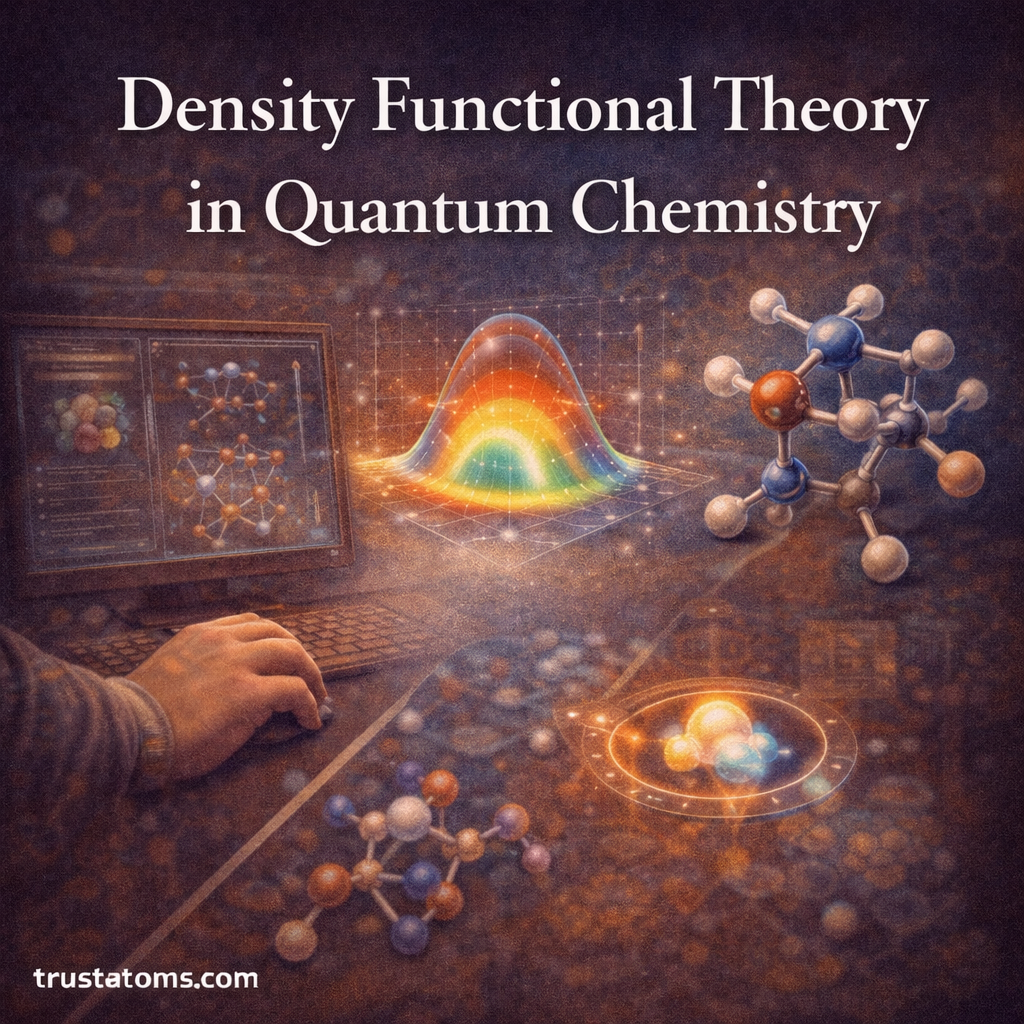
Understanding how electrons behave inside atoms and molecules is one of the most challenging problems in chemistry. Because electrons interact with each other and move according to the laws of quantum mechanics, accurately predicting their behavior requires advanced mathematical models.
One of the most widely used approaches for studying electronic structure is Density Functional Theory (DFT). DFT allows scientists to calculate the properties of atoms, molecules, and materials by focusing on electron density rather than tracking each electron individually.
Today, Density Functional Theory plays a central role in quantum chemistry, materials science, nanotechnology, and molecular physics. It allows researchers to investigate chemical systems with high accuracy while keeping computational costs manageable.
What Is Density Functional Theory?
Density Functional Theory is a computational method used to study the electronic structure of atoms, molecules, and solids.
Instead of calculating the complex wavefunction of every electron, DFT focuses on a simpler quantity known as electron density.
Electron density describes the probability of finding an electron at a particular point in space around a molecule or atom.
This approach simplifies quantum calculations while still capturing the essential physics of electron behavior.
Using electron density, DFT can help scientists determine:
- Molecular geometry
- Bond strength
- Reaction energy
- Electronic properties
- Magnetic and optical behavior
Because of its balance between accuracy and efficiency, DFT has become one of the most commonly used tools in theoretical chemistry.
The Concept of Electron Density

Electron density is the central concept behind Density Functional Theory.
Rather than describing each electron separately, DFT represents the distribution of electrons throughout a molecule or material as a continuous function.
This density function tells scientists:
- Where electrons are most likely to be located
- How electrons interact with atomic nuclei
- How electron distribution changes during chemical reactions
By analyzing electron density, researchers can understand how molecules form bonds and how chemical properties arise from electronic structure.
Foundations of Density Functional Theory
Density Functional Theory is built on important theoretical principles developed in the mid-20th century.
Two foundational concepts define the theory.
The First Principle: Electron Density Determines All Properties
The first principle states that the ground-state electron density uniquely determines the properties of a quantum system.
This means that if the electron density is known, the energy and other properties of the system can be calculated.
This insight dramatically simplified quantum chemistry calculations.
The Second Principle: Energy Minimization
The second principle states that the correct electron density minimizes the total energy of the system.
In practice, computational methods search for the electron density distribution that produces the lowest possible energy.
This lowest-energy configuration corresponds to the most stable molecular structure.
Exchange and Correlation Effects
One of the key challenges in Density Functional Theory is accounting for interactions between electrons.
Electrons influence each other through two major effects:
Exchange Effects
Exchange interactions arise from the quantum mechanical nature of electrons and their spin properties.
These interactions influence how electrons avoid occupying the same region of space.
Correlation Effects
Correlation effects describe how electrons move in response to the positions of other electrons.
Because electrons repel each other electrically, their motion becomes correlated.
Approximating these exchange and correlation effects is one of the central challenges in DFT calculations.
Different mathematical approximations are used to model these interactions with increasing accuracy.
Types of Density Functionals
In Density Functional Theory, mathematical expressions called functionals are used to estimate the system’s energy based on electron density.
Several types of functionals are commonly used in computational chemistry.
Local Density Approximation (LDA)
The Local Density Approximation assumes that electron density behaves similarly to that of a uniform electron gas.
While simple, this approximation can provide useful results for certain systems, especially solid materials.
Generalized Gradient Approximation (GGA)
The Generalized Gradient Approximation improves accuracy by including information about how electron density changes across space.
GGA functionals are widely used because they provide a good balance between accuracy and computational cost.
Hybrid Functionals
Hybrid functionals combine Density Functional Theory with elements of other quantum mechanical methods.
These functionals often provide higher accuracy when predicting molecular energies and reaction properties.
Hybrid methods are commonly used in modern computational chemistry studies.
Applications of Density Functional Theory
Density Functional Theory is used across many areas of chemistry and materials science.
Molecular Structure Prediction
DFT can determine the stable geometry of molecules by identifying the lowest-energy arrangement of atoms.
This helps scientists understand how molecules form and behave.
Chemical Reaction Studies
Researchers use DFT to analyze reaction pathways and calculate reaction energies.
This helps identify:
- Reaction intermediates
- Activation barriers
- Product stability
These insights support the design of more efficient chemical processes.
Materials Science
DFT plays a critical role in designing new materials with tailored properties.
Scientists use it to study:
- Semiconductors
- Magnetic materials
- Catalysts
- Nanostructures
Understanding electronic structure helps researchers develop advanced materials for energy and technology applications.
Catalysis Research
Catalysts accelerate chemical reactions by lowering activation energy.
Density Functional Theory helps researchers understand how catalysts interact with reactant molecules at the atomic level.
This knowledge supports the design of improved industrial catalysts.
Advantages of Density Functional Theory
DFT offers several advantages compared to other quantum chemistry methods.
Key benefits include:
- Efficient calculations for large systems
- Good balance between accuracy and speed
- Ability to model complex molecules and materials
- Wide availability in computational chemistry software
Because of these advantages, DFT is widely used in both academic and industrial research.
Limitations of Density Functional Theory
Despite its usefulness, Density Functional Theory has limitations.
Some challenges include:
- Approximations in exchange-correlation functionals
- Difficulty modeling weak interactions accurately
- Limited accuracy for certain excited states
- Dependence on the choice of functional
Researchers continue developing improved functionals and computational methods to overcome these limitations.
The Future of Density Functional Theory
Density Functional Theory continues to evolve as computational power increases and new theoretical approaches emerge.
Future developments may include:
- Improved exchange-correlation models
- Integration with machine learning techniques
- Better modeling of complex materials
- More accurate simulations of chemical reactions
These advancements will expand the ability of scientists to simulate chemical systems with greater precision.
Final Thoughts
Density Functional Theory has revolutionized quantum chemistry by providing a practical way to study electronic structure in atoms, molecules, and materials. By focusing on electron density rather than complex wavefunctions, DFT makes it possible to analyze large and complex chemical systems efficiently.
As computational methods continue to advance, Density Functional Theory will remain a cornerstone of theoretical chemistry, enabling scientists to design new materials, explore reaction mechanisms, and deepen our understanding of molecular behavior.