Statistical thermodynamics connects microscopic molecular behavior with the macroscopic properties we observe in chemical systems. While classical thermodynamics focuses on bulk measurements such as temperature, pressure, and energy, statistical thermodynamics explains these properties by analyzing the behavior of individual atoms and molecules.
In chemical analysis, this approach allows scientists to understand reaction probabilities, molecular energy distributions, and equilibrium behavior. By combining probability theory with thermodynamics, statistical thermodynamics provides powerful tools for predicting chemical processes and interpreting experimental data.
What Is Statistical Thermodynamics?
Statistical thermodynamics is the branch of physical chemistry that uses statistical methods to relate microscopic molecular properties to macroscopic thermodynamic quantities.
Instead of studying a single molecule, the theory considers large numbers of molecules and calculates the average behavior of the system.
Key thermodynamic properties explained through statistical methods include:
- Temperature
- Entropy
- Free energy
- Internal energy
- Heat capacity
These properties emerge from the collective motion and energy distribution of countless particles.
Why Statistical Thermodynamics Matters in Chemical Analysis
Chemical analysis often involves understanding how molecules behave in different environments. Statistical thermodynamics helps explain why reactions occur, how molecules distribute energy, and how systems reach equilibrium.
Applications in chemical analysis include:
- Predicting reaction feasibility
- Interpreting spectroscopy results
- Modeling gas and solution behavior
- Understanding molecular energy states
- Calculating equilibrium constants
This theoretical framework allows chemists to interpret experimental data with deeper molecular insight.
Microstates and Macrostates
A central concept in statistical thermodynamics is the relationship between microstates and macrostates.
Microstates
A microstate represents one specific arrangement of particles and energy in a system.
Examples of microstates include:
- Individual molecular positions
- Specific molecular velocities
- Particular energy level assignments
Each microstate describes the system at the most detailed level.
Macrostates
A macrostate describes the overall observable properties of the system, such as temperature or pressure.
Many different microstates can correspond to the same macrostate. For example, a gas sample with a certain temperature and pressure may have billions of possible molecular arrangements that produce the same measured conditions.
The greater the number of microstates associated with a macrostate, the more probable that state becomes.
The Role of Probability in Molecular Systems
Because molecular motion is random and complex, statistical thermodynamics relies heavily on probability theory.
Rather than predicting the behavior of individual molecules, the theory calculates the likelihood of different energy distributions within the system.
Important ideas include:
- Systems naturally move toward the most probable state
- Energy is distributed across molecules in predictable patterns
- Equilibrium corresponds to maximum probability
These probability-based principles allow chemists to explain why systems evolve toward stable thermodynamic conditions.
The Boltzmann Distribution
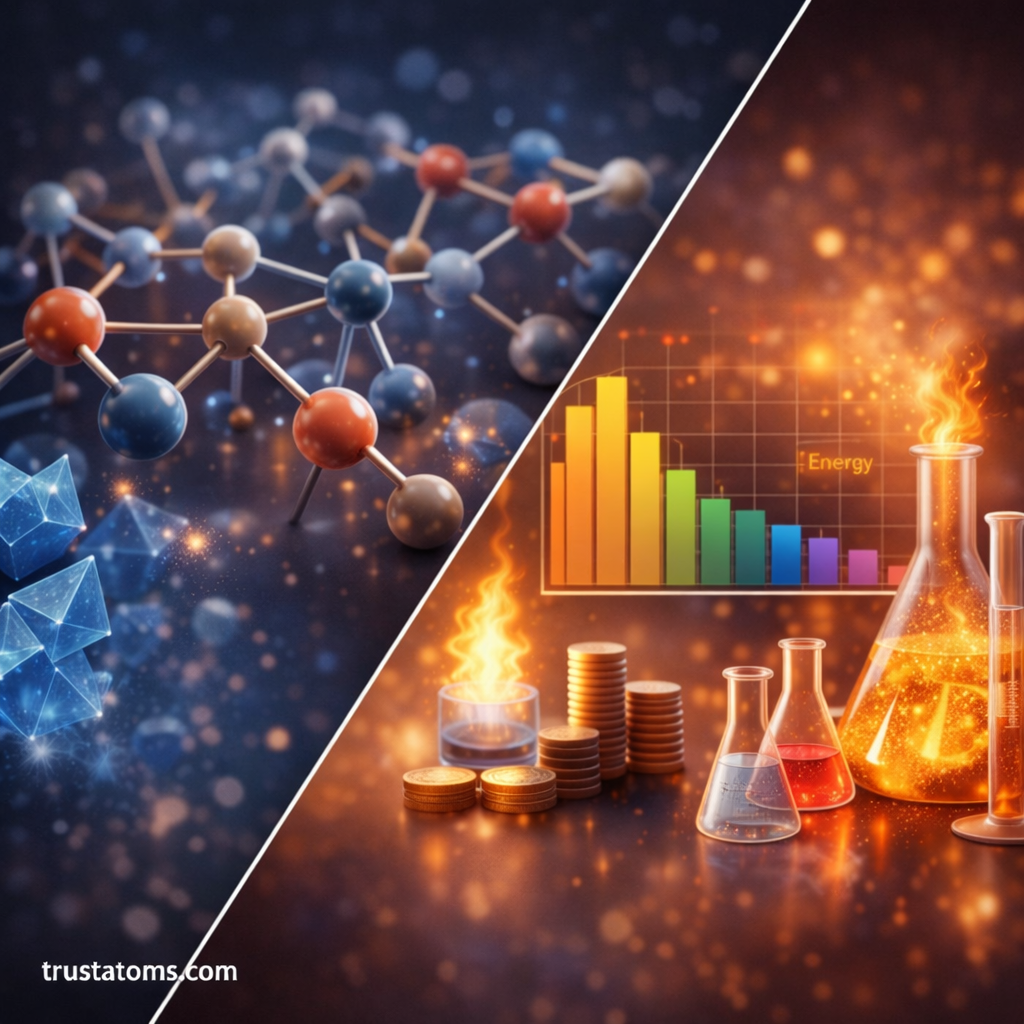
One of the most important concepts in statistical thermodynamics is the Boltzmann distribution.
This distribution describes how molecules occupy different energy levels at a given temperature.
According to the Boltzmann distribution:
- Lower energy states are more populated than higher energy states
- Higher temperatures increase the population of higher energy levels
- Energy distribution follows an exponential probability pattern
In chemical analysis, this concept helps explain phenomena such as:
- Reaction rate changes with temperature
- Spectral line intensities
- Molecular excitation levels
Understanding these distributions is essential for interpreting experimental observations in many branches of chemistry.
Partition Functions
The partition function is one of the central mathematical tools in statistical thermodynamics. It summarizes all possible energy states available to a molecular system.
The partition function allows scientists to calculate important thermodynamic properties, including:
- Internal energy
- Entropy
- Free energy
- Heat capacity
By evaluating the partition function for a system, chemists can predict how molecular energy levels contribute to measurable thermodynamic quantities.
Partition functions often include contributions from several types of molecular motion:
- Translational motion
- Rotational motion
- Vibrational motion
- Electronic energy states
Each of these motions influences the overall thermodynamic behavior of molecules.
Statistical Thermodynamics and Chemical Equilibrium
Chemical equilibrium occurs when forward and reverse reaction rates become equal. Statistical thermodynamics provides a molecular explanation for why equilibrium occurs and how it can be predicted.
Equilibrium constants can be derived using statistical models that account for:
- Molecular energy levels
- Molecular degeneracy
- Temperature effects
- Partition functions
Through this framework, chemists can calculate equilibrium constants based on molecular properties rather than relying solely on experimental measurements.
Applications in Modern Chemical Analysis
Statistical thermodynamics supports many modern analytical techniques and chemical investigations.
Spectroscopy
Spectroscopic methods rely on transitions between molecular energy levels. Statistical thermodynamics explains the distribution of molecules across these energy states.
Examples include:
- Infrared spectroscopy
- UV–visible spectroscopy
- Raman spectroscopy
Reaction Rate Studies
Reaction kinetics often depend on the fraction of molecules with sufficient energy to overcome reaction barriers. Statistical models help explain these distributions.
Environmental and Atmospheric Chemistry
Statistical thermodynamics helps scientists model gas behavior, chemical equilibrium, and energy transfer in atmospheric systems.
Materials and Surface Chemistry
In materials science, statistical methods help explain adsorption, catalysis, and surface reactions.
Entropy and Molecular Disorder
Entropy is a key concept linking thermodynamics and probability. In statistical thermodynamics, entropy measures the number of possible microstates available to a system.
The relationship can be summarized as:
- More microstates correspond to higher entropy
- Systems naturally evolve toward higher entropy states
- Greater molecular disorder increases entropy
This microscopic interpretation explains why many chemical processes proceed spontaneously under certain conditions.
Limitations and Challenges
While statistical thermodynamics is extremely powerful, it also faces several challenges.
Some limitations include:
- Complex calculations for large molecular systems
- Dependence on approximations and computational methods
- Difficulty modeling highly interactive or biological systems
Despite these challenges, advances in computing and molecular simulation continue to expand the field.
Conclusion
Statistical thermodynamics provides a crucial bridge between microscopic molecular behavior and the macroscopic properties measured in chemical systems. By applying probability theory to large collections of molecules, chemists can explain energy distributions, reaction probabilities, and equilibrium behavior.
Through tools such as the Boltzmann distribution and partition functions, statistical thermodynamics allows scientists to predict and interpret chemical phenomena with remarkable precision. As computational chemistry continues to advance, this field will remain essential for understanding complex chemical systems and improving analytical techniques.