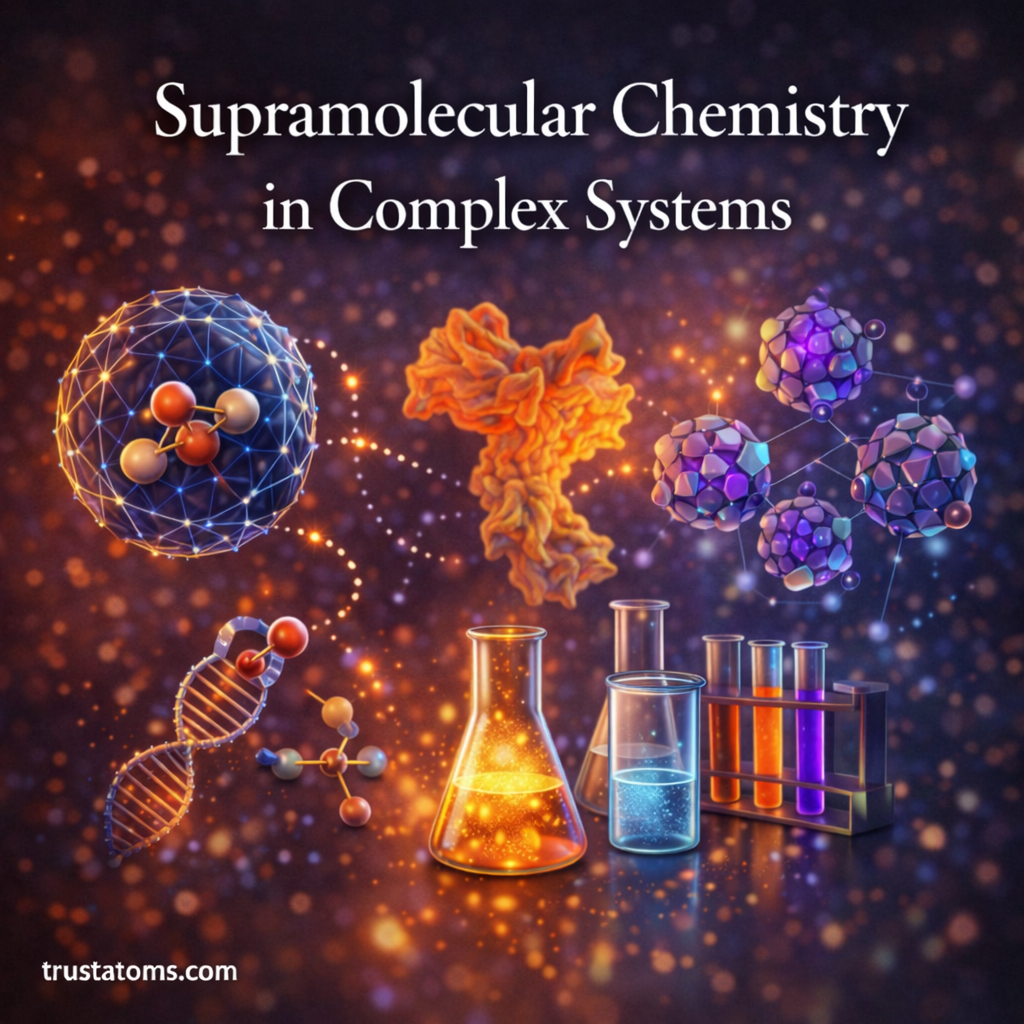
Supramolecular chemistry focuses on how molecules interact with one another through non-covalent forces rather than traditional chemical bonds. Instead of studying individual molecules alone, this field examines how groups of molecules assemble, organize, and function together in larger structures.
In complex systems, these molecular interactions can lead to highly organized arrangements such as molecular cages, host–guest complexes, self-assembled materials, and biological structures. Supramolecular chemistry plays an essential role in fields such as nanotechnology, drug delivery, materials science, and molecular biology.
What Is Supramolecular Chemistry?
Supramolecular chemistry is often described as “chemistry beyond the molecule.” It studies how molecules recognize and bind to one another through weak, reversible interactions.
These interactions include:
- Hydrogen bonding
- Van der Waals forces
- Electrostatic attractions
- π–π stacking interactions
- Hydrophobic interactions
Unlike covalent bonds, these forces are weaker and reversible. However, when many such interactions occur simultaneously, they can produce stable and highly organized molecular assemblies.
The Importance of Non-Covalent Interactions
Non-covalent interactions are the foundation of supramolecular chemistry. While each interaction is relatively weak, their combined effects can create strong and highly selective molecular structures.
Key characteristics of non-covalent interactions include:
- Reversible bonding
- Molecular recognition
- Structural flexibility
- Self-assembly capabilities
These properties allow complex systems to form and adapt dynamically, which is essential in biological and synthetic molecular systems.
Molecular Recognition
One of the central concepts in supramolecular chemistry is molecular recognition. This process occurs when molecules selectively bind to one another due to complementary shapes, charges, or chemical properties.
Molecular recognition is often compared to a lock-and-key mechanism, where a host molecule selectively binds a guest molecule.
Examples of molecular recognition include:
- Enzyme–substrate interactions
- DNA base pairing
- Receptor–ligand binding
- Synthetic host–guest complexes
This selective binding allows molecules to perform specific functions within complex systems.
Host–Guest Chemistry
Host–guest chemistry is a major area within supramolecular chemistry. In this arrangement, one molecule (the host) forms a cavity or binding site that can hold another molecule (the guest).
The host molecule typically provides a structured environment that stabilizes the guest through non-covalent interactions.
Examples of host structures include:
- Cyclodextrins
- Crown ethers
- Calixarenes
- Cucurbiturils
These molecules can selectively bind ions, organic compounds, or small molecules, making them useful in chemical sensing, catalysis, and drug delivery.
Self-Assembly in Molecular Systems
Self-assembly is the spontaneous organization of molecules into ordered structures without external guidance.
In supramolecular chemistry, self-assembly occurs when molecules interact through non-covalent forces and arrange themselves into stable configurations.
Common self-assembled structures include:
- Molecular capsules
- Supramolecular polymers
- Liquid crystals
- Nanostructured materials
Self-assembly plays a critical role in both natural and synthetic systems. For example, biological membranes form through the self-assembly of lipid molecules.
Supramolecular Polymers
Unlike traditional polymers held together by covalent bonds, supramolecular polymers rely on reversible non-covalent interactions between repeating units.
These materials offer several advantages:
- Dynamic bonding behavior
- Self-healing capabilities
- Responsive structural changes
- Reversible assembly and disassembly
Because of these properties, supramolecular polymers are being explored for advanced materials such as responsive coatings, biomedical devices, and smart materials.
Supramolecular Chemistry in Biological Systems
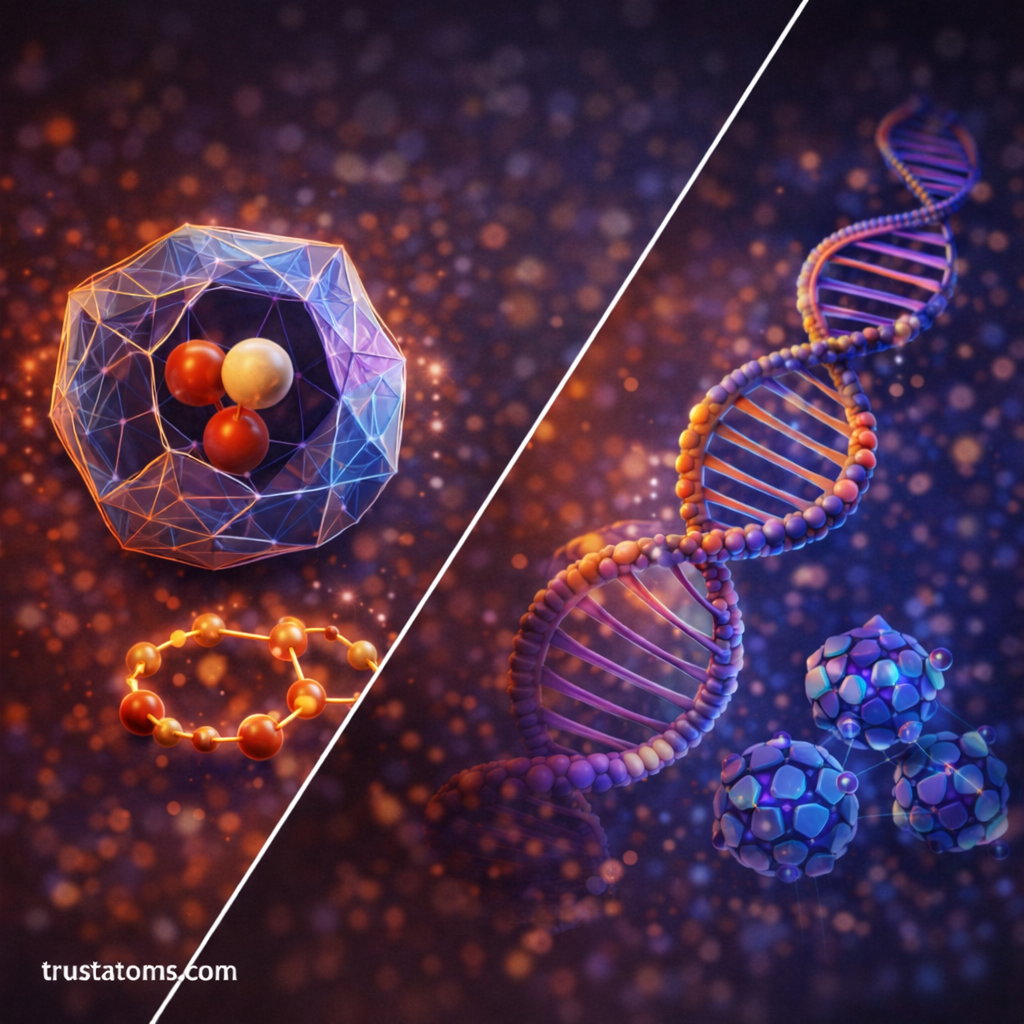
Many biological structures rely heavily on supramolecular interactions.
Important examples include:
DNA Structure
DNA strands are held together by hydrogen bonds between complementary base pairs, forming the well-known double helix structure.
Protein Folding
Proteins fold into specific three-dimensional structures through a combination of hydrogen bonding, hydrophobic interactions, and electrostatic forces.
Cell Membranes
Cell membranes form through the self-assembly of phospholipids, which organize into bilayers due to hydrophobic interactions.
These biological systems demonstrate how supramolecular chemistry governs many essential life processes.
Applications of Supramolecular Chemistry
Supramolecular chemistry has many practical applications across science and technology.
Drug Delivery Systems
Supramolecular host–guest complexes can encapsulate drug molecules and release them at specific locations in the body.
Molecular Sensors
Supramolecular systems can detect chemical substances by selectively binding target molecules.
Catalysis
Supramolecular catalysts create specialized environments that accelerate chemical reactions.
Nanotechnology
Self-assembled molecular structures help create nanoscale materials and devices.
Smart Materials
Responsive supramolecular materials can change properties when exposed to stimuli such as temperature, light, or pH.
Supramolecular Chemistry and Complex Systems
In complex systems, supramolecular interactions allow molecules to organize into large, cooperative networks.
These systems often exhibit emergent behavior, meaning the collective properties of the system are greater than the sum of its individual components.
Examples include:
- Biological molecular machines
- Molecular self-repair systems
- Artificial molecular networks
- Responsive nanomaterials
Understanding these systems helps scientists design new materials and technologies inspired by natural molecular organization.
Challenges in Supramolecular Chemistry
Despite its rapid growth, supramolecular chemistry faces several challenges.
Some of the main difficulties include:
- Controlling molecular assembly with high precision
- Predicting complex interaction networks
- Maintaining stability in dynamic systems
- Scaling supramolecular systems for industrial applications
Researchers continue to develop new techniques and computational tools to overcome these challenges.
The Future of Supramolecular Chemistry
The field of supramolecular chemistry continues to expand as scientists explore more complex molecular systems.
Emerging research areas include:
- Artificial molecular machines
- Programmable molecular assemblies
- Bio-inspired materials
- Molecular electronics
- Advanced nanotechnology
These developments may lead to breakthroughs in medicine, energy storage, and advanced materials.
Conclusion
Supramolecular chemistry explores how molecules interact and assemble through non-covalent forces to form complex systems. By studying molecular recognition, host–guest interactions, and self-assembly, chemists can understand and design sophisticated molecular structures.
From biological systems to advanced nanomaterials, supramolecular chemistry provides powerful insights into how molecules cooperate to create functional structures. As research progresses, this field will continue to shape innovations in materials science, biotechnology, and molecular engineering.