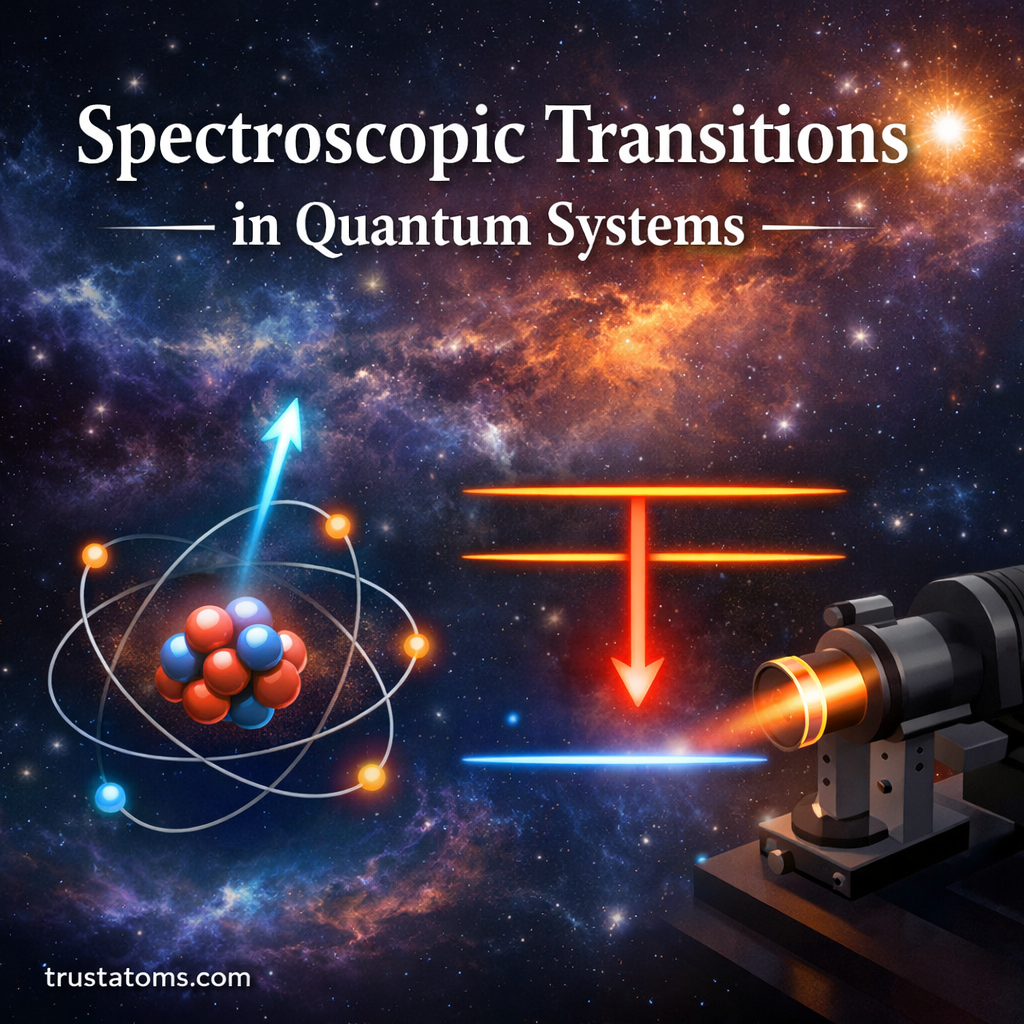
Spectroscopic transitions are fundamental processes that occur when atoms, molecules, or other quantum systems absorb or emit energy. These transitions reveal how electrons move between discrete energy levels, producing the spectral lines scientists observe in spectroscopy experiments.
From identifying elements in distant stars to understanding molecular structures in chemistry labs, spectroscopic transitions provide a powerful window into the quantum world.
In this guide, we’ll explore how spectroscopic transitions work, why they occur, and why they are essential in modern chemistry and physics.
What Are Spectroscopic Transitions?
A spectroscopic transition occurs when a particle within a quantum system—usually an electron—moves between two quantized energy states.
Because quantum systems have discrete energy levels, electrons cannot occupy energies in between. Instead, they transition abruptly from one level to another when interacting with electromagnetic radiation.
These transitions occur when energy is either:
- Absorbed from incoming radiation
- Emitted as radiation when a system relaxes
The energy difference between the two states determines the frequency (or wavelength) of the radiation involved.
This relationship is often described conceptually as:
Energy difference between levels = energy of the photon involved in the transition.
This principle forms the basis of spectroscopy, a scientific technique used to analyze the composition and structure of matter.
Energy Levels in Quantum Systems
In classical physics, particles can have any energy value. Quantum systems behave very differently.
Electrons in atoms and molecules occupy specific allowed energy states called quantized energy levels.
Key characteristics of quantum energy levels include:
- Each level has a precise energy value
- Electrons cannot exist between levels
- Transitions occur only when the exact energy difference is matched
For example:
- When energy is absorbed, an electron moves to a higher energy level (excitation).
- When energy is released, the electron falls to a lower energy level (relaxation).
These transitions produce unique spectral signatures for every element or molecule.
Types of Spectroscopic Transitions
Different spectroscopic transitions occur depending on the structure of the quantum system and the type of energy interaction involved.
Electronic Transitions
Electronic transitions occur when electrons move between orbitals in atoms or molecules.
These transitions typically involve relatively large energy differences and are often observed in the:
- Ultraviolet region
- Visible light region
Examples include:
- Atomic emission spectra
- Molecular UV–visible absorption spectra
Electronic transitions are commonly used in chemical analysis and materials science.
Vibrational Transitions
In molecules, atoms are connected by chemical bonds that can vibrate.
Vibrational transitions occur when a molecule absorbs energy that changes the vibrational motion of these bonds.
These transitions typically occur in the infrared region of the electromagnetic spectrum.
Infrared spectroscopy uses vibrational transitions to:
- Identify functional groups
- Analyze molecular structures
- Detect chemical compounds
Rotational Transitions
Rotational transitions occur when molecules change their rotational energy states.
These transitions require relatively small energy differences and are typically detected in the:
- Microwave region of the electromagnetic spectrum
Rotational spectroscopy is especially useful for studying:
- Gas-phase molecules
- Molecular geometry
- Bond lengths
Absorption vs. Emission Transitions
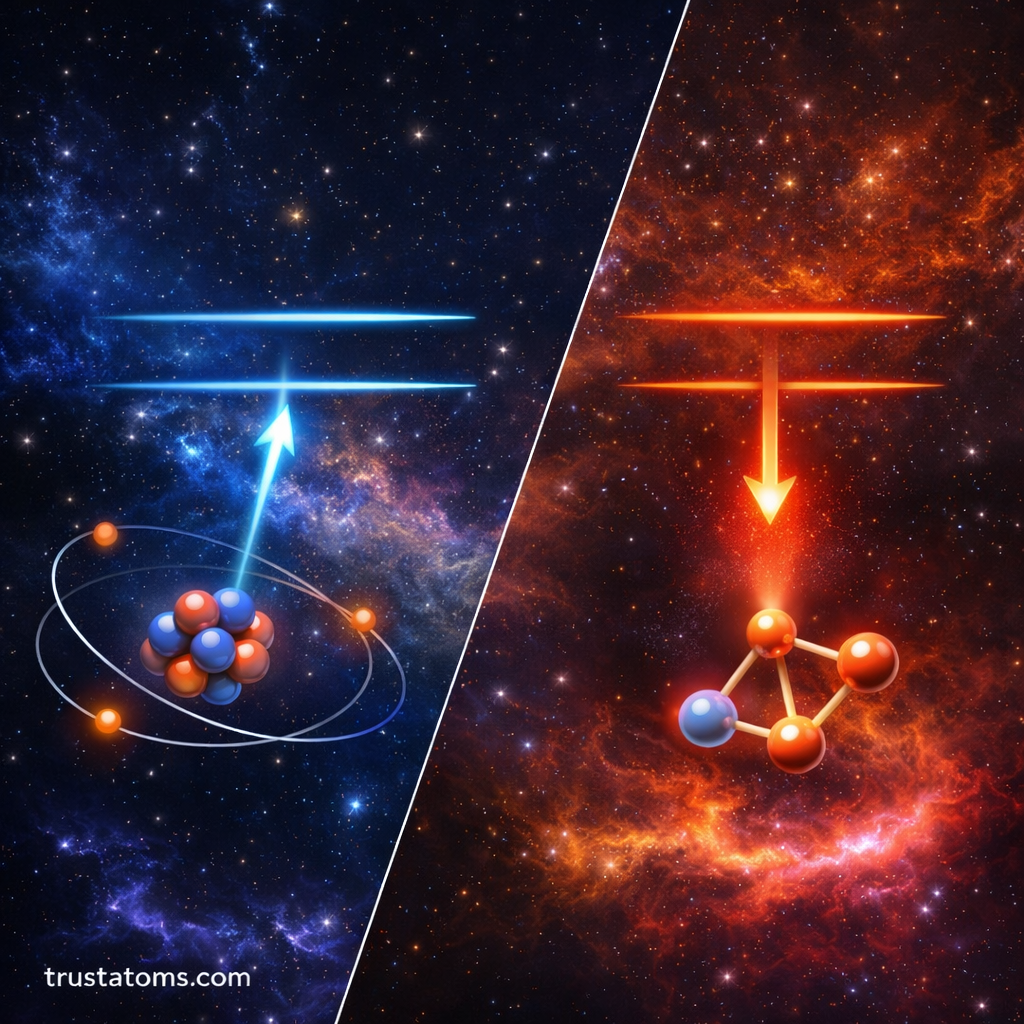
Spectroscopic transitions can occur through either absorption or emission processes.
Absorption Transitions
During absorption:
- A photon interacts with a quantum system
- The system gains energy
- An electron moves to a higher energy level
The absorbed photon disappears because its energy is transferred into the system.
This process produces absorption spectra, where specific wavelengths are removed from incoming light.
Emission Transitions
Emission occurs when an excited system releases energy.
Steps involved include:
- The system begins in an excited state
- The electron drops to a lower energy level
- A photon is emitted carrying away the energy difference
This process produces emission spectra, where bright spectral lines appear at specific wavelengths.
Selection Rules in Spectroscopy
Not every possible transition between energy levels can occur. Quantum mechanics imposes restrictions called selection rules.
Selection rules determine whether a transition is:
- Allowed (high probability)
- Forbidden (extremely low probability)
These rules depend on factors such as:
- Angular momentum changes
- Molecular symmetry
- Spin properties
Although forbidden transitions can sometimes occur, they are typically much weaker.
Selection rules help scientists interpret spectroscopic data accurately.
Why Spectroscopic Transitions Matter
Spectroscopic transitions are essential for understanding matter at the atomic and molecular level.
Their applications span many scientific fields.
Chemistry applications include:
- Identifying unknown substances
- Studying reaction mechanisms
- Determining molecular structures
Physics and astronomy applications include:
- Identifying elements in stars
- Measuring cosmic gas composition
- Studying plasma behavior
In environmental science, spectroscopy helps detect pollutants and analyze atmospheric chemistry.
Because each substance produces unique spectral patterns, spectroscopic transitions function like a fingerprint of matter.
Common Spectroscopic Techniques
Several analytical methods rely on spectroscopic transitions.
Important examples include:
UV–Visible Spectroscopy
Used to study electronic transitions in molecules and atoms.
Common uses:
- Measuring concentration of chemical solutions
- Studying molecular electronic structure
Infrared (IR) Spectroscopy
Focuses on vibrational transitions in molecules.
Widely used for:
- Functional group identification
- Organic compound analysis
Nuclear Magnetic Resonance (NMR)
Examines transitions of nuclear spin states in magnetic fields.
Applications include:
- Determining molecular structure
- Characterizing organic molecules
Microwave Spectroscopy
Analyzes rotational transitions in molecules.
Useful for:
- Measuring bond lengths
- Determining molecular geometry
Spectroscopy and Quantum Mechanics
Spectroscopic transitions provide direct evidence for the principles of quantum mechanics.
They demonstrate that:
- Energy is quantized
- Atomic and molecular systems have discrete states
- Matter interacts with radiation in predictable ways
Without spectroscopy, much of our understanding of atomic structure and molecular behavior would remain hidden.
Modern technologies—from medical imaging to astronomical observations—rely on these quantum interactions.
Final Thoughts
Spectroscopic transitions are one of the most powerful tools for exploring the microscopic world. By observing how quantum systems absorb and emit energy, scientists can uncover detailed information about atoms, molecules, and materials.
From identifying elements in distant galaxies to analyzing chemical reactions in laboratories, spectroscopy continues to shape modern science. Understanding spectroscopic transitions not only reveals how quantum systems behave but also provides the foundation for many technologies used in chemistry, physics, and beyond.