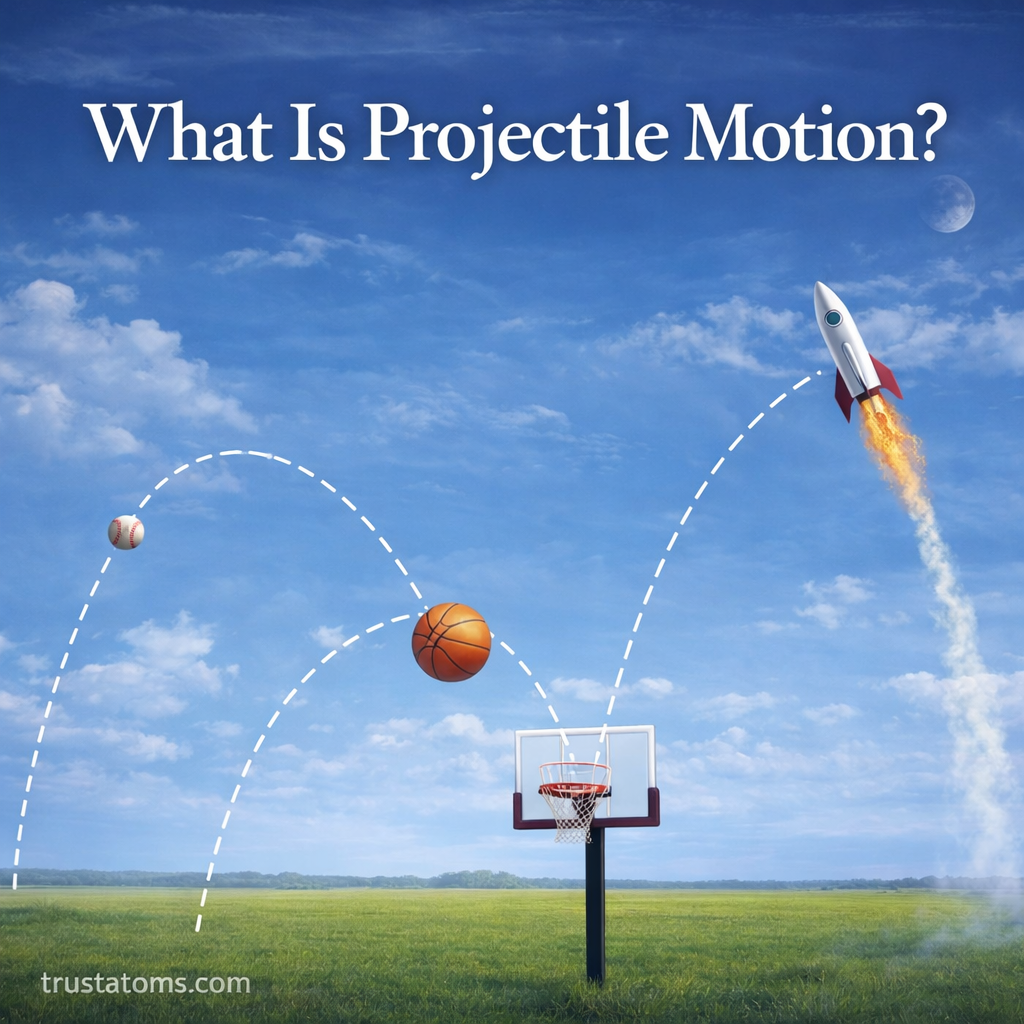
Projectile motion describes how an object moves through the air when it is launched and influenced only by gravity (ignoring air resistance).
From a thrown baseball to a launched rocket, projectile motion explains the curved path objects follow when they move under gravity alone.
In this guide, you’ll learn:
- What projectile motion is
- Why the path is curved
- The two components of motion
- Key formulas
- Real-world examples
What Is Projectile Motion?
Projectile motion is the motion of an object that is thrown, launched, or projected into the air and then moves under the influence of gravity only.
A projectile can be:
- A kicked soccer ball
- A thrown rock
- A fired cannonball
- A stream of water from a hose
Once released, the only force acting on it (in basic physics problems) is gravity.
This causes the object to follow a curved path called a trajectory.
Why Is the Path Curved?
The curved shape happens because two motions occur at the same time:
- Horizontal motion
- Vertical motion
These motions are independent of each other.
Gravity only affects vertical motion. It does not affect horizontal motion (assuming no air resistance).
Because of this:
- The horizontal speed remains constant.
- The vertical speed changes due to gravity.
This combination creates a parabolic path.
The Two Components of Projectile Motion
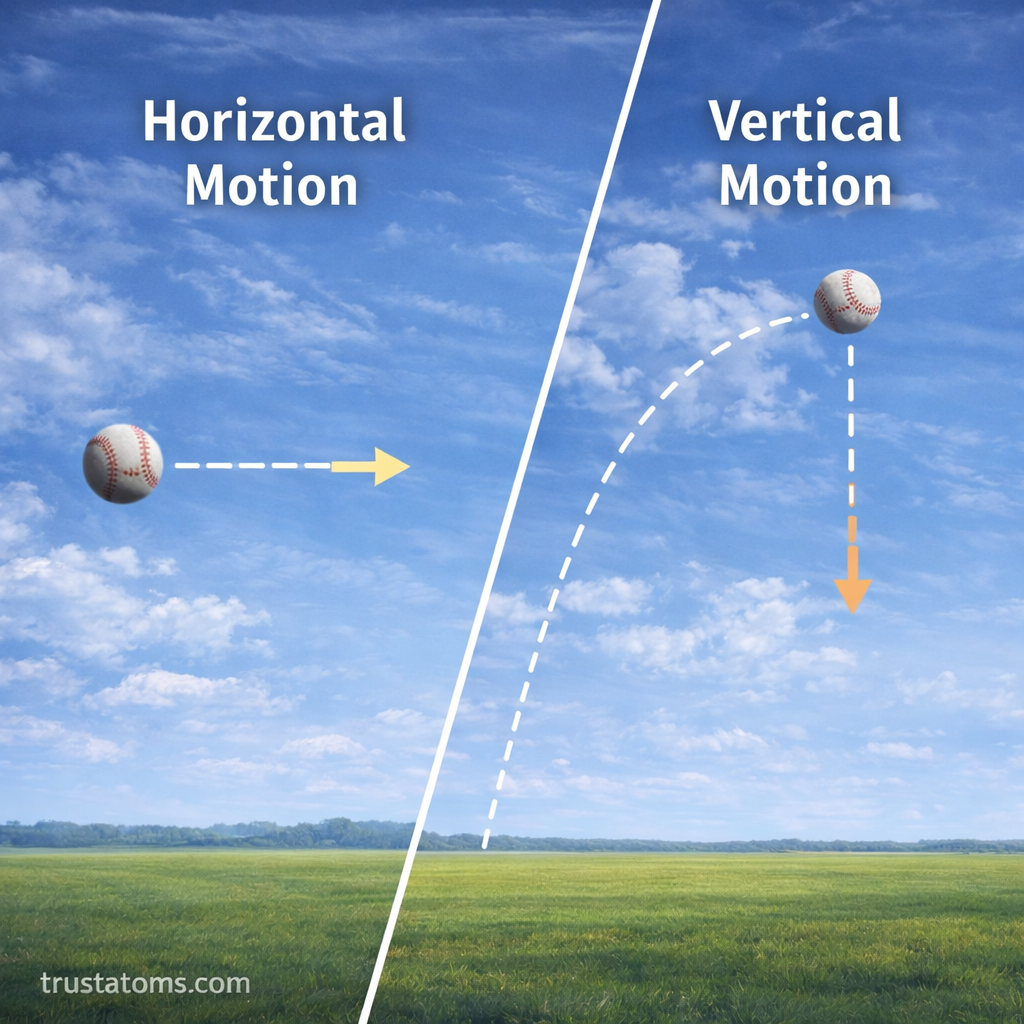
Projectile motion becomes much easier to understand when separated into components.
Horizontal Motion
In the horizontal direction:
- Velocity remains constant.
- There is no horizontal acceleration (in ideal conditions).
The horizontal distance traveled depends on:
Horizontal distance = horizontal velocity × time
The longer the object stays in the air, the farther it travels horizontally.
Vertical Motion
In the vertical direction:
- Gravity causes constant downward acceleration.
- Acceleration due to gravity is approximately 9.8 m/s² on Earth.
This means:
- The object slows down as it rises.
- It briefly stops at the highest point.
- It speeds up as it falls.
Vertical motion follows the same rules as free fall.
The Shape of Projectile Motion
The path of a projectile is a parabola.
This curved shape happens because:
- Horizontal motion is constant.
- Vertical motion is accelerating downward.
If you were to graph height versus horizontal distance, you would see a smooth, symmetrical curve (in ideal conditions).
Key Projectile Motion Relationships
While full calculations involve equations, the most important relationships are:
- Greater initial speed → longer range
- Larger launch angle → greater height
- Time in air depends on vertical motion
- Range depends on both speed and angle
Understanding these relationships helps predict motion without heavy math.
How Launch Angle Affects Motion
The angle at which an object is launched changes how far and how high it travels.
General patterns include:
- A low angle → longer horizontal distance, lower height
- A high angle → greater height, shorter horizontal distance
- Around 45° → maximum range (in ideal conditions)
Interestingly, two different angles can produce the same range if the launch speed is constant.
Real-World Examples of Projectile Motion
Projectile motion appears in many everyday situations:
- Basketball shots
- Fireworks displays
- Water fountains
- Golf drives
- Volleyball serves
Even the early stages of rocket launches follow projectile motion before orbital mechanics take over.
Engineers, athletes, and scientists all rely on understanding these motion principles.
What About Air Resistance?
In real-world conditions, air resistance affects motion.
Air resistance:
- Slows objects down
- Reduces horizontal distance
- Changes the symmetry of the path
- Alters maximum height
In introductory physics, air resistance is often ignored to simplify calculations.
Without air resistance:
- The trajectory is perfectly symmetrical.
- Time going up equals time coming down.
With air resistance:
- The path becomes slightly uneven.
Independence of Motion
One of the most important principles in projectile motion is the independence of horizontal and vertical motion.
This means:
- Horizontal motion does not affect vertical motion.
- Vertical motion does not affect horizontal motion.
For example:
If you drop one ball and throw another ball horizontally at the same time, they hit the ground at the same moment (ignoring air resistance).
This demonstrates that gravity affects vertical motion only.
Special Case: Horizontal Launch
If an object is launched horizontally:
- Initial vertical velocity is zero.
- Gravity immediately accelerates it downward.
Common examples include:
- An object rolling off a table
- Water flowing off a cliff
The object still follows a curved path because gravity constantly pulls it downward.
Why Projectile Motion Matters
Understanding projectile motion is essential in:
- Sports science
- Military engineering
- Aerospace design
- Robotics
- Game physics simulations
It also forms the foundation for more advanced physics topics such as:
- Orbital mechanics
- Ballistics
- Classical mechanics
Projectile motion connects simple classroom physics to real-world motion all around us.
Common Mistakes to Avoid
Students often:
- Mix up horizontal and vertical components
- Forget that gravity only affects vertical motion
- Assume speed is constant in both directions
- Forget to break velocity into components
Always separate motion into horizontal and vertical parts first before solving problems.
Final Thoughts
Projectile motion explains how objects move through the air under gravity.
By breaking motion into two independent components:
- Horizontal motion (constant velocity)
- Vertical motion (constant acceleration)
We can predict height, time in the air, and distance traveled.
From sports to spaceflight, projectile motion is one of the clearest examples of how physics helps us understand motion in the real world.