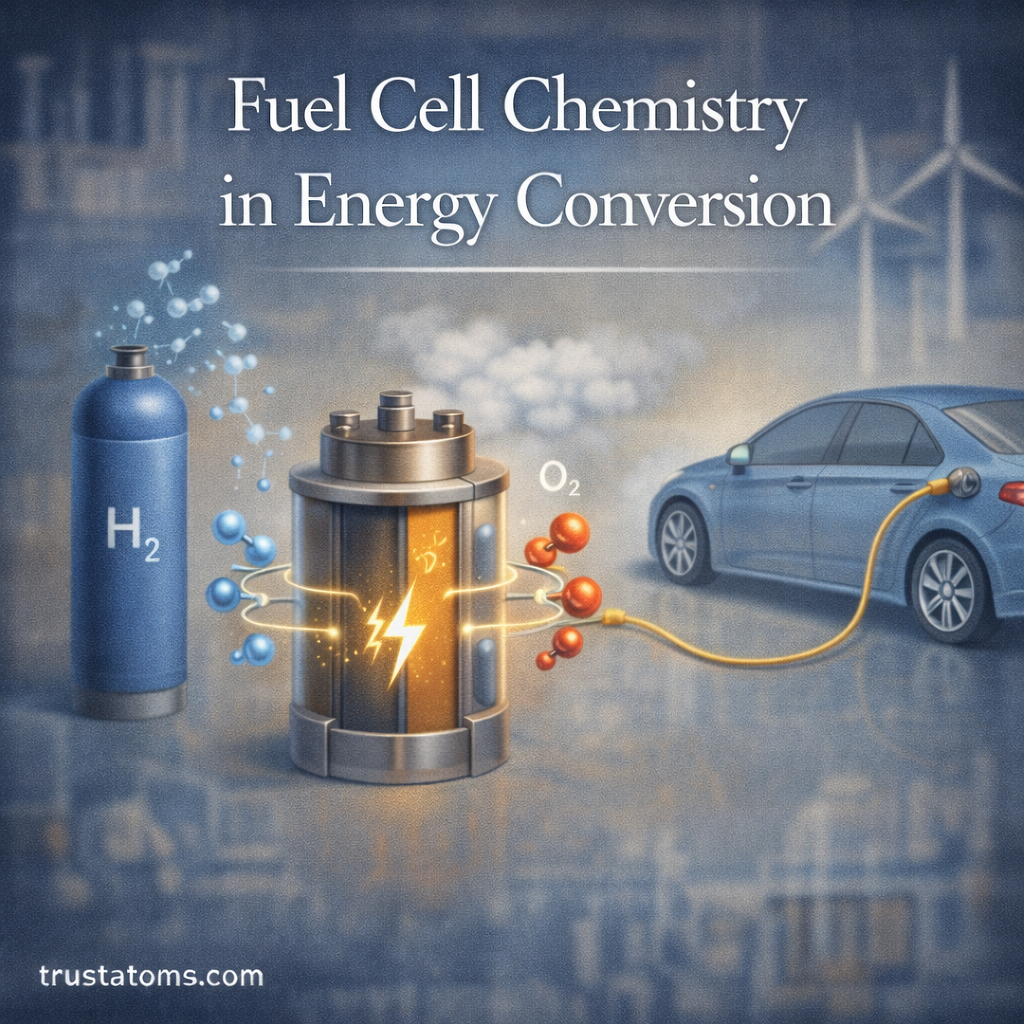
Fuel cells are advanced electrochemical devices that convert chemical energy directly into electrical energy. Unlike conventional combustion engines that burn fuel to generate heat and mechanical work, fuel cells use controlled redox reactions to produce electricity with higher efficiency and lower emissions.
Because they can operate continuously as long as fuel is supplied, fuel cells are becoming increasingly important in clean energy systems, transportation technologies, and backup power solutions.
Understanding the chemistry behind fuel cells reveals how these systems convert fuel molecules into usable electrical energy.
What Is a Fuel Cell?
A fuel cell is an electrochemical device that generates electricity through chemical reactions between a fuel and an oxidizing agent.
Most commonly:
- Hydrogen acts as the fuel
- Oxygen from air acts as the oxidant
These substances react in a controlled electrochemical process that produces:
- Electricity
- Water
- Heat
Unlike batteries, fuel cells do not store energy internally. Instead, they produce electricity continuously as long as fuel is supplied.
Basic Chemistry of Fuel Cells
Fuel cells operate using oxidation–reduction (redox) reactions that transfer electrons through an external circuit.
The process occurs at two electrodes:
- Anode – oxidation of fuel
- Cathode – reduction of oxygen
Electrons released during oxidation travel through an external circuit, generating electrical power.
Anode Reaction
At the anode, hydrogen molecules split into protons and electrons.
The electrons move through the external circuit, creating electric current.
Meanwhile, the protons move through the electrolyte toward the cathode.
Cathode Reaction
At the cathode, oxygen molecules react with incoming electrons and protons.
This reaction forms water as the primary product.
Overall Reaction
The overall reaction in a hydrogen fuel cell converts hydrogen and oxygen into water while releasing electrical energy.
This reaction produces:
- Electricity
- Heat
- Water vapor
Because water is the only chemical byproduct, hydrogen fuel cells are often considered environmentally friendly energy systems.
Main Components of a Fuel Cell
Although many types of fuel cells exist, most contain similar components.
Anode
The anode is the electrode where the fuel undergoes oxidation.
Key functions include:
- Breaking fuel molecules into ions and electrons
- Conducting electrons into the external circuit
Catalysts are typically used to accelerate the reaction.
Cathode
The cathode is the electrode where oxygen is reduced.
This electrode combines oxygen with electrons and ions to complete the reaction.
Efficient catalysts help speed up this process.
Electrolyte
The electrolyte is the medium that allows ions to move between electrodes while blocking electron flow.
Depending on the fuel cell type, electrolytes may include:
- Polymer membranes
- Liquid alkaline solutions
- Solid oxide materials
The electrolyte plays a crucial role in determining operating temperature and efficiency.
Catalyst
Fuel cells rely on catalysts to speed up electrochemical reactions.
Common catalysts include:
- Platinum
- Nickel
- Various metal alloys
Catalyst research is an active field because reducing catalyst cost can make fuel cells more economically viable.
Types of Fuel Cells
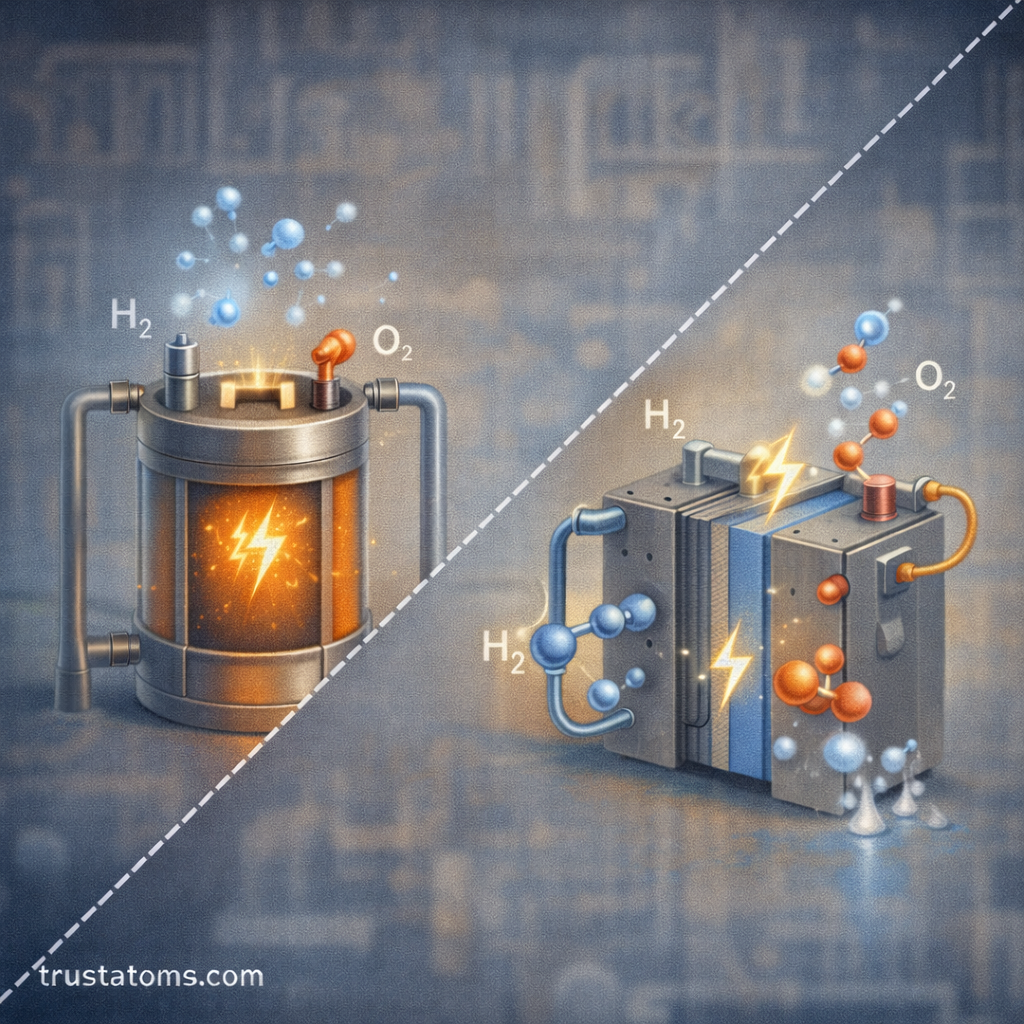
Different fuel cell technologies operate using different electrolytes and operating conditions.
Proton Exchange Membrane Fuel Cells (PEMFC)
PEM fuel cells are among the most widely studied fuel cell technologies.
Key characteristics include:
- Polymer electrolyte membrane
- Low operating temperatures
- Fast startup times
Applications include:
- Hydrogen-powered vehicles
- Portable power systems
- Backup power supplies
Solid Oxide Fuel Cells (SOFC)
Solid oxide fuel cells operate at very high temperatures.
Typical characteristics:
- Ceramic electrolyte
- High efficiency
- Ability to use multiple fuels
These systems are often used for stationary power generation.
Alkaline Fuel Cells (AFC)
Alkaline fuel cells use an alkaline electrolyte solution.
They offer:
- High electrical efficiency
- Fast electrode reactions
Historically, these systems were used in space missions.
Molten Carbonate Fuel Cells (MCFC)
Molten carbonate fuel cells operate at elevated temperatures and use molten carbonate salts as electrolytes.
Advantages include:
- High efficiency
- Ability to use natural gas or other fuels
These systems are mainly used for large-scale energy production.
Advantages of Fuel Cell Technology
Fuel cells offer several benefits compared to traditional power systems.
High Efficiency
Fuel cells convert chemical energy directly into electricity without combustion.
This can result in higher energy efficiency compared to internal combustion engines.
Low Emissions
Hydrogen fuel cells produce only water and heat as byproducts.
This greatly reduces greenhouse gas emissions when clean hydrogen is used.
Quiet Operation
Fuel cells operate without mechanical combustion, which makes them relatively quiet compared to engines or generators.
Continuous Power Generation
Unlike batteries that must be recharged, fuel cells can produce electricity continuously while fuel is supplied.
Challenges in Fuel Cell Chemistry
Despite their advantages, fuel cell technologies face several challenges.
Hydrogen Production
Hydrogen must be produced before it can be used in fuel cells.
Many current hydrogen production methods rely on fossil fuels.
Developing sustainable hydrogen production is a key goal for the energy sector.
Catalyst Cost
Many fuel cells rely on expensive catalysts such as platinum.
Reducing catalyst cost remains an important area of research.
Fuel Infrastructure
Hydrogen storage and distribution infrastructure is still limited in many parts of the world.
Expanding this infrastructure is necessary for large-scale adoption.
Durability
Fuel cell components must withstand long operating periods without degradation.
Improving durability and lifespan is a major engineering focus.
Applications of Fuel Cells
Fuel cells are increasingly used in many sectors.
Transportation
Fuel cell vehicles use hydrogen fuel cells to power electric motors.
Benefits include:
- Zero tailpipe emissions
- Fast refueling
- Long driving range
Hydrogen-powered buses, trucks, and cars are currently being deployed in several countries.
Portable Power
Fuel cells can provide compact, reliable energy for portable electronics and remote systems.
Applications include:
- Military equipment
- Emergency backup power
- Remote sensors
Stationary Power Generation
Large fuel cell systems can generate electricity for:
- Homes
- Commercial buildings
- Data centers
These systems can operate continuously and provide reliable power.
Renewable Energy Storage
Fuel cells can also be integrated into renewable energy systems.
Excess electricity from wind or solar power can produce hydrogen through electrolysis.
That hydrogen can later power fuel cells to generate electricity when needed.
The Future of Fuel Cell Chemistry
Research into fuel cell chemistry continues to expand rapidly.
Scientists are working to improve:
- Catalyst efficiency
- Alternative fuel sources
- Hydrogen production methods
- Fuel cell durability
Emerging technologies include:
- Non-precious metal catalysts
- High-temperature fuel cell materials
- Integrated hydrogen energy systems
These innovations could make fuel cells a central part of future sustainable energy systems.
Final Thoughts
Fuel cell chemistry provides a powerful method for converting chemical energy into electricity through controlled redox reactions. By combining hydrogen and oxygen in electrochemical systems, fuel cells produce clean electrical power with water as the main byproduct.
As research advances and infrastructure improves, fuel cells are expected to play an increasingly important role in transportation, renewable energy storage, and global energy systems. Understanding the chemistry behind these devices helps reveal why fuel cells are considered one of the most promising technologies for a cleaner energy future.