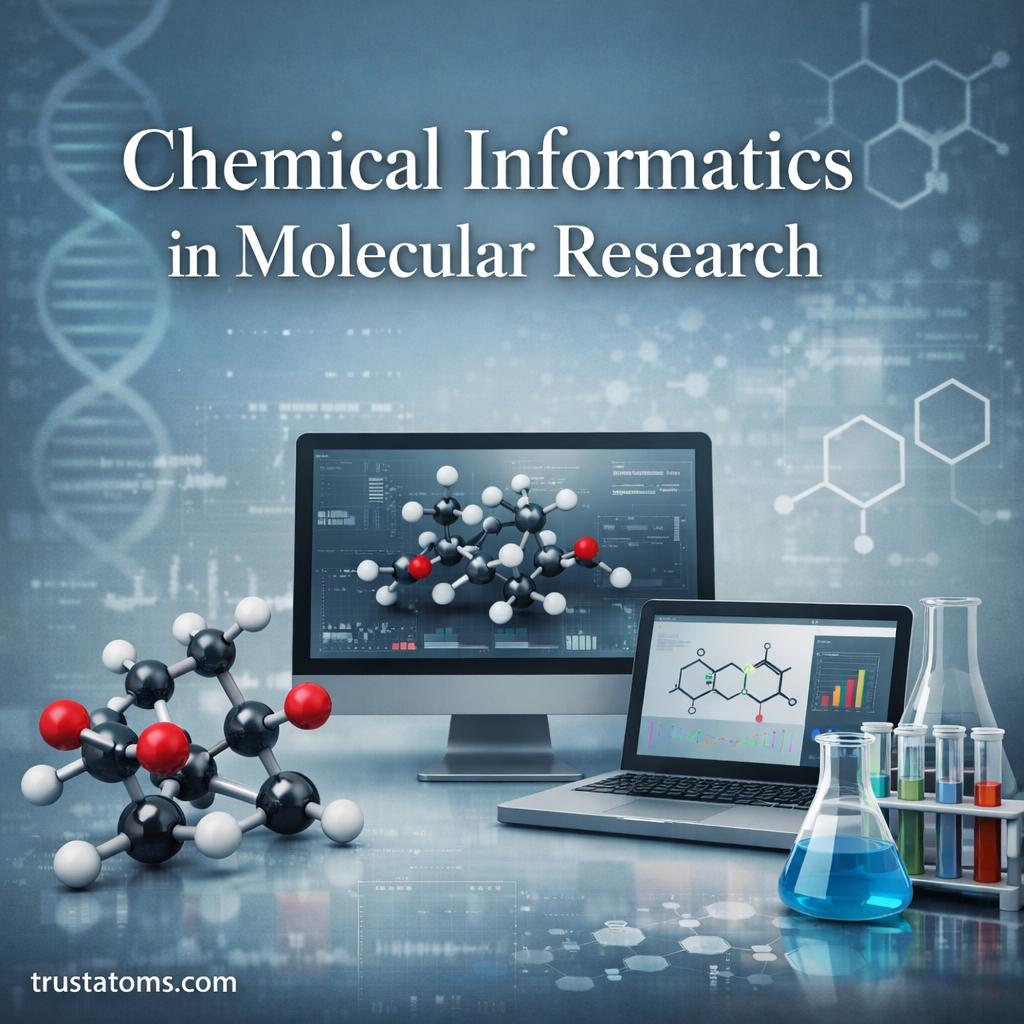
Chemical informatics—often called cheminformatics—is a field that combines chemistry, computer science, mathematics, and data science to analyze and understand chemical information. In modern molecular research, it plays a crucial role in accelerating discovery, predicting molecular behavior, and organizing large chemical datasets.
From drug discovery to materials science, researchers increasingly rely on computational tools to explore molecular structures, chemical reactions, and biological interactions before conducting costly laboratory experiments.
This article explains what chemical informatics is, how it works, and why it has become a central part of modern molecular research.
What Is Chemical Informatics?
Chemical informatics is the use of computational methods and databases to store, analyze, and model chemical data.
Instead of relying only on laboratory experiments, scientists can use software and algorithms to:
- Predict chemical properties
- Simulate molecular interactions
- Analyze large chemical datasets
- Design new molecules for specific purposes
By combining chemical knowledge with computer modeling, chemical informatics helps researchers discover patterns and insights that would be difficult to detect manually.
Why Chemical Informatics Matters in Molecular Research
Modern chemistry generates enormous amounts of data. Laboratories studying pharmaceuticals, materials, or environmental chemistry may produce millions of molecular measurements.
Chemical informatics helps manage and interpret this data by:
- Organizing chemical databases
- Identifying relationships between molecules
- Predicting molecular activity
- Accelerating compound discovery
Without computational tools, analyzing such large datasets would be extremely slow and inefficient.
For example, pharmaceutical researchers may evaluate thousands or millions of molecules using computational screening before selecting a few promising candidates for laboratory testing.
Core Components of Chemical Informatics
Several technologies and methods form the foundation of chemical informatics.
Chemical Databases
Chemical databases store information about molecular structures, properties, and reactions.
Examples of stored data include:
- Molecular formulas
- Structural representations
- Reaction pathways
- Spectroscopic data
- Biological activity information
These databases allow researchers to quickly search for compounds with similar properties or structures.
Molecular Representation
Computers cannot interpret molecules directly, so chemical structures must be converted into digital formats.
Common molecular representations include:
- SMILES strings (text representations of molecules)
- Molecular graphs representing atoms and bonds
- 3D molecular coordinates for spatial modeling
These formats allow algorithms to analyze molecules computationally.
Computational Modeling
Computational modeling predicts how molecules behave under certain conditions.
Examples include:
- Predicting chemical reactivity
- Modeling molecular structures
- Simulating molecular interactions
These simulations can reveal potential reactions or properties before experimental testing begins.
Machine Learning and Data Analysis
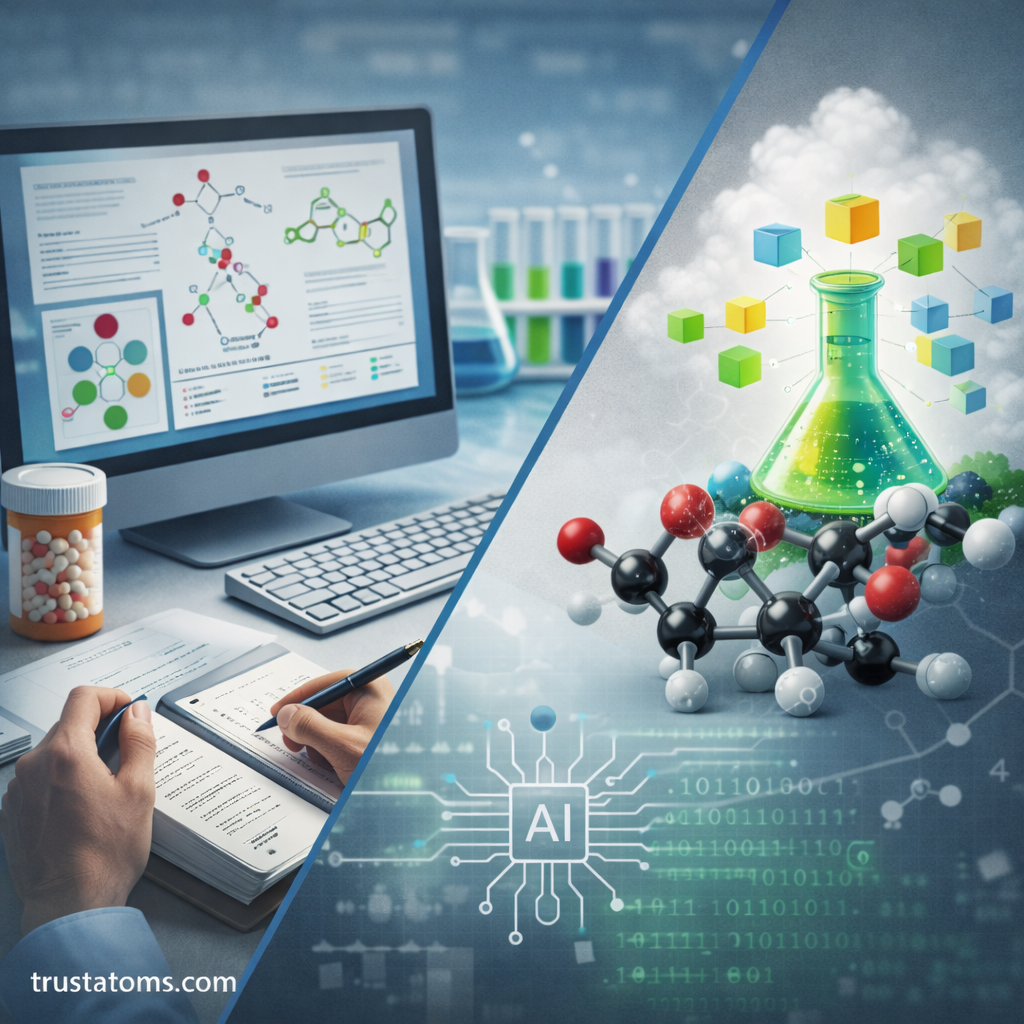
Machine learning has become an increasingly important tool in chemical informatics.
Algorithms can analyze massive chemical datasets to identify patterns and predict molecular behavior.
Machine learning applications include:
- Predicting drug effectiveness
- Forecasting toxicity
- Identifying promising molecular structures
- Optimizing chemical synthesis routes
These predictive models help scientists make faster, more informed research decisions.
Applications of Chemical Informatics
Chemical informatics supports many areas of molecular science.
Drug Discovery
In pharmaceutical research, chemical informatics helps identify molecules that may interact with biological targets.
Researchers use computational screening to:
- Analyze large libraries of compounds
- Predict molecular binding to proteins
- Identify potential drug candidates
This process significantly reduces the time and cost of drug development.
Materials Science
Scientists developing new materials rely on chemical informatics to explore molecular structures with desirable properties.
For example, researchers may design molecules for:
- Advanced polymers
- Energy storage materials
- Catalysts
- Nanomaterials
Computational models help determine which molecular designs are most promising.
Environmental Chemistry
Chemical informatics is also used to study environmental contaminants and chemical behavior in ecosystems.
Researchers can:
- Predict pollutant toxicity
- Model chemical degradation pathways
- Analyze environmental chemical databases
These insights support environmental protection and regulatory decisions.
Chemical Synthesis Planning
Chemical informatics tools can help chemists design efficient synthetic pathways for complex molecules.
Software can analyze potential reactions and suggest:
- Reaction sequences
- Catalysts
- Optimal reaction conditions
This reduces trial-and-error in laboratory synthesis.
Advantages of Chemical Informatics
Chemical informatics offers several important advantages in molecular research.
Faster Discovery
Computational screening allows scientists to analyze thousands of molecules rapidly, speeding up discovery processes.
Reduced Experimental Costs
By predicting which molecules are most promising, researchers can focus laboratory experiments on the best candidates.
Improved Data Organization
Chemical databases allow scientists to store, search, and analyze chemical information efficiently.
Enhanced Collaboration
Digital chemical data can be shared across research institutions, allowing scientists worldwide to collaborate more effectively.
Challenges in Chemical Informatics
Despite its advantages, chemical informatics still faces several challenges.
Data Quality
Machine learning models and computational tools depend on high-quality chemical datasets. Poor data can lead to inaccurate predictions.
Complexity of Chemical Systems
Chemical reactions and biological interactions can be extremely complex, making them difficult to model perfectly.
Computational Resources
Large-scale molecular simulations and machine learning models often require significant computing power.
Advances in cloud computing and high-performance computing are helping address these challenges.
The Future of Chemical Informatics
Chemical informatics continues to evolve rapidly as computing technologies improve.
Several trends are shaping its future:
- Integration with artificial intelligence
- Expansion of open chemical databases
- Increased use of high-performance computing
- Automation of molecular design and synthesis
These developments may allow scientists to design new molecules and materials entirely through computational workflows before confirming them experimentally.
As research datasets continue to grow, chemical informatics will remain essential for unlocking insights hidden within complex molecular systems.
Final Thoughts
Chemical informatics has transformed the way scientists study molecules. By combining chemistry with data science and computational modeling, researchers can analyze massive chemical datasets, predict molecular behavior, and accelerate discovery across many scientific fields.
From drug development to materials science, the ability to explore chemical information digitally has become a powerful tool for modern molecular research.
As computing technologies continue to advance, chemical informatics will play an even greater role in shaping the future of chemistry and molecular innovation.