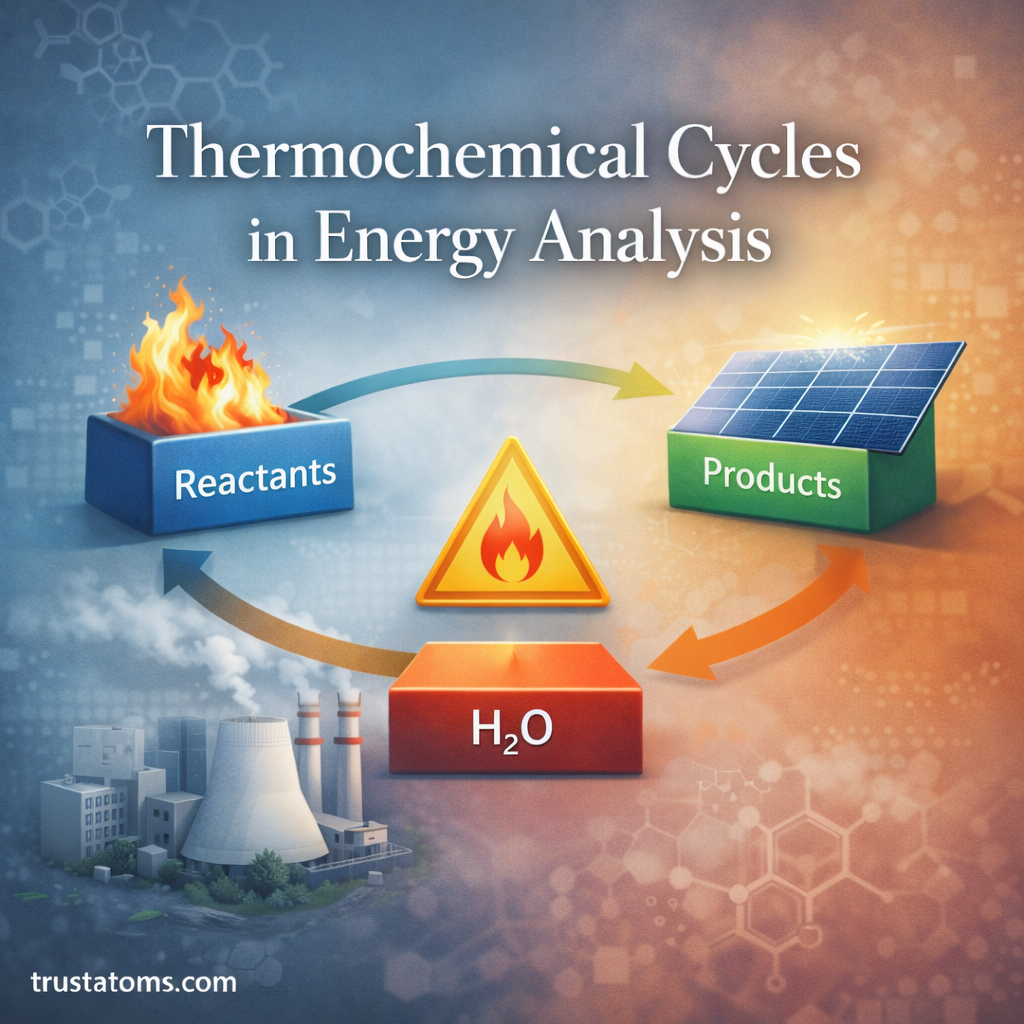
Thermochemical cycles are an important concept in chemistry and energy science. They help scientists understand how energy moves through chemical reactions and how different reactions can be combined to measure or calculate energy changes.
In energy analysis, thermochemical cycles allow researchers to determine values that may be difficult or impossible to measure directly in experiments. By applying principles of thermodynamics, chemists can analyze energy transformations in fuels, industrial reactions, and environmental processes.
Understanding thermochemical cycles helps scientists design more efficient chemical processes, evaluate energy systems, and study how reactions store or release energy.
What Are Thermochemical Cycles?
A thermochemical cycle is a series of chemical reactions arranged so that the overall change in energy can be calculated from the individual steps.
These cycles rely on the idea that the total energy change of a reaction depends only on the initial and final states, not on the pathway taken to reach them.
This principle is known as Hess’s Law, which states that the enthalpy change for a reaction is equal to the sum of the enthalpy changes for the individual steps.
Thermochemical cycles are particularly useful when:
- A reaction cannot be measured directly
- The reaction occurs too quickly or too slowly
- Experimental conditions are difficult to reproduce
- Multiple reaction pathways exist
By combining known energy changes from simpler reactions, scientists can calculate the energy change for more complex processes.
The Role of Enthalpy in Thermochemical Cycles
In thermochemical analysis, the most commonly studied energy measurement is enthalpy.
Enthalpy represents the total heat energy involved in a chemical reaction at constant pressure.
Chemical reactions generally fall into two categories:
Exothermic Reactions
Exothermic reactions release heat energy into the surroundings.
Examples include:
- Combustion reactions
- Fuel oxidation
- Many industrial chemical processes
These reactions have negative enthalpy changes because energy leaves the system.
Endothermic Reactions
Endothermic reactions absorb energy from the surroundings.
Examples include:
- Thermal decomposition reactions
- Photosynthesis processes
- Certain industrial synthesis reactions
These reactions have positive enthalpy changes because energy enters the system.
Thermochemical cycles track how these energy changes combine across multiple reactions.
Hess’s Law and Energy Calculations
Hess’s Law is the mathematical foundation of thermochemical cycles.
The law states:
The total enthalpy change of a reaction equals the sum of the enthalpy changes of the individual reactions that lead to the same overall result.
This allows scientists to calculate energy changes even when the reaction cannot be observed directly.
Example Process
A typical thermochemical calculation may involve the following steps:
- Identify the overall reaction of interest
- Gather known enthalpy values for related reactions
- Rearrange and combine these reactions to match the target reaction
- Add or subtract the enthalpy values accordingly
By manipulating known reactions, chemists can determine the energy change of the target reaction.
Common Types of Thermochemical Cycles
Several types of thermochemical cycles are used in chemistry and energy analysis.
Born–Haber Cycle
The Born–Haber cycle is used to analyze the formation of ionic compounds.
It breaks the formation of an ionic solid into several theoretical steps, including:
- Atomization of elements
- Ionization of atoms
- Electron affinity processes
- Formation of the crystal lattice
This cycle allows scientists to estimate lattice energy, which is difficult to measure experimentally.
Combustion Cycles
Combustion thermochemical cycles analyze the energy released when fuels react with oxygen.
They are commonly used to evaluate:
- Fossil fuels
- Biofuels
- Synthetic fuels
- Hydrogen energy systems
Understanding combustion enthalpy helps researchers determine the energy efficiency of fuels.
Formation Cycles
Formation cycles involve the energy required to create a compound from its elements in their standard states.
Standard enthalpy of formation values are used extensively in thermochemical calculations because they allow reactions to be compared across many substances.
These cycles help chemists analyze:
- Reaction stability
- Chemical bonding strength
- Energy efficiency of reactions
Applications of Thermochemical Cycles in Energy Analysis
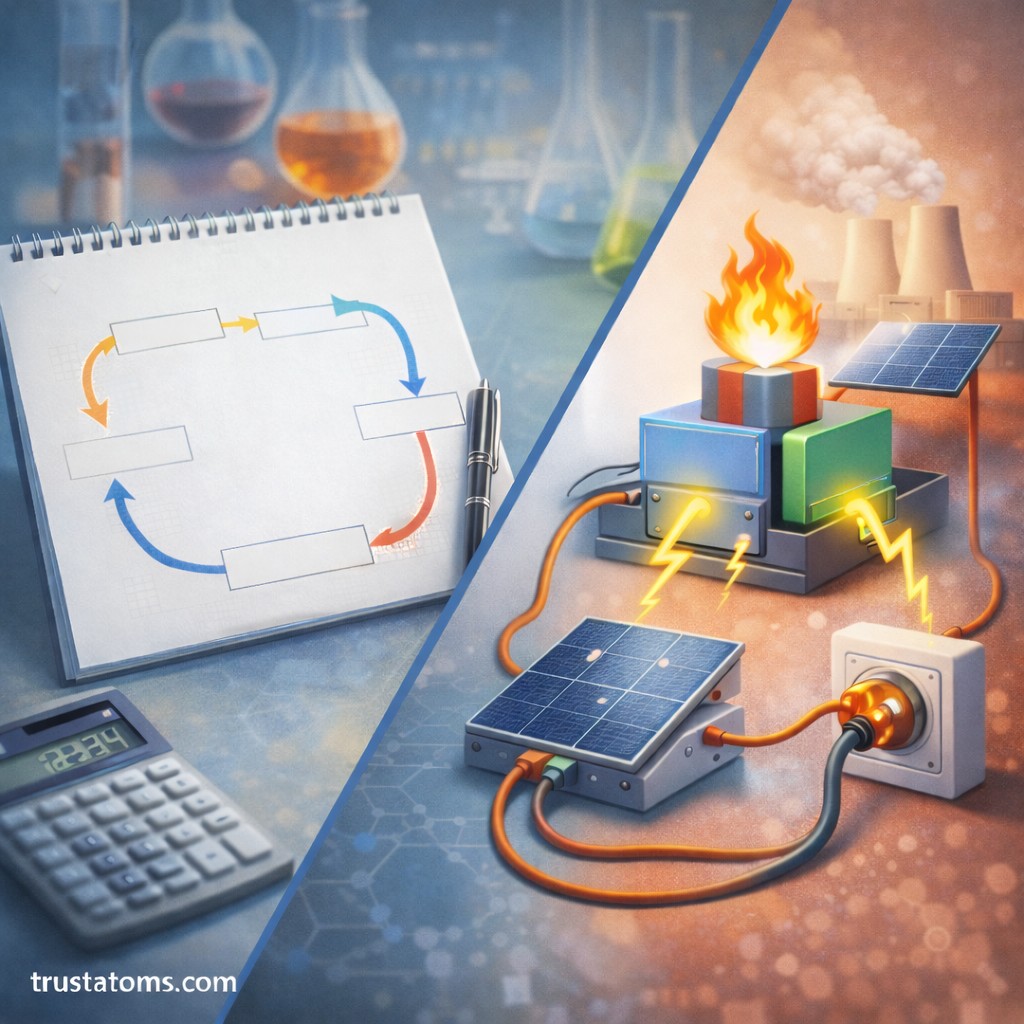
Thermochemical cycles are widely used in scientific research and industry.
Fuel Energy Evaluation
Energy scientists analyze the heat released during combustion to determine the efficiency of fuels.
Thermochemical cycles help calculate:
- Fuel energy density
- Combustion enthalpy
- Efficiency of energy conversion
These calculations are important in transportation, power generation, and renewable energy research.
Industrial Chemical Processes
Many industrial reactions require precise energy control.
Thermochemical cycles help engineers:
- Predict heat production in reactors
- Optimize reaction pathways
- Improve process safety
- Reduce energy consumption
Examples include chemical manufacturing processes such as ammonia production or metal extraction.
Environmental Chemistry
Thermochemical cycles also help scientists understand energy transformations in environmental systems.
Researchers use them to study:
- Atmospheric reactions
- Energy changes in natural chemical cycles
- Environmental pollutant reactions
This information helps scientists model climate systems and chemical reactions occurring in the atmosphere.
Renewable Energy Research
Thermochemical cycles are increasingly used to explore renewable energy technologies.
Examples include:
- Hydrogen production from water
- Solar thermochemical fuel generation
- Carbon-neutral energy cycles
By analyzing the energy requirements of these processes, scientists can identify more efficient energy solutions.
Advantages of Thermochemical Cycles
Thermochemical cycles provide several important benefits in chemical research.
Indirect Energy Measurement
They allow scientists to calculate energy changes for reactions that are difficult to observe experimentally.
Better Understanding of Reaction Pathways
Breaking reactions into smaller steps helps researchers analyze how energy moves through complex systems.
Improved Energy Efficiency
Understanding energy flow allows scientists to design more efficient chemical reactions and industrial processes.
Standardized Energy Data
Thermochemical cycles support the creation of standardized energy databases that researchers can use worldwide.
Limitations and Challenges
While thermochemical cycles are powerful analytical tools, they have certain limitations.
Dependence on Accurate Data
Thermochemical calculations rely heavily on accurate enthalpy values from experiments or databases.
Simplified Models
Cycles sometimes assume ideal conditions, which may differ from real industrial or environmental systems.
Complex Reaction Networks
Some chemical systems involve many intermediate reactions, making thermochemical cycles difficult to construct.
Despite these challenges, thermochemical analysis remains a cornerstone of chemical energy research.
The Future of Thermochemical Energy Analysis
Advances in computational chemistry and data modeling are improving the accuracy of thermochemical calculations.
Scientists are now combining thermochemical cycles with:
- Molecular simulations
- Computational thermodynamics
- machine learning tools
These technologies allow researchers to analyze complex chemical systems more efficiently and explore new energy technologies.
Thermochemical cycles will continue to play an important role in understanding chemical energy transformations, especially as global energy systems evolve toward cleaner and more sustainable sources.
Final Thoughts
Thermochemical cycles provide a powerful framework for understanding how energy flows through chemical reactions. By applying Hess’s Law and analyzing step-by-step reaction pathways, scientists can calculate energy changes that would otherwise be difficult to measure.
These methods are essential for evaluating fuels, improving industrial chemical processes, and advancing renewable energy technologies.
As energy science continues to evolve, thermochemical analysis will remain a key tool for exploring how chemistry can support efficient and sustainable energy systems.