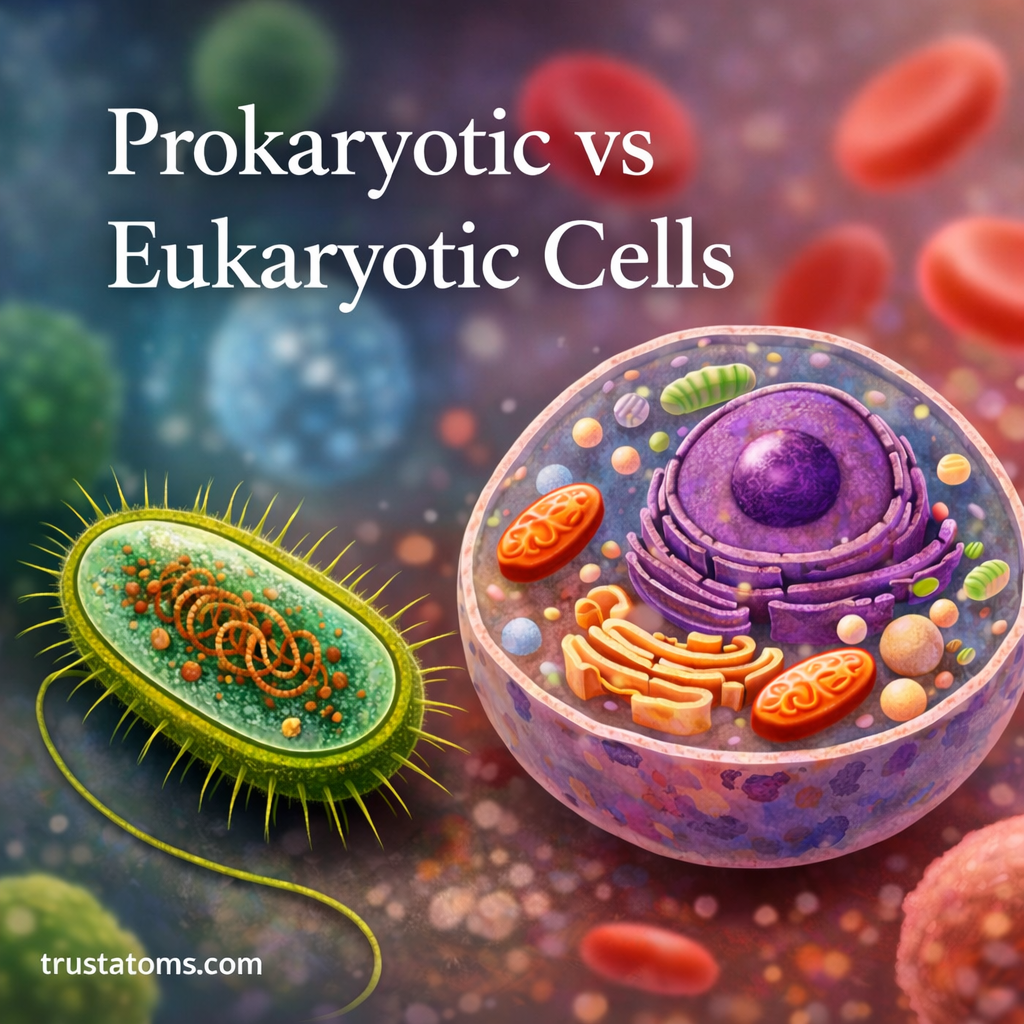
Cells are the fundamental units of life, but not all cells are built the same way. One of the most important distinctions in biology is between prokaryotic cells and eukaryotic cells. These two cell types differ in structure, complexity, and the kinds of organisms they form.
Understanding the differences between prokaryotic and eukaryotic cells helps explain how life evolved and how organisms function at the microscopic level.
This guide explores what defines each type of cell, their major differences, and why these distinctions matter in biology.
What Are Prokaryotic Cells?
Prokaryotic cells are the simplest and oldest forms of life on Earth. They lack a nucleus and other membrane-bound organelles, which makes their internal structure relatively simple.
Organisms that have prokaryotic cells are called prokaryotes.
Examples include:
- Bacteria
- Archaea
These organisms are typically single-celled, meaning one cell carries out all the functions needed for life.
Key Characteristics of Prokaryotic Cells
Prokaryotic cells share several defining features:
- No nucleus
- DNA located in a region called the nucleoid
- Lack of membrane-bound organelles
- Usually very small (about 1–5 micrometers)
- Simple internal structure
Despite their simplicity, prokaryotic cells are extremely efficient and adaptable, allowing them to survive in diverse environments—from deep oceans to extreme heat and cold.
What Are Eukaryotic Cells?
Eukaryotic cells are larger and more complex than prokaryotic cells. Their most defining feature is the presence of a nucleus, which contains the cell’s genetic material.
Organisms with eukaryotic cells are called eukaryotes.
Examples include:
- Animals
- Plants
- Fungi
- Protists
Eukaryotic organisms may be single-celled or multicellular, allowing for much greater biological complexity.
Key Characteristics of Eukaryotic Cells
Eukaryotic cells have several structural features that distinguish them from prokaryotic cells:
- A true nucleus that houses DNA
- Membrane-bound organelles
- Complex internal organization
- Larger cell size (typically 10–100 micrometers)
- Ability to support specialized cellular functions
These features allow eukaryotic cells to perform more specialized roles within multicellular organisms.
Major Structural Differences Between Prokaryotic and Eukaryotic Cells
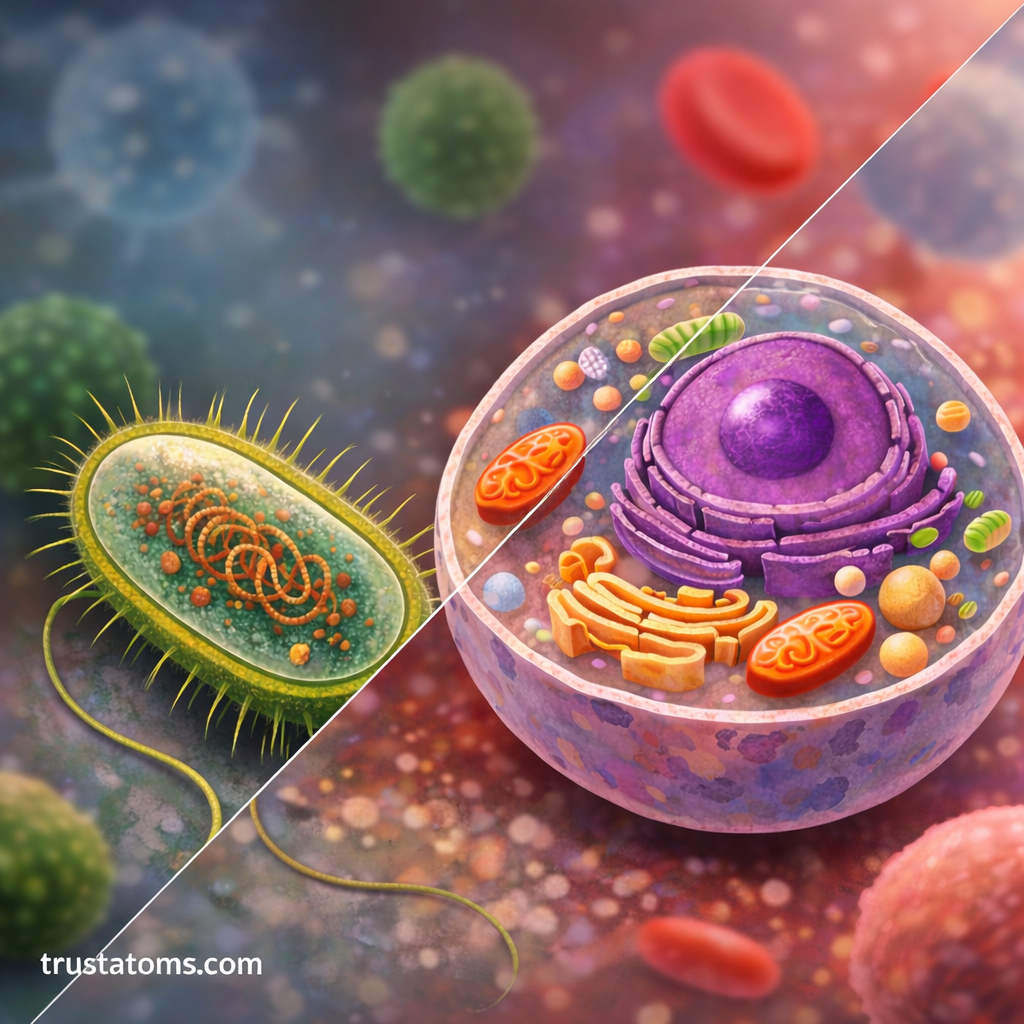
Although both cell types carry out the processes required for life, their structures differ significantly.
Nucleus
One of the most important differences involves the location of genetic material.
Prokaryotic cells:
- DNA is located in the nucleoid region
- No surrounding nuclear membrane
Eukaryotic cells:
- DNA is enclosed inside a nucleus
- The nucleus is surrounded by a protective membrane
This separation allows eukaryotic cells to regulate gene activity more precisely.
Organelles
Organelles are specialized structures that perform specific tasks within the cell.
Prokaryotic cells:
- Do not contain membrane-bound organelles
- Cellular processes occur directly in the cytoplasm
Eukaryotic cells:
- Contain many organelles, including:
- Mitochondria
- Endoplasmic reticulum
- Golgi apparatus
- Lysosomes
These organelles allow the cell to divide complex processes into specialized tasks.
Cell Size and Complexity
Another key difference is size and internal organization.
Prokaryotic cells:
- Smaller
- Simpler internal structure
- Fewer compartments
Eukaryotic cells:
- Larger
- More complex internal architecture
- Many specialized structures
This complexity enables eukaryotic cells to perform more advanced biological functions.
Cellular Organization
The way cells organize into organisms also differs.
Prokaryotic organisms:
- Almost always single-celled
- Each cell operates independently
Eukaryotic organisms:
- Can be single-celled or multicellular
- Cells may specialize into tissues and organs
This specialization is what allows organisms like humans, plants, and animals to exist.
Similarities Between Prokaryotic and Eukaryotic Cells
Despite their differences, both cell types share several fundamental features because they perform the same essential functions of life.
Both types of cells contain:
- A cell membrane
- Cytoplasm
- DNA as genetic material
- Ribosomes for protein synthesis
These shared components reflect the common biological processes required for survival.
Evolutionary Importance of Cell Types
Scientists believe that prokaryotic cells evolved first, appearing more than 3.5 billion years ago.
Later, eukaryotic cells likely developed through a process known as endosymbiosis, where early cells formed cooperative relationships with smaller cells that eventually became organelles.
For example:
- Mitochondria likely evolved from ancient bacteria
- Chloroplasts in plants probably originated from photosynthetic bacteria
This evolutionary step allowed for the emergence of complex life forms.
Why the Difference Matters in Biology
Understanding the distinction between prokaryotic and eukaryotic cells is essential in many scientific fields.
For example:
In medicine, scientists study bacterial (prokaryotic) cells to develop antibiotics that target them without harming human (eukaryotic) cells.
In genetics, differences in cellular organization affect how genes are expressed and regulated.
In evolutionary biology, comparing these cell types helps scientists understand how complex life evolved.
Quick Comparison Table
Below is a simplified overview of the key differences.
Prokaryotic Cells
- No nucleus
- Smaller size
- No membrane-bound organelles
- Usually single-celled
- Examples: bacteria and archaea
Eukaryotic Cells
- True nucleus present
- Larger size
- Contain membrane-bound organelles
- May be single-celled or multicellular
- Examples: animals, plants, fungi, protists
Final Thoughts
Prokaryotic and eukaryotic cells represent two fundamental designs of life. While prokaryotic cells are simpler and smaller, they are incredibly adaptable and have existed on Earth for billions of years. Eukaryotic cells, on the other hand, provide the structural complexity needed for advanced organisms.
Studying these two cell types helps scientists understand the diversity of life, the evolution of organisms, and the biological processes that sustain living systems.
From microscopic bacteria to complex multicellular organisms, all life ultimately depends on the remarkable capabilities of cells.