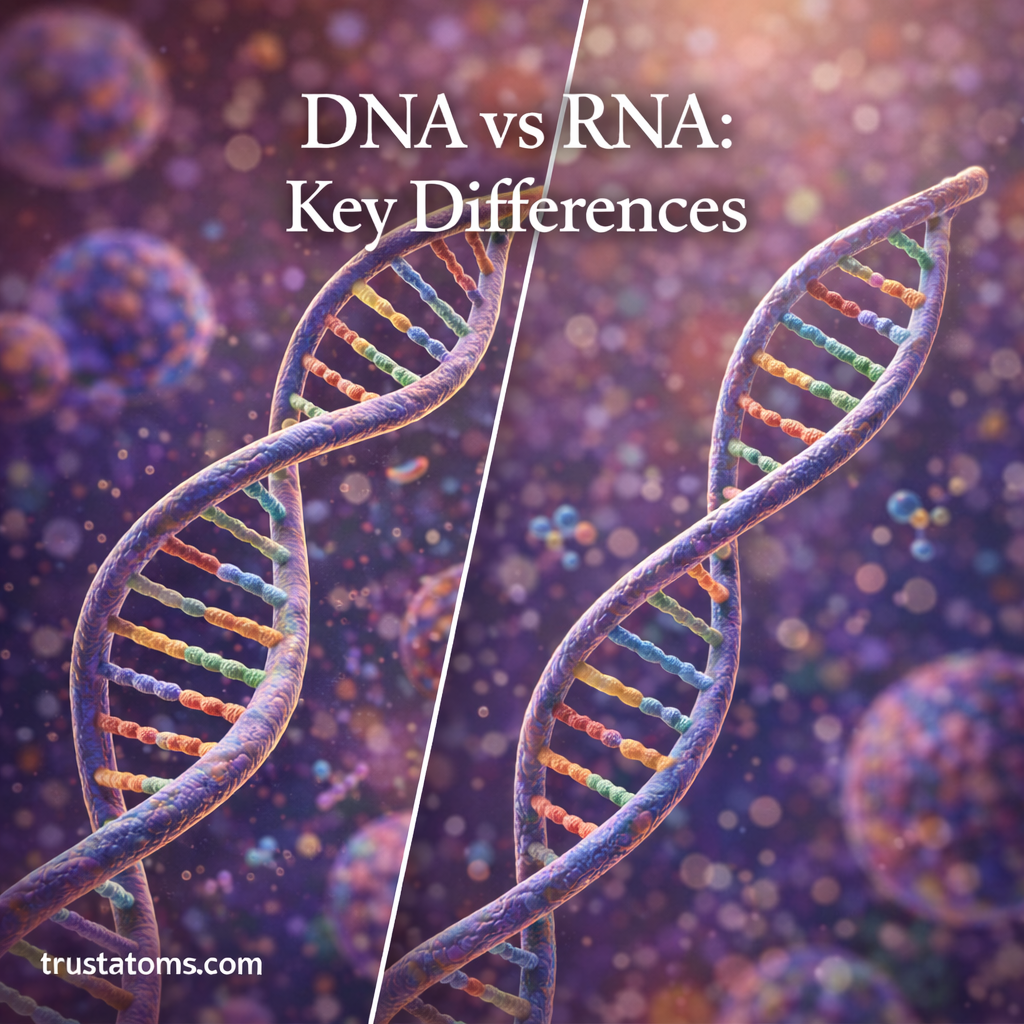
DNA and RNA are two essential molecules that carry and use genetic information in living organisms. Both belong to a group of molecules known as nucleic acids, and they work together to ensure cells can store instructions and build the proteins necessary for life.
Although DNA and RNA share some similarities, they differ in structure, function, and how they operate within the cell. Understanding these differences helps explain how genetic information flows from stored instructions to biological activity.
This article explores the key differences between DNA and RNA, their structures, and how they work together in the process of gene expression.
What Is DNA?
DNA, or deoxyribonucleic acid, is the molecule that stores long-term genetic information. It acts as the biological blueprint for building and maintaining an organism.
DNA contains instructions that determine:
- How cells function
- How proteins are produced
- How organisms grow and develop
- How traits are passed from parents to offspring
In most organisms, DNA is located inside the nucleus of cells. It is organized into structures called chromosomes, which contain thousands of genes.
What Is RNA?
RNA, or ribonucleic acid, plays a key role in using the instructions stored in DNA. Rather than storing genetic information long term, RNA helps translate genetic instructions into functional proteins.
RNA molecules assist in several steps of gene expression, including:
- Carrying messages from DNA
- Delivering amino acids for protein assembly
- Forming structures involved in protein production
Unlike DNA, RNA molecules are typically short-lived and are produced only when cells need to build specific proteins.
Structural Differences Between DNA and RNA
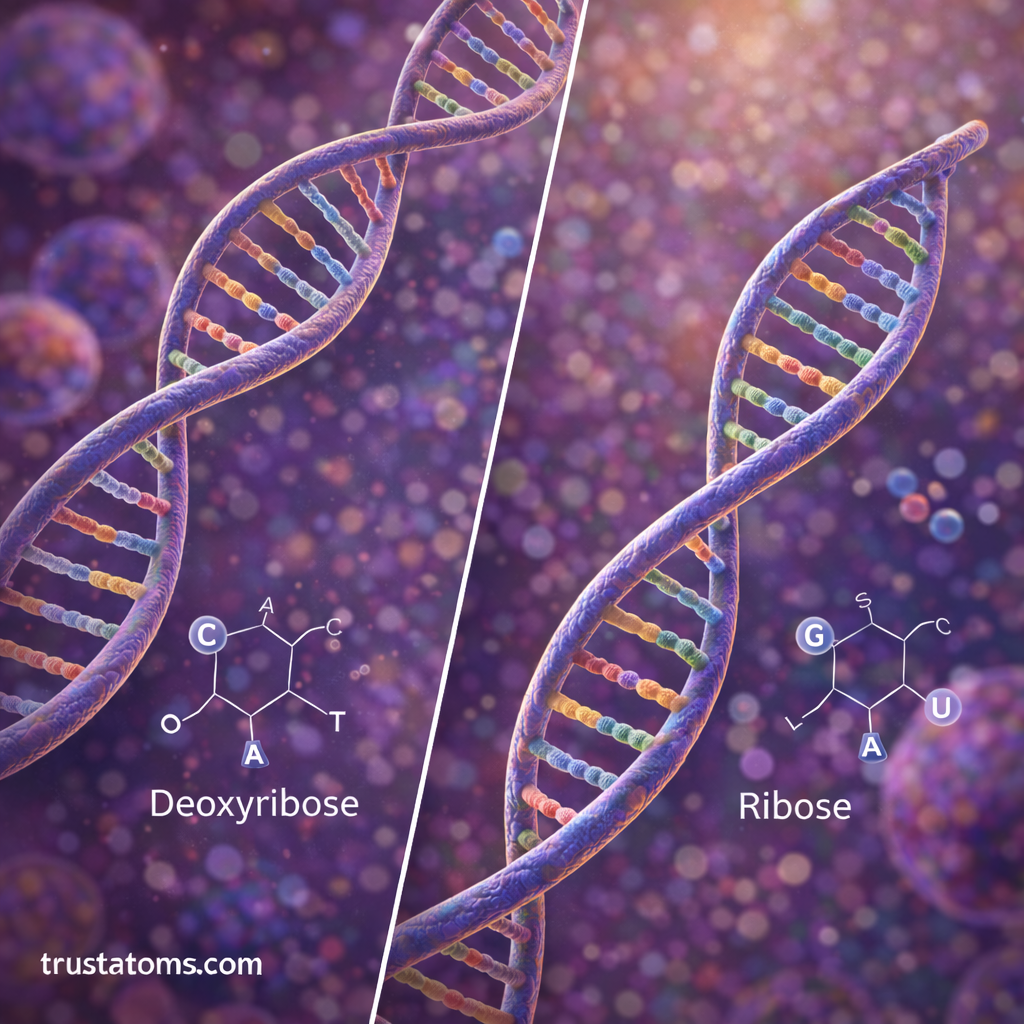
Although DNA and RNA are chemically related, their structures differ in several important ways.
Strand Structure
One of the most visible differences is how the molecules are arranged.
DNA:
- Double-stranded molecule
- Forms the famous double helix structure
- Two strands are connected by base pairs
RNA:
- Usually single-stranded
- Can fold into different shapes depending on its function
This difference allows RNA to interact with other molecules more easily during protein synthesis.
Sugar Molecule
Both DNA and RNA contain a sugar molecule as part of their nucleotide structure, but the sugars differ slightly.
DNA contains:
- Deoxyribose sugar
RNA contains:
- Ribose sugar
The extra oxygen atom in ribose makes RNA slightly less stable than DNA, which is one reason RNA molecules are typically temporary.
Nitrogenous Bases
DNA and RNA both use nitrogenous bases to encode genetic information.
DNA bases include:
- Adenine (A)
- Thymine (T)
- Cytosine (C)
- Guanine (G)
RNA bases include:
- Adenine (A)
- Uracil (U)
- Cytosine (C)
- Guanine (G)
The key difference is that RNA uses uracil instead of thymine.
Functional Differences Between DNA and RNA
DNA and RNA serve different roles inside the cell.
DNA: Information Storage
DNA acts as the permanent storage system for genetic information.
Its main functions include:
- Storing genes
- Passing hereditary information to offspring
- Providing instructions for protein production
Because DNA contains vital information, cells protect it carefully within the nucleus.
RNA: Information Use and Protein Production
RNA helps cells read and use genetic instructions.
Its functions include:
- Carrying instructions from DNA to ribosomes
- Helping assemble proteins
- Supporting gene regulation
RNA essentially acts as the working copy of genetic instructions.
Types of RNA
Several forms of RNA help convert genetic information into proteins.
Messenger RNA (mRNA)
mRNA carries genetic instructions from DNA to ribosomes.
Key roles include:
- Copying a gene’s instructions
- Delivering the instructions for protein production
Transfer RNA (tRNA)
tRNA helps assemble proteins by transporting amino acids to the ribosome.
Its job is to:
- Match amino acids with the correct genetic code
- Build proteins in the proper sequence
Ribosomal RNA (rRNA)
rRNA forms part of the ribosome structure and helps catalyze protein assembly.
It plays a critical role in the translation stage of protein synthesis.
DNA and RNA in Protein Synthesis
DNA and RNA work together during gene expression, which is the process by which cells produce proteins.
This process occurs in two main stages.
1. Transcription
During transcription:
- A gene in DNA is copied into messenger RNA.
- The mRNA carries the instructions away from the DNA.
2. Translation
During translation:
- Ribosomes read the mRNA sequence.
- Transfer RNA delivers the correct amino acids.
- Amino acids link together to form a protein.
Proteins created through this process support nearly every function in living organisms.
Quick Comparison: DNA vs RNA
Below is a simplified comparison of the key differences.
DNA
- Double-stranded structure
- Contains deoxyribose sugar
- Uses thymine (T)
- Long-term storage of genetic information
- Mostly located in the nucleus
RNA
- Single-stranded structure
- Contains ribose sugar
- Uses uracil (U)
- Helps produce proteins
- Found in nucleus and cytoplasm
Why the Differences Matter
The differences between DNA and RNA allow cells to efficiently manage genetic information.
DNA provides a stable archive of genetic instructions, while RNA acts as a temporary working molecule that helps cells build proteins when needed.
This division of responsibilities allows cells to protect their genetic code while still producing the molecules required for life.
Final Thoughts
DNA and RNA are closely related molecules that play distinct roles in biology. DNA stores the instructions for life, while RNA helps interpret and carry out those instructions.
By working together, these molecules ensure that cells can reproduce, adapt, and function properly. Studying DNA and RNA not only helps scientists understand the fundamentals of life but also drives advances in medicine, biotechnology, and genetics.