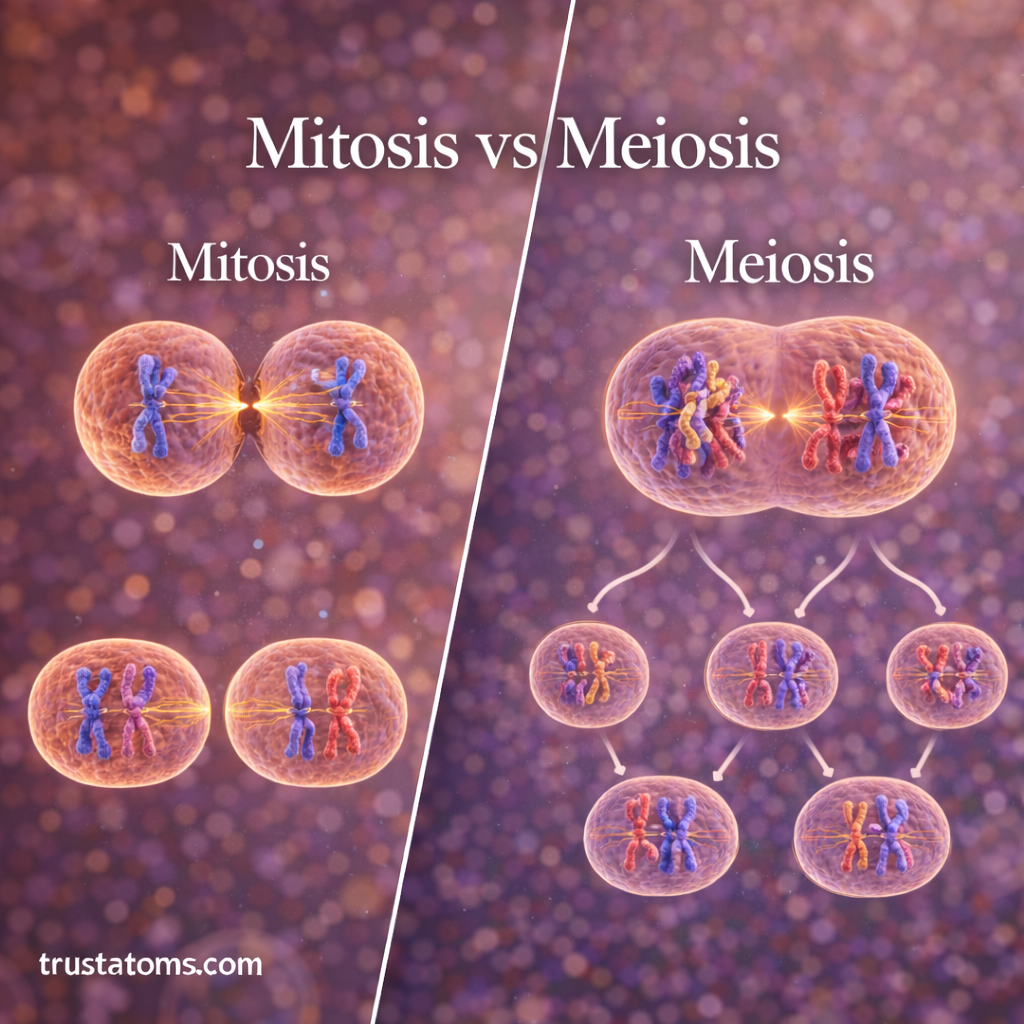
Cells divide to support growth, repair tissues, and produce reproductive cells. Two major types of cell division make this possible: mitosis and meiosis. While both processes involve dividing cells and distributing genetic material, they serve very different biological purposes.
Mitosis helps organisms grow and maintain body tissues, while meiosis produces reproductive cells required for sexual reproduction. Understanding the differences between these processes is fundamental to biology and genetics.
This guide explains how mitosis and meiosis work, their stages, and the key differences between them.
What Is Mitosis?
Mitosis is a type of cell division that produces two genetically identical daughter cells from a single parent cell.
It occurs in somatic cells, which are the regular body cells responsible for maintaining tissues and organs.
Examples of cells that divide through mitosis include:
- Skin cells
- Muscle cells
- Blood cells
- Liver cells
Each new cell receives an identical copy of the parent cell’s DNA, ensuring stability and consistency in genetic information.
What Is Meiosis?
Meiosis is a specialized type of cell division that produces reproductive cells, also known as gametes.
These cells include:
- Sperm cells
- Egg cells
Unlike mitosis, meiosis reduces the number of chromosomes by half. This is essential for sexual reproduction because it allows fertilization to restore the correct chromosome number.
Another key feature of meiosis is that it produces genetically unique cells, contributing to genetic diversity.
Why Cells Use Two Different Division Processes
Mitosis and meiosis exist because organisms require different types of cell production.
Mitosis supports:
- Growth
- Tissue repair
- Replacement of old or damaged cells
Meiosis supports:
- Sexual reproduction
- Genetic variation
- Stable chromosome numbers across generations
Without mitosis, organisms could not maintain their tissues. Without meiosis, reproduction would cause chromosome numbers to double each generation.
The Stages of Mitosis
Mitosis occurs during the cell cycle and includes several stages that ensure chromosomes are properly distributed.
The main stages include:
- Prophase
Chromosomes condense and become visible, and the spindle fibers begin to form. - Metaphase
Chromosomes align along the center of the cell. - Anaphase
Sister chromatids separate and move toward opposite ends of the cell. - Telophase
Nuclear membranes form around each set of chromosomes.
After mitosis finishes, the cell completes division through cytokinesis, producing two identical cells.
The Stages of Meiosis
Meiosis involves two rounds of division, known as Meiosis I and Meiosis II.
Meiosis I
This stage reduces the chromosome number by half.
Key phases include:
- Prophase I – homologous chromosomes pair and exchange genetic material through crossing over
- Metaphase I – chromosome pairs line up in the center of the cell
- Anaphase I – homologous chromosomes separate
- Telophase I – the cell divides into two haploid cells
Meiosis II
The second division resembles mitosis.
Key phases include:
- Prophase II
- Metaphase II
- Anaphase II
- Telophase II
At the end of meiosis II, four genetically unique haploid cells are produced.
Major Differences Between Mitosis and Meiosis
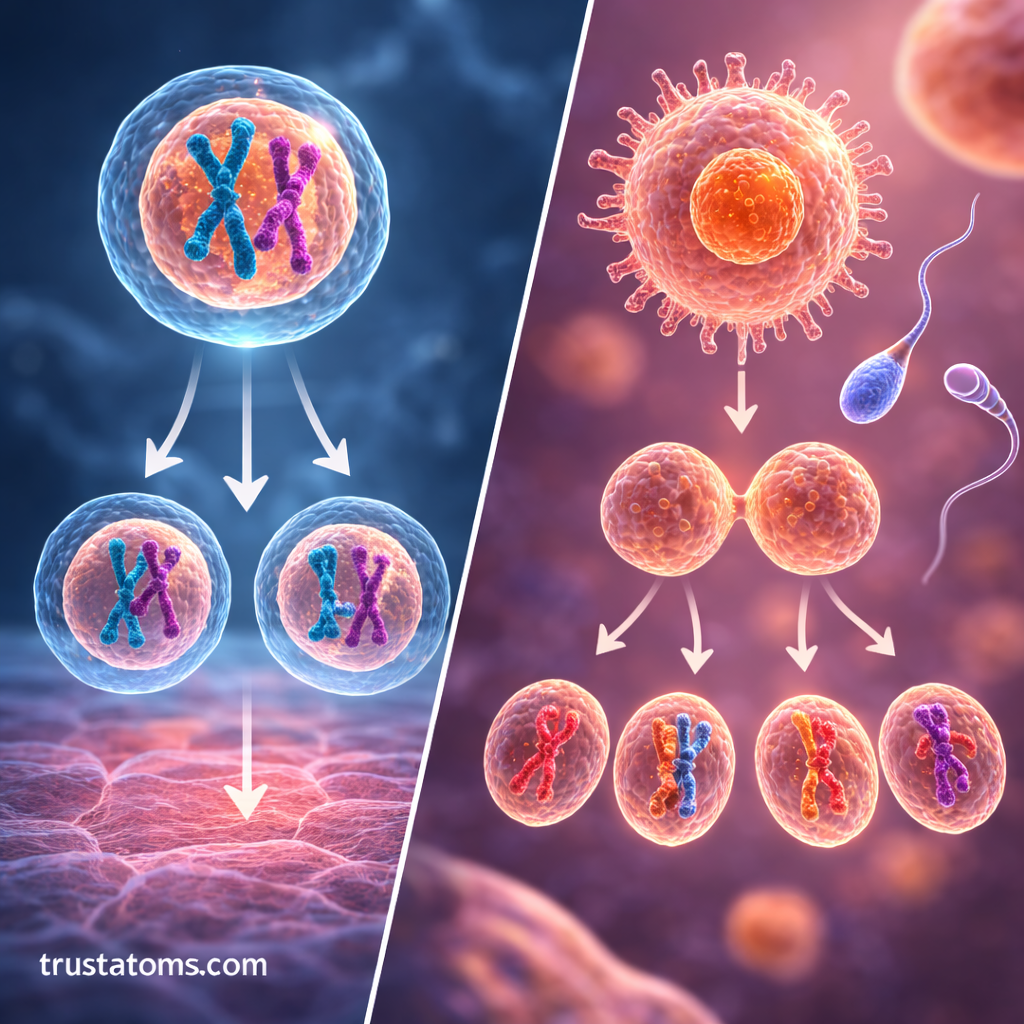
Although both processes involve cell division, several important differences distinguish them.
Number of Divisions
Mitosis involves one round of cell division, while meiosis involves two rounds of division.
Number of Daughter Cells
Mitosis produces:
- Two daughter cells
Meiosis produces:
- Four daughter cells
Genetic Similarity
Cells produced through mitosis are genetically identical to the parent cell.
Cells produced through meiosis are genetically unique, due to processes like crossing over and independent assortment.
Chromosome Number
Mitosis maintains the same chromosome number as the parent cell.
Meiosis reduces the chromosome number by half, producing haploid cells.
Purpose
Mitosis supports growth and maintenance.
Meiosis supports sexual reproduction and genetic diversity.
Quick Comparison: Mitosis vs Meiosis
Mitosis
- Occurs in body cells
- One round of division
- Produces two identical cells
- Maintains chromosome number
- Used for growth and repair
Meiosis
- Occurs in reproductive cells
- Two rounds of division
- Produces four unique cells
- Reduces chromosome number by half
- Used for sexual reproduction
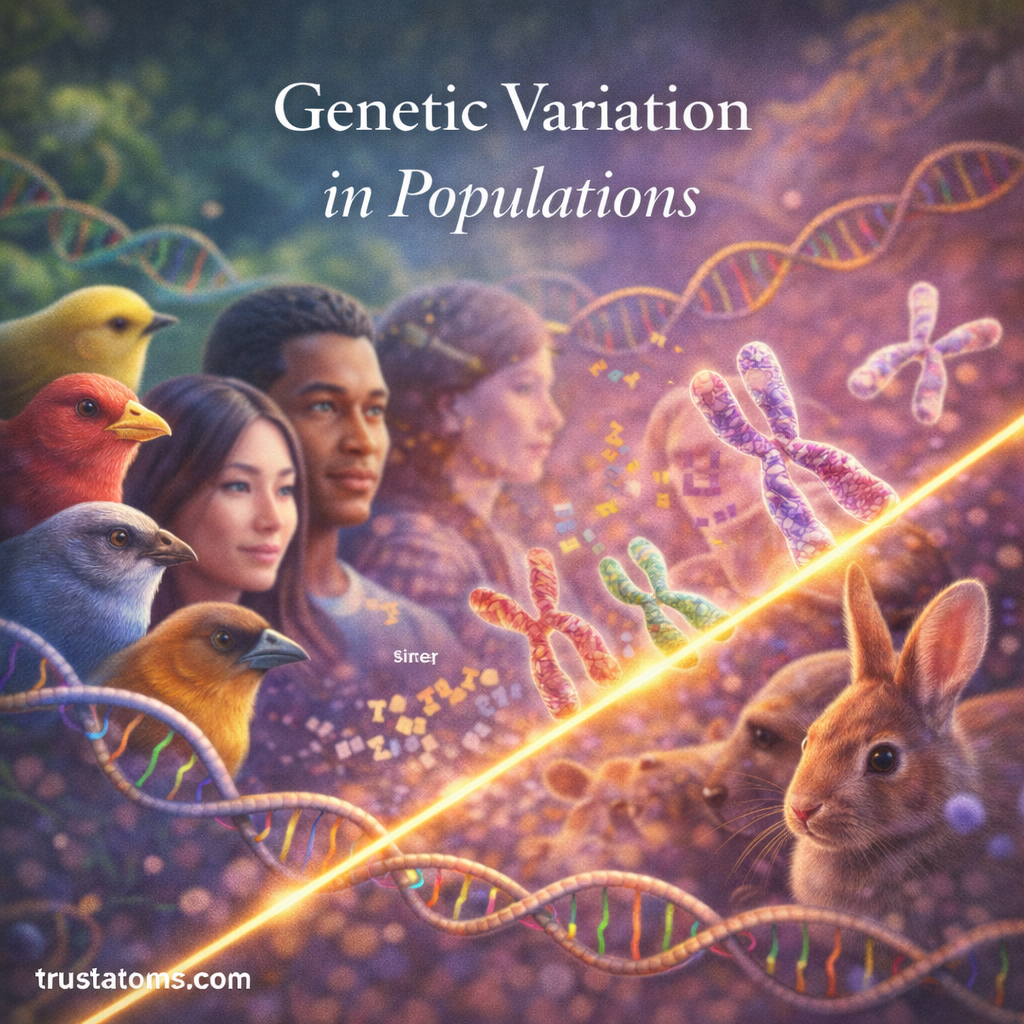
Why Genetic Variation Matters
One of the most important outcomes of meiosis is genetic variation.
Variation occurs through:
- Crossing over between homologous chromosomes
- Independent assortment of chromosomes
- Random fertilization
These processes create unique combinations of genes, which contribute to the diversity seen within populations.
Genetic variation also helps populations adapt to environmental changes through evolution.
Final Thoughts
Mitosis and meiosis are two essential forms of cell division that support different biological needs. Mitosis allows organisms to grow, repair tissues, and maintain stable body cells, while meiosis produces reproductive cells that enable sexual reproduction and genetic diversity.
By working together, these processes ensure that organisms can both maintain their bodies and pass genetic information to future generations.
Understanding the differences between mitosis and meiosis helps reveal how life grows, evolves, and reproduces at the cellular level.