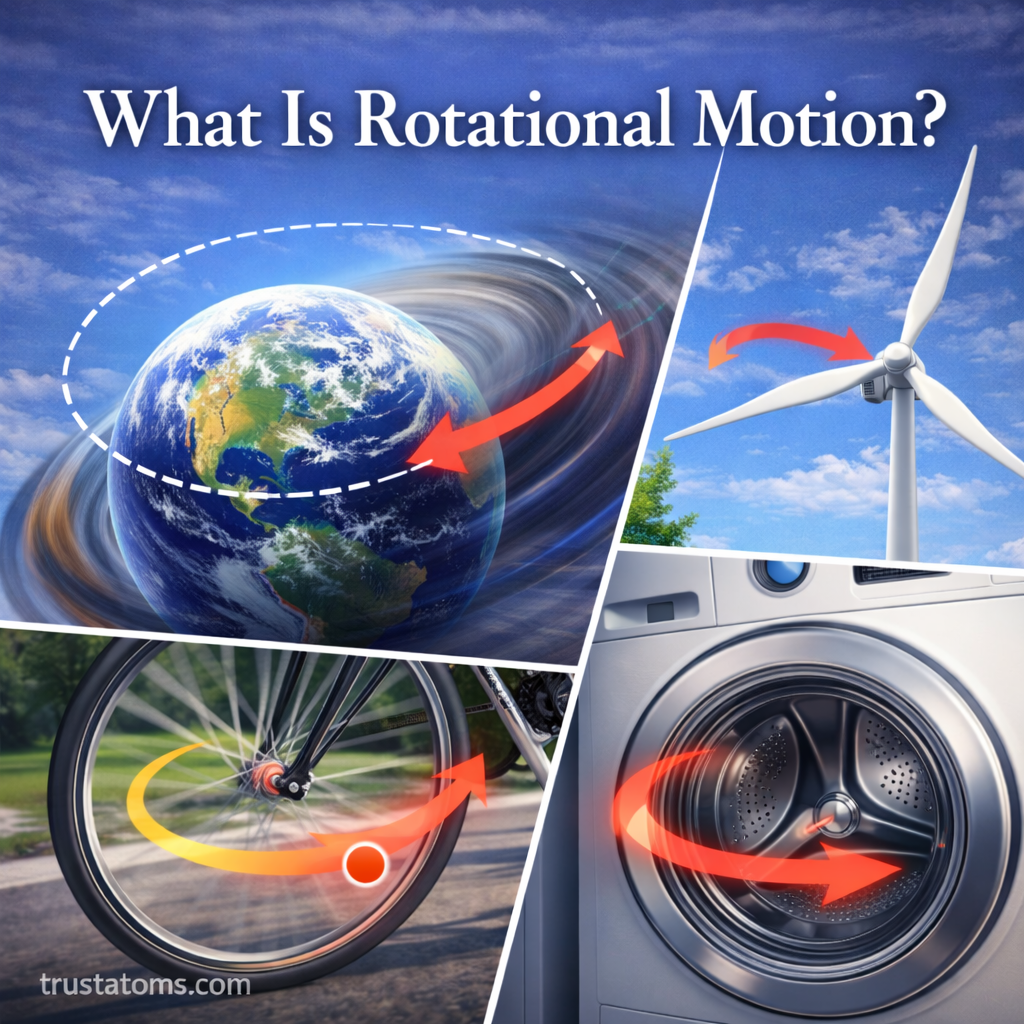
Rotational motion is the movement of an object as it spins around an axis.
From a turning wheel to the rotation of Earth, rotational motion is everywhere. Unlike straight-line (linear) motion, rotational motion involves circular movement around a fixed point or axis.
Understanding rotational motion is essential in physics, engineering, astronomy, and everyday mechanics.
In this guide, you’ll learn:
- What rotational motion means
- The difference between linear and rotational motion
- Key rotational quantities
- Real-world examples
- Why rotational motion matters
What Is Rotational Motion?
Rotational motion occurs when an object turns around a central axis.
An axis is an imaginary line about which an object rotates.
Examples include:
- A ceiling fan spinning
- A bicycle wheel turning
- Earth rotating on its axis
- A rotating washing machine drum
In each case, every point on the object moves in a circle around the axis.
Linear Motion vs. Rotational Motion
It’s important to distinguish between linear and rotational motion.
Linear Motion
- Movement in a straight line
- Described by distance, velocity, and acceleration
Example: A car driving down a highway.
Rotational Motion
- Movement around an axis
- Described by angles and angular quantities
Example: A spinning wheel.
Even though the edge of a wheel moves forward in a straight line, the wheel itself rotates.
Many real-world systems involve both types of motion at the same time.
Key Concepts in Rotational Motion
Rotational motion uses special quantities that are similar to linear motion but measured differently.
Angular Displacement
Instead of distance, rotational motion measures angle.
- Measured in degrees or radians
- Describes how far something rotates
Angular Velocity
Angular velocity describes how fast something rotates.
- Measured in radians per second
- Indicates how quickly the angle changes
If a fan spins faster, its angular velocity increases.
Angular Acceleration
Angular acceleration describes how quickly angular velocity changes.
If a wheel starts spinning faster and faster, it has angular acceleration.
Tangential Motion and Rotation
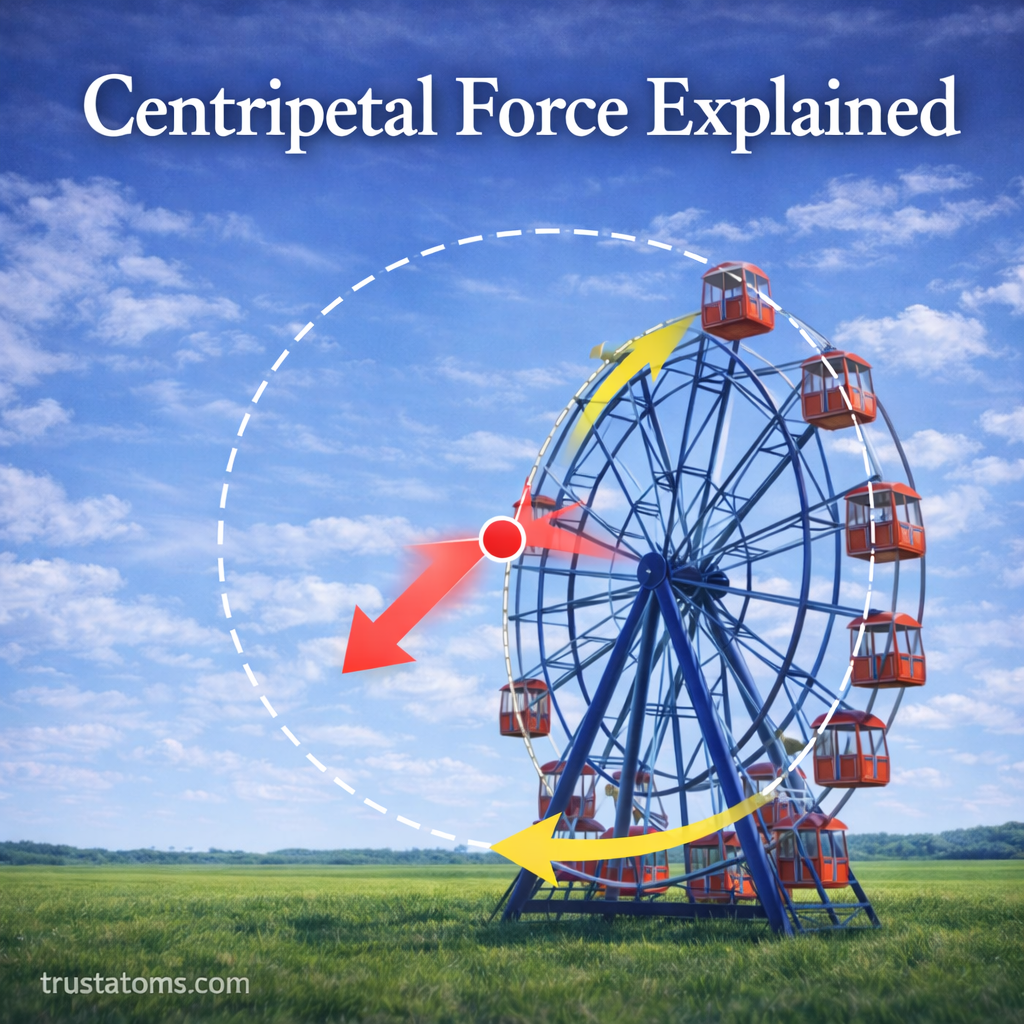
Even though an object rotates, points on the object still move in circular paths.
The edge of a spinning wheel:
- Moves faster than points closer to the center
- Covers more distance in the same time
This happens because:
Tangential speed = radius × angular velocity
Points farther from the axis move faster in linear terms.
Rotational Inertia (Moment of Inertia)
In linear motion, mass resists acceleration.
In rotational motion, moment of inertia resists angular acceleration.
Moment of inertia depends on:
- The mass of the object
- How that mass is distributed
- The distance from the axis
Objects with mass farther from the center are harder to spin.
For example:
- A figure skater spins faster when pulling arms inward
- A heavy flywheel resists changes in rotation
Torque: The Force of Rotation
Torque is the rotational equivalent of force.
While force causes linear acceleration, torque causes angular acceleration.
Torque depends on:
- The applied force
- The distance from the axis
- The angle at which force is applied
Examples of torque in action:
- Opening a door
- Using a wrench
- Pedaling a bicycle
The farther from the pivot point you apply force, the easier it is to rotate an object.
Real-World Examples of Rotational Motion

Rotational motion is everywhere:
- Earth rotating every 24 hours
- Car tires spinning while driving
- Wind turbines generating electricity
- Gears in machines
- Washing machine drums spinning
Even atoms and subatomic particles exhibit rotational behaviors in advanced physics models.
Rotational Motion and Energy
Rotating objects have rotational kinetic energy.
This energy depends on:
- Moment of inertia
- Angular velocity
The faster something spins, the more rotational energy it has.
This is why:
- Power tools spin rapidly
- Flywheels store energy
- Amusement rides require strong safety design
Rolling Motion: Rotation + Translation
Rolling motion combines:
- Rotational motion
- Linear motion
For example:
- A rolling soccer ball
- A moving bicycle tire
The wheel rotates around its axis while also moving forward.
This combination is common in vehicles and machinery.
Why Rotational Motion Matters
Understanding rotational motion is essential for:
- Engineering design
- Mechanical systems
- Aerospace physics
- Robotics
- Astronomy
It helps explain how machines operate and how planets move.
Without rotational motion, many modern technologies would not function.
Common Mistakes to Avoid
Students often:
- Confuse angular velocity with linear velocity
- Forget that points farther from the center move faster
- Overlook torque when analyzing motion
- Forget that mass distribution affects rotation
Always identify:
- The axis of rotation
- The forces or torques involved
- Whether motion is purely rotational or combined with linear motion
Final Thoughts
Rotational motion is the spinning movement of an object around an axis.
It introduces new concepts like angular velocity, torque, and moment of inertia — all of which parallel familiar ideas from linear motion.
From rotating wheels to spinning planets, rotational motion plays a fundamental role in both everyday life and advanced physics.
Understanding it opens the door to deeper concepts in mechanics and motion.