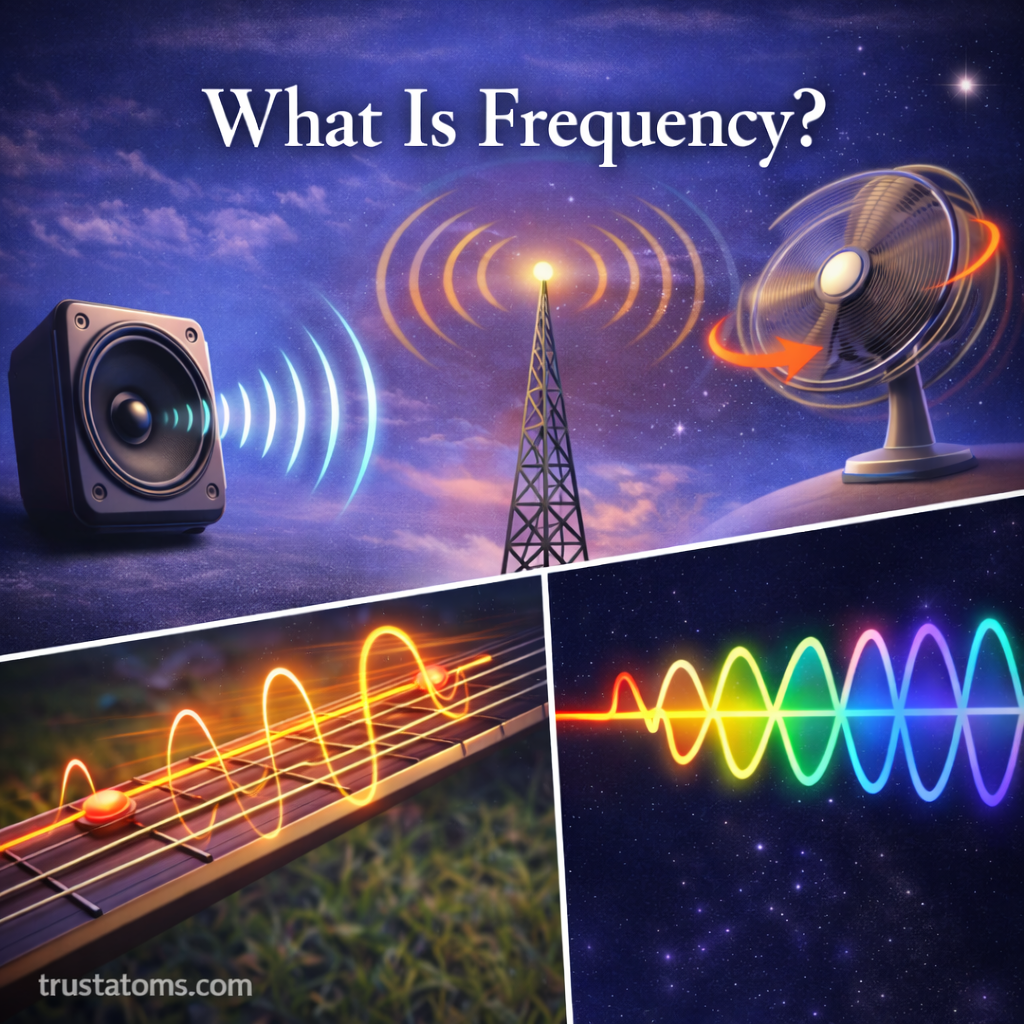
Frequency measures how often something happens within a specific amount of time.
In physics, frequency usually describes how many cycles, waves, vibrations, or oscillations occur per second. From sound waves to radio signals to rotating fans, frequency is a fundamental concept that helps us understand repeating motion.
In this guide, you’ll learn:
- What frequency means in physics
- The unit of frequency
- The frequency formula
- How frequency relates to wavelength and period
- Real-world examples
What Is Frequency in Physics?
Frequency is the number of complete cycles that occur in one second.
A cycle can be:
- One full vibration
- One complete wave
- One full rotation
- One oscillation back and forth
If something repeats 10 times in one second, its frequency is 10.
The faster the repetition, the higher the frequency.
The Unit of Frequency: Hertz (Hz)
Frequency is measured in hertz (Hz).
1 hertz = 1 cycle per second
Examples:
- 5 Hz means 5 cycles per second
- 60 Hz means 60 cycles per second
- 1,000 Hz means 1,000 cycles per second
The unit is named after Heinrich Hertz, a physicist who studied electromagnetic waves.
The Frequency Formula
The basic formula for frequency is:
f = 1 / T
Where:
- f = frequency
- T = period
The period is the time required for one complete cycle.
If one vibration takes 0.5 seconds:
Frequency = 1 / 0.5 = 2 Hz
This means two cycles occur every second.
Frequency and Period Relationship
Frequency and period are inversely related.
This means:
- High frequency → short period
- Low frequency → long period
If something vibrates very quickly:
- The time for each cycle is small.
If something vibrates slowly:
- The time for each cycle is longer.
Frequency in Waves
Frequency is especially important in wave motion.
In waves:
- Frequency tells us how many wave cycles pass a point each second.
- It affects energy and behavior of the wave.
There is a relationship between:
Wave speed, frequency, and wavelength.
Wave speed = frequency × wavelength
If wave speed stays constant:
- Higher frequency → shorter wavelength
- Lower frequency → longer wavelength
Frequency in Sound
In sound waves, frequency determines pitch.
- High frequency → high-pitched sound
- Low frequency → low-pitched sound
For example:
- A whistle produces high-frequency sound waves.
- A bass drum produces low-frequency sound waves.
Human hearing typically ranges from about:
20 Hz to 20,000 Hz
Frequency in Light and Electromagnetic Waves
Light is also a wave, and its frequency determines its color.
- Higher frequency → violet/blue light
- Lower frequency → red light
Beyond visible light:
- Radio waves have low frequencies.
- X-rays have very high frequencies.
The higher the frequency, the more energy the wave carries.
Frequency in Circular and Rotational Motion
Frequency also applies to rotational motion.
For example:
If a fan completes 5 full rotations every second:
Its frequency is 5 Hz.
This is often related to revolutions per second (rps).
Machines, engines, and turbines are often analyzed using frequency.
Everyday Examples of Frequency
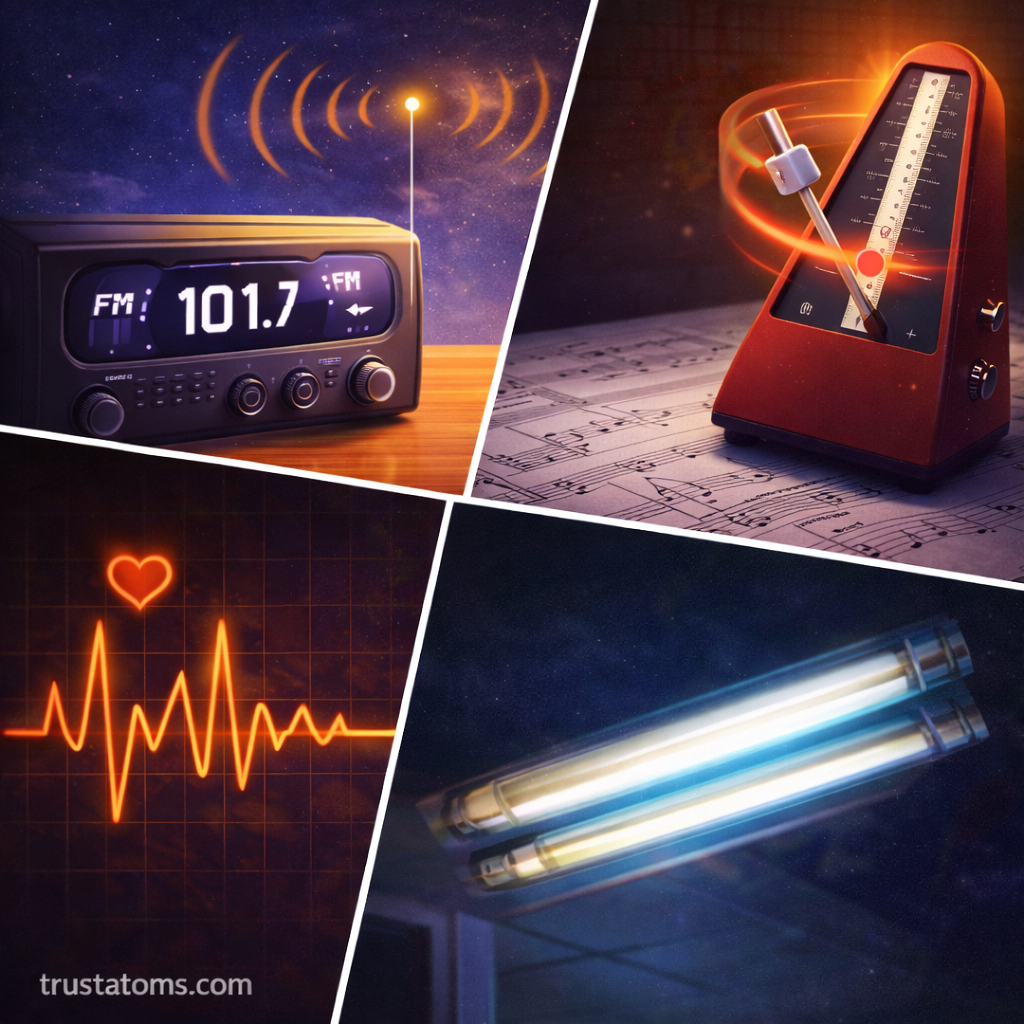
Frequency appears in many real-world situations:
- Heartbeats per second
- Blinking lights
- Rotating wheels
- Vibrating guitar strings
- Radio transmissions
- Alternating current in power systems
In many countries, household electricity operates at 50 Hz or 60 Hz.
Why Frequency Matters
Frequency helps scientists and engineers:
- Design musical instruments
- Build communication systems
- Analyze wave behavior
- Study energy transfer
- Understand mechanical vibrations
It is a key concept in physics, electronics, acoustics, and engineering.
Common Mistakes to Avoid
Students often:
- Confuse frequency with speed
- Forget that frequency measures cycles per second
- Mix up frequency and period
- Assume higher frequency always means faster motion (it depends on context)
Always identify:
- What is repeating
- How long one cycle takes
- Whether the motion is oscillation, rotation, or wave-based
Final Thoughts
Frequency measures how often something repeats in a given amount of time.
Whether it’s sound waves, light waves, rotating machines, or vibrating strings, frequency helps describe patterns of motion and energy.
Understanding frequency builds a foundation for learning about waves, electricity, sound, and many advanced topics in physics.
It is one of the most important repeating-motion concepts in science.