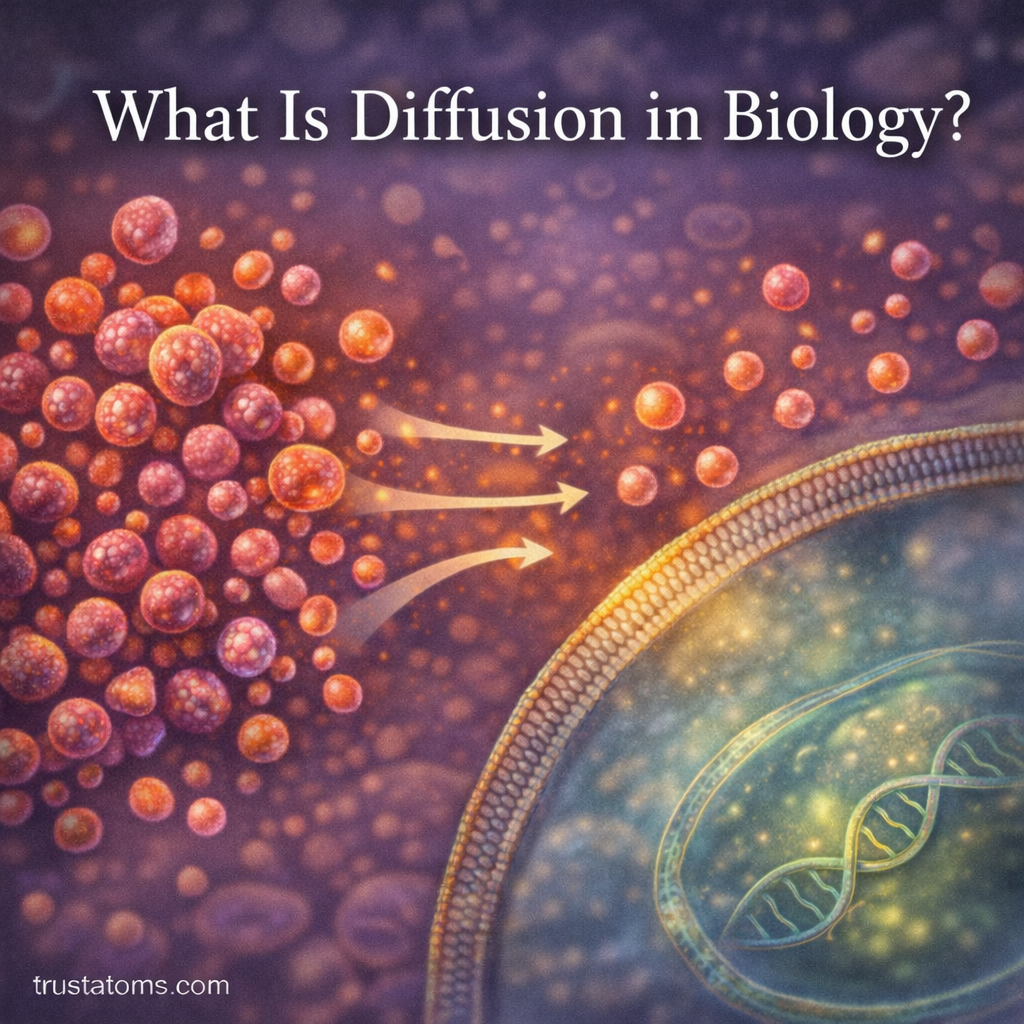
Diffusion is one of the most fundamental processes in biology. It allows molecules to move naturally from areas of higher concentration to areas of lower concentration without the need for energy. This simple movement plays a major role in how cells exchange materials, maintain balance, and support life.
Every living cell depends on diffusion to transport essential substances such as oxygen, carbon dioxide, nutrients, and waste products. Without diffusion, cells would struggle to maintain the chemical balance needed for normal biological function.
Understanding diffusion helps explain how cells interact with their environment and how many biological systems maintain stability.
The Basic Definition of Diffusion
Diffusion is the passive movement of particles from a region where they are more concentrated to a region where they are less concentrated. This movement continues until the particles are evenly distributed.
The process occurs naturally because molecules are constantly moving due to their kinetic energy.
Key characteristics of diffusion include:
- Movement from high concentration to low concentration
- No energy required from the cell
- Random molecular motion
- Movement until equilibrium is reached
At equilibrium, particles continue to move randomly, but there is no net change in their distribution.
Why Diffusion Is Important in Cells
Cells must constantly exchange substances with their surrounding environment. Diffusion provides a simple and efficient way for many molecules to cross cellular membranes.
Through diffusion, cells can:
- Take in oxygen for respiration
- Release carbon dioxide produced during metabolism
- Absorb small nutrients
- Remove metabolic waste
Because diffusion requires no energy input, it is one of the most energy-efficient transport mechanisms used by cells.
How Diffusion Works at the Molecular Level
Molecules are always in motion due to thermal energy. In liquids and gases, this motion causes particles to move randomly in different directions.
When a region contains many molecules, they naturally spread out over time.
This spreading occurs because:
- Molecules collide with each other.
- Collisions cause particles to move in new directions.
- Over time, molecules spread from crowded areas to less crowded areas.
Eventually, the molecules become evenly distributed throughout the available space.
Diffusion Across Cell Membranes
Cells are surrounded by a structure called the plasma membrane. This membrane controls which substances can enter or leave the cell.
Some small or nonpolar molecules can pass directly through the membrane by diffusion.
Examples of molecules that often diffuse across membranes include:
- Oxygen
- Carbon dioxide
- Small lipid-soluble molecules
The membrane acts as a selective barrier, allowing some substances to diffuse freely while blocking others.
Factors That Affect the Rate of Diffusion
Although diffusion occurs naturally, several factors influence how quickly it happens.
Concentration Gradient
The concentration gradient refers to the difference in concentration between two areas.
A larger concentration difference leads to faster diffusion because more molecules move from the crowded region.
Temperature
Higher temperatures increase molecular motion. As molecules move faster, diffusion occurs more quickly.
Surface Area
Diffusion happens more efficiently when a larger surface area is available for molecules to move across.
Distance
Shorter distances allow molecules to diffuse more rapidly. When molecules must travel longer distances, diffusion becomes slower.
These factors help explain why biological structures often evolve to maximize surface area and minimize diffusion distance.
Types of Diffusion in Biological Systems
Although the basic concept of diffusion is simple, biological systems use several variations of this process.
Simple Diffusion
Simple diffusion occurs when molecules move directly across a membrane without the help of specialized proteins.
This process typically involves small, nonpolar molecules that can easily pass through the lipid membrane.
Facilitated Diffusion
Facilitated diffusion occurs when molecules require assistance from membrane proteins.
These proteins form channels or carriers that allow specific molecules to pass through the membrane.
Facilitated diffusion still follows the concentration gradient and does not require energy.
Examples include the movement of:
- Glucose
- Certain ions
- Water molecules through specialized channels
Diffusion in Tissues and Organisms
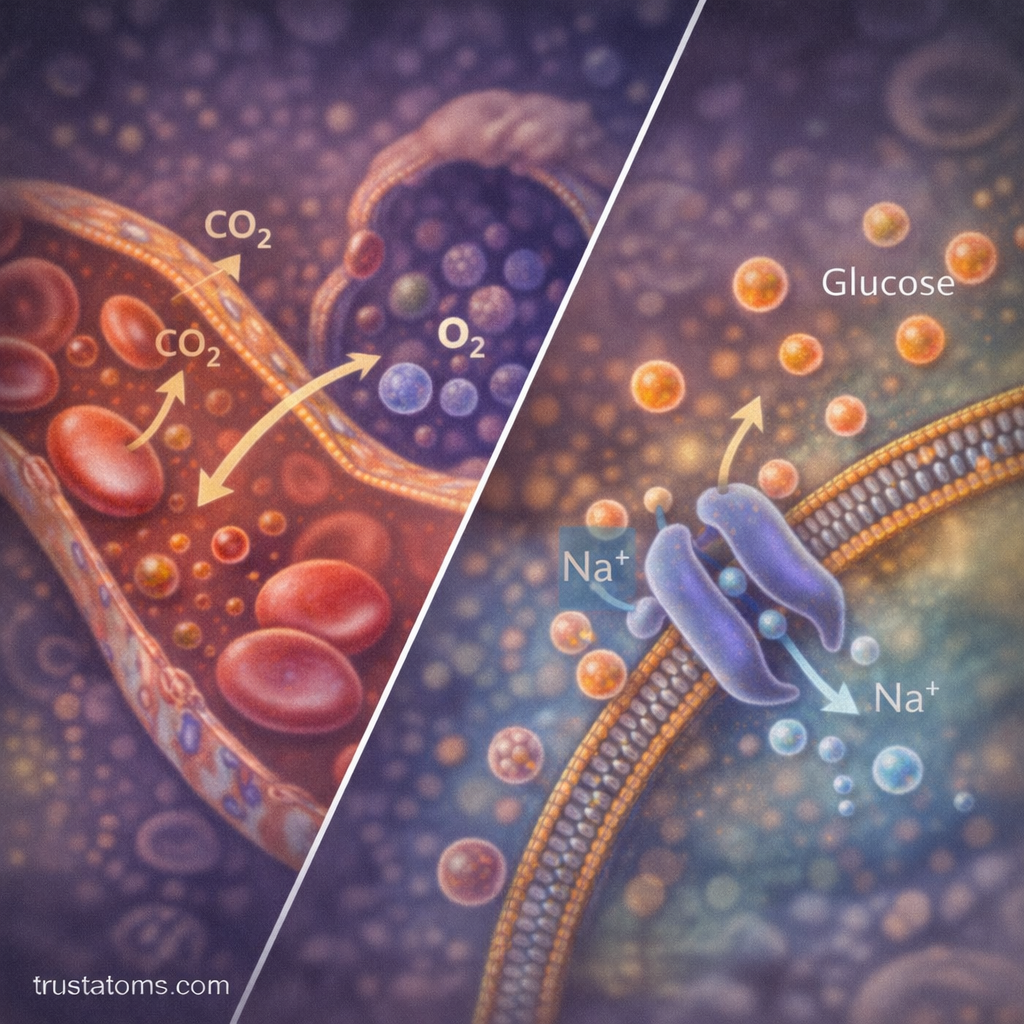
Diffusion is not limited to individual cells. It also plays an important role in tissues and organs throughout the body.
Examples include:
- Oxygen moving from the lungs into the bloodstream
- Carbon dioxide diffusing from blood into the lungs
- Nutrients diffusing from capillaries into surrounding tissues
In plants, diffusion helps move gases between leaf cells and the surrounding air.
Although diffusion is effective over short distances, larger organisms often require specialized systems such as circulatory systems to transport substances over longer distances.
Diffusion and Cellular Homeostasis
Homeostasis refers to the ability of cells and organisms to maintain stable internal conditions.
Diffusion contributes to homeostasis by helping regulate the concentration of molecules inside cells.
For example, diffusion helps maintain balance by:
- Removing waste products
- Delivering essential gases
- Distributing small nutrients
Without diffusion, cells would have difficulty maintaining the chemical conditions necessary for life.
Diffusion Compared With Active Transport
Diffusion is part of a broader group of cellular transport processes.
Unlike diffusion, active transport requires energy to move substances across membranes.
Key differences include:
Diffusion:
- Moves molecules from high concentration to low concentration
- Requires no cellular energy
- Relies on natural molecular motion
Active transport:
- Moves molecules against their concentration gradient
- Requires energy, often in the form of ATP
- Uses specialized transport proteins
Cells rely on both diffusion and active transport to regulate the movement of different substances.
Why Diffusion Matters in Biology
Diffusion may appear simple, but it plays a critical role in biological systems. From cellular respiration to nutrient exchange, many essential processes depend on the natural movement of molecules.
Because diffusion occurs continuously and without energy cost, it provides an efficient way for cells to maintain chemical balance.
Understanding diffusion helps explain how cells survive, how tissues exchange materials, and how organisms maintain stable internal environments.
Final Thoughts
Diffusion is one of the most basic yet essential processes in biology. Through the natural movement of molecules from areas of higher concentration to lower concentration, cells are able to exchange gases, nutrients, and waste products with their surroundings.
This passive transport process supports cellular homeostasis, tissue function, and overall biological stability. Even though diffusion operates on a microscopic scale, it plays a major role in sustaining life across all living organisms.