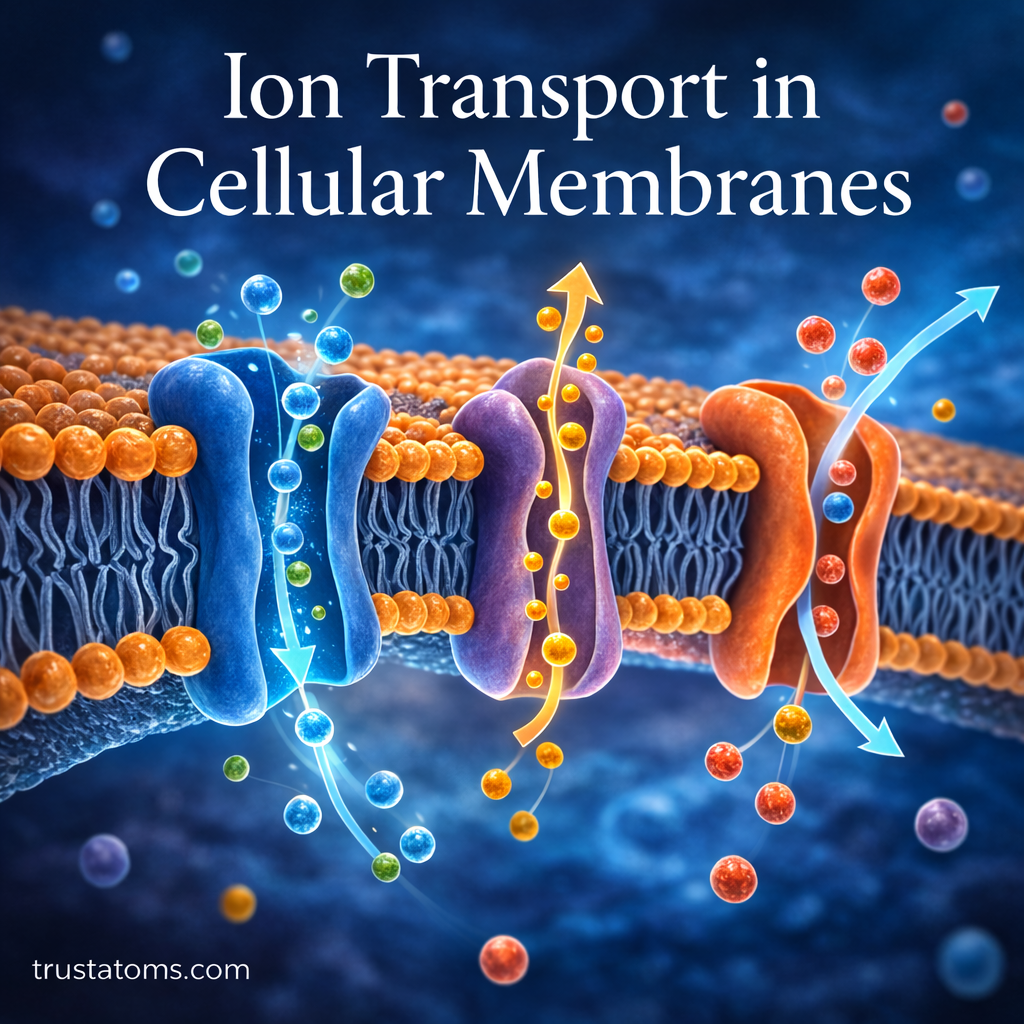
Cells rely on the controlled movement of charged particles, known as ions, to maintain proper biological function. Ion transport across cellular membranes plays a critical role in regulating electrical signals, maintaining chemical balance, and supporting essential cellular activities.
Because ions carry electrical charge, their movement must be carefully regulated. Cellular membranes contain specialized proteins that control when and how ions enter or leave the cell. These transport systems allow cells to maintain stable internal conditions while responding to changes in the surrounding environment.
Ion transport is especially important in processes such as nerve signaling, muscle contraction, nutrient absorption, and maintaining cellular homeostasis.
What Are Ions in Biological Systems?
Ions are atoms or molecules that carry an electrical charge because they have gained or lost electrons. In biological systems, ions are commonly dissolved in water and participate in many chemical reactions.
Common ions found in living cells include:
- Sodium (Na⁺)
- Potassium (K⁺)
- Calcium (Ca²⁺)
- Chloride (Cl⁻)
- Hydrogen ions (H⁺)
These ions help regulate electrical signals, enzyme activity, and fluid balance within cells and tissues.
The Structure of the Cellular Membrane
The cellular membrane, also called the plasma membrane, is composed primarily of a phospholipid bilayer. This structure acts as a protective barrier that separates the internal environment of the cell from the external environment.
The lipid portion of the membrane prevents most ions from passing through freely. Because ions carry electrical charge and are typically surrounded by water molecules, they cannot easily cross the membrane without assistance.
To overcome this barrier, cells use specialized membrane proteins that allow ions to move in a controlled manner.
Why Ion Transport Is Necessary
Cells must carefully regulate the concentration of ions on each side of the membrane. Differences in ion concentration help create electrical gradients and chemical gradients that support many biological processes.
Ion transport helps cells:
- Maintain electrical membrane potential
- Regulate cellular pH levels
- Control water balance
- Support nerve and muscle activity
- Facilitate nutrient transport
Without controlled ion movement, cells would lose their ability to maintain stable internal conditions.
Types of Ion Transport Mechanisms
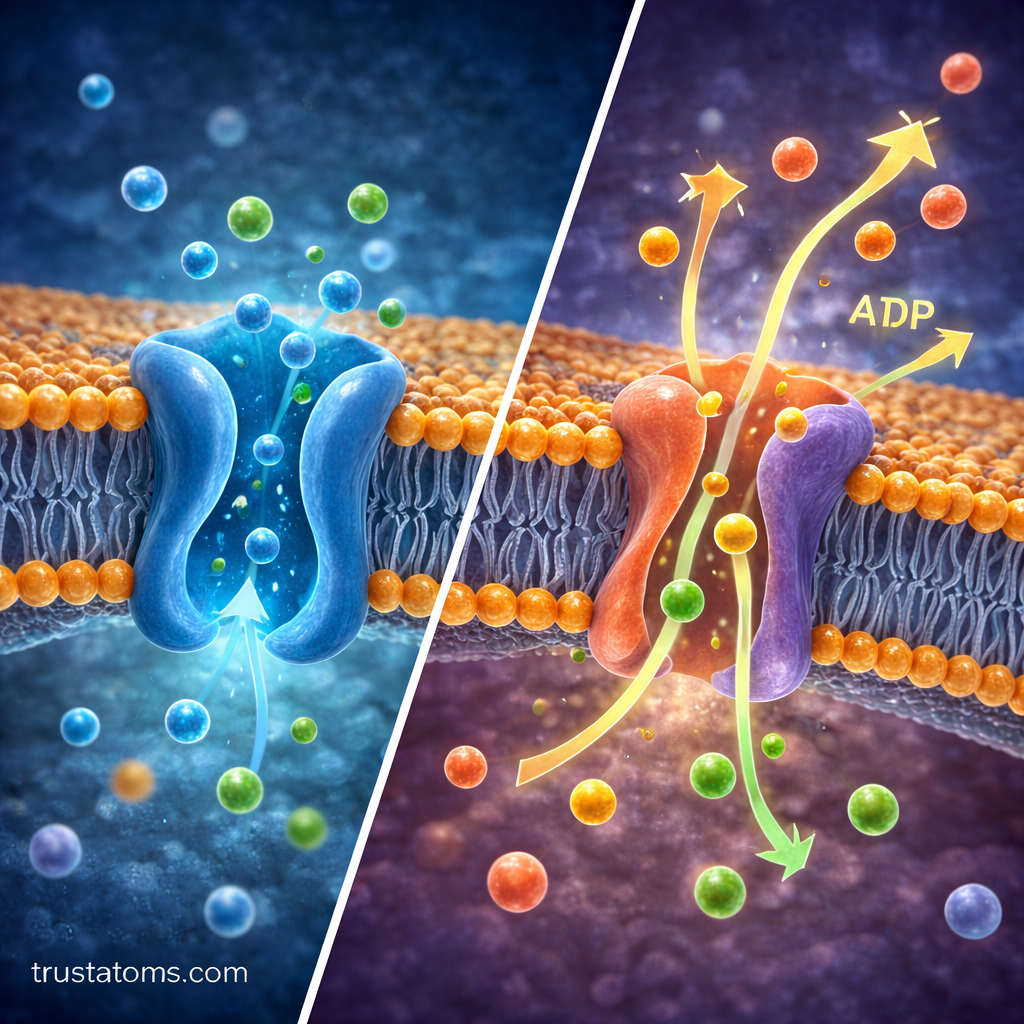
Ion transport across cellular membranes occurs through two main types of processes:
- Passive transport
- Active transport
These mechanisms differ primarily in whether the cell must use energy to move ions.
Passive Ion Transport
Passive transport allows ions to move across membranes without the use of cellular energy. Instead, ions move down their concentration gradient—from areas of higher concentration to lower concentration.
This process occurs through specialized proteins called ion channels.
Ion Channels
Ion channels form tiny openings in the membrane that allow specific ions to pass through.
Different ion channels are selective for different ions, meaning they only allow certain charged particles to pass.
Examples include channels that allow the movement of:
- Sodium ions
- Potassium ions
- Calcium ions
- Chloride ions
Some ion channels remain open continuously, while others open and close in response to specific signals.
Gated Ion Channels
Certain ion channels open or close depending on specific conditions.
Types of gated channels include:
- Voltage-gated channels that respond to changes in membrane potential
- Ligand-gated channels that open when specific molecules bind to the channel
- Mechanically gated channels that respond to physical pressure or stretch
These mechanisms allow cells to control ion flow precisely.
Active Ion Transport
Active transport moves ions across membranes against their concentration gradient. Because this movement requires energy, cells typically use molecules such as ATP to power the process.
Active transport allows cells to maintain important ion concentration differences between the inside and outside of the cell.
Ion Pumps
Ion pumps are proteins that use energy to transport ions across membranes.
One of the most well-known examples is the sodium-potassium pump.
This pump performs several important steps:
- It moves sodium ions out of the cell.
- It transports potassium ions into the cell.
- It uses energy from ATP to perform this exchange.
The sodium-potassium pump is essential for maintaining electrical gradients used by nerve cells.
Electrochemical Gradients
Ion movement is influenced by two major factors:
- Concentration gradients
- Electrical charge differences
Together, these forces form an electrochemical gradient.
The electrochemical gradient determines the direction ions will move when channels open.
For example:
- Positive ions may move toward negatively charged regions.
- Ions may diffuse from high concentration areas to low concentration areas.
These gradients are essential for many biological signaling processes.
Ion Transport and Nerve Signaling
Ion transport plays a major role in the functioning of the nervous system.
Nerve cells communicate through electrical signals known as action potentials. These signals are generated by rapid changes in ion movement across the cell membrane.
During nerve signaling:
- Sodium channels open, allowing sodium ions to enter the cell.
- The membrane potential changes rapidly.
- Potassium channels open, allowing potassium ions to exit the cell.
- The membrane returns to its resting state.
This controlled movement of ions allows electrical signals to travel along nerve cells.
Ion Transport in Muscle Cells
Muscle contraction also depends heavily on ion transport.
Calcium ions play a particularly important role in triggering muscle contraction.
When a muscle cell receives a signal:
- Calcium ions are released inside the cell.
- These ions interact with contractile proteins.
- Muscle fibers shorten, producing contraction.
Once the contraction ends, calcium ions are pumped back into storage compartments within the cell.
Ion Transport and Cellular Homeostasis
Ion transport systems are critical for maintaining homeostasis—the stable internal environment required for normal cellular function.
These systems help regulate:
- Cell volume
- Fluid balance
- Electrical charge across membranes
- Enzyme activity
- Metabolic processes
By controlling ion concentrations, cells maintain the conditions necessary for biochemical reactions to occur efficiently.
Why Ion Transport Matters in Biology
Ion transport across cellular membranes is essential for life. From electrical signaling in the brain to muscle movement and nutrient absorption, many biological systems rely on controlled ion movement.
These processes demonstrate how cellular membranes act not only as protective barriers but also as highly regulated gateways that control molecular exchange.
Understanding ion transport provides insight into how cells maintain stability, communicate with one another, and respond to environmental changes.
Final Thoughts
Ion transport in cellular membranes is a fundamental biological process that allows cells to regulate electrical signals, chemical gradients, and internal balance. Through passive channels and energy-driven pumps, ions move across membranes in carefully controlled ways.
These transport systems support essential functions such as nerve signaling, muscle contraction, and maintaining cellular homeostasis. By regulating the movement of charged particles, cells ensure that biological systems operate efficiently and remain responsive to changing conditions.