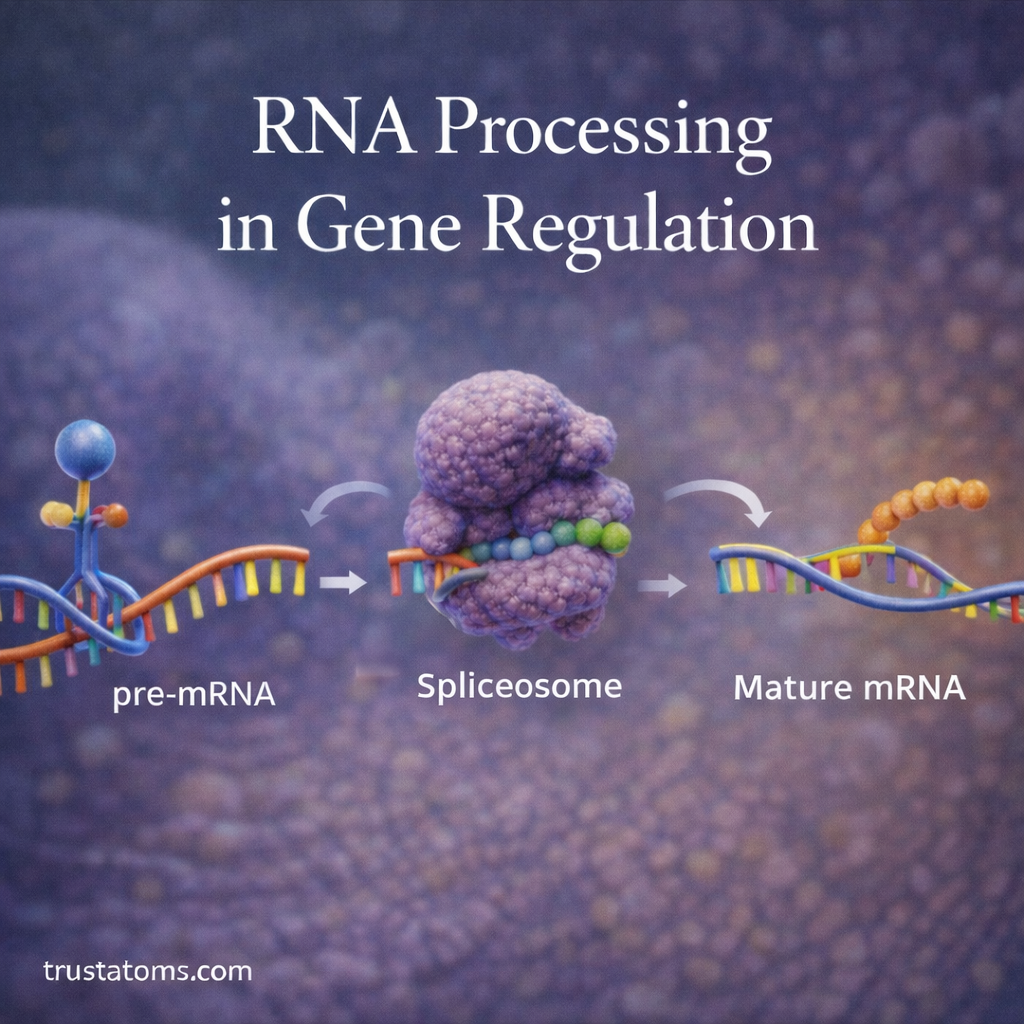
RNA processing is a set of cellular steps that modify newly made RNA molecules before they are used to produce proteins. These modifications are especially important in eukaryotic cells and play a major role in gene regulation, which is the control of when and how genes are expressed.
After DNA is transcribed into RNA, the resulting molecule—called pre-messenger RNA (pre-mRNA)—cannot immediately guide protein production. It must first undergo several processing steps that prepare it for translation.
Through RNA processing, cells can control which genetic instructions are used, how often they are used, and how proteins are ultimately produced. This makes RNA processing an essential layer of regulation in gene expression.
The Connection Between RNA Processing and Gene Regulation
Gene regulation allows cells to control which genes are active at specific times. RNA processing contributes to this regulation by determining how RNA molecules are modified, transported, and translated into proteins.
Key ways RNA processing regulates genes include:
- Determining which RNA segments remain in the final transcript
- Influencing how stable RNA molecules are
- Controlling when RNA leaves the nucleus
- Affecting how efficiently proteins are produced
These regulatory mechanisms allow cells to produce different proteins depending on their needs, environmental signals, or developmental stage.
From Pre-mRNA to Mature mRNA
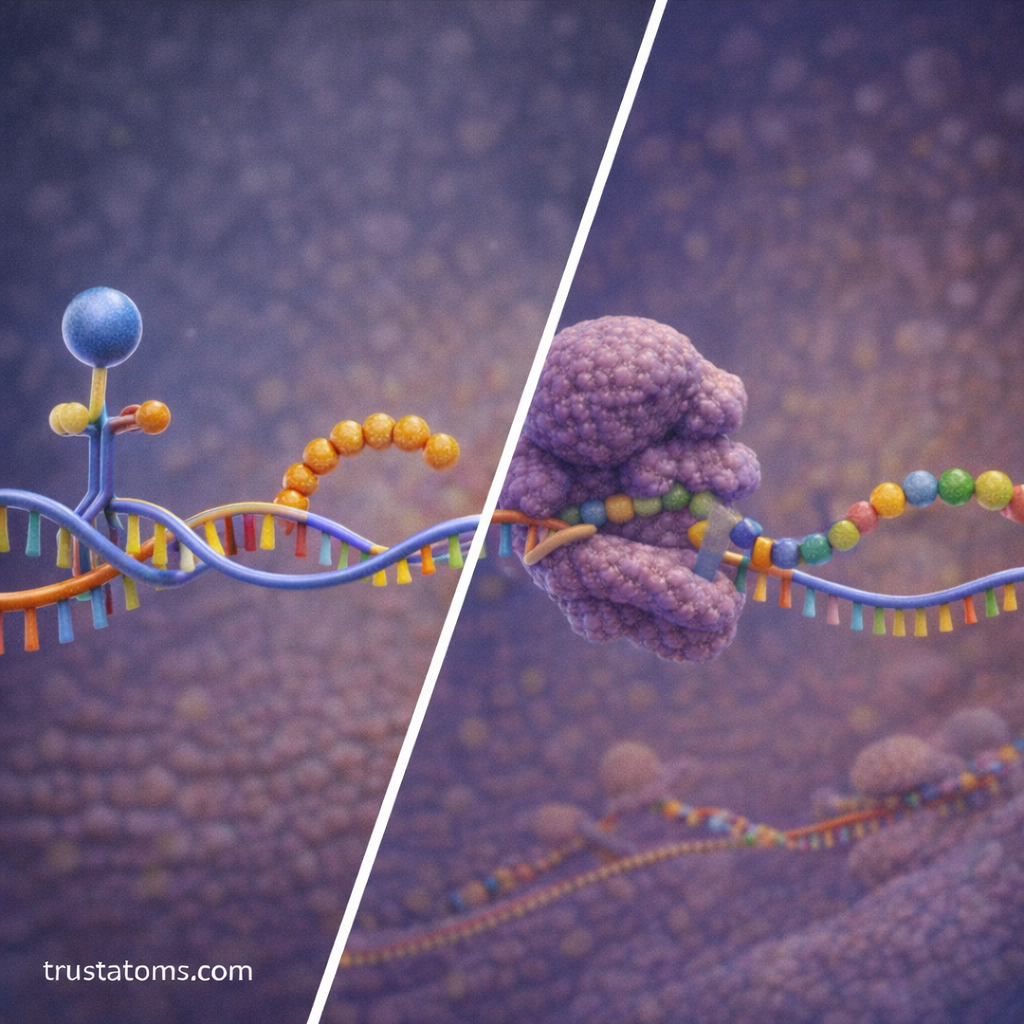
In eukaryotic cells, transcription produces pre-mRNA, which contains both coding and non-coding regions.
Before the RNA can be used by ribosomes, it must be converted into mature messenger RNA (mRNA) through processing.
The three primary processing steps are:
- 5′ capping
- RNA splicing
- Polyadenylation (poly-A tail addition)
These modifications protect the RNA molecule and prepare it for translation.
5′ Cap Addition
One of the first modifications added to pre-mRNA is the 5′ cap, a modified nucleotide attached to the beginning of the RNA molecule.
The 5′ cap serves several important functions:
- Protects RNA from degradation
- Helps ribosomes recognize the RNA during translation
- Assists in transporting RNA from the nucleus to the cytoplasm
Without this cap structure, RNA molecules would be unstable and quickly broken down within the cell.
RNA Splicing
RNA splicing is the process of removing non-coding regions from pre-mRNA.
Pre-mRNA contains two types of sequences:
- Exons – coding segments that contain instructions for building proteins
- Introns – non-coding segments that must be removed
During splicing:
- Introns are cut out of the RNA molecule.
- Exons are joined together.
- A continuous coding sequence is formed.
This process is carried out by a large molecular complex known as the spliceosome.
Alternative Splicing and Protein Diversity
One of the most powerful regulatory tools in RNA processing is alternative splicing.
Alternative splicing allows cells to produce multiple protein versions from a single gene by combining exons in different ways.
For example, a single gene may produce:
- A protein used in muscle tissue
- A slightly different protein used in nerve cells
- Another variant used during early development
Because of alternative splicing, the number of proteins produced by human cells is far greater than the number of genes in the genome.
Poly-A Tail Addition
Another important modification is the addition of a poly-A tail, which is a long chain of adenine nucleotides added to the end of the RNA molecule.
The poly-A tail performs several key functions:
- Stabilizes the RNA molecule
- Protects RNA from degradation
- Helps transport RNA out of the nucleus
- Improves translation efficiency
Longer poly-A tails often make RNA molecules more stable, allowing them to remain active in the cell for longer periods.
RNA Processing and Cellular Control
RNA processing helps cells fine-tune gene activity. Instead of simply turning genes on or off, cells can adjust gene expression more precisely.
Examples of regulatory control include:
- Producing different protein variants through alternative splicing
- Controlling how quickly RNA molecules degrade
- Regulating how efficiently ribosomes translate RNA into proteins
- Determining which RNA molecules leave the nucleus
These mechanisms allow cells to respond to changes in their environment and adapt their behavior.
RNA Processing in Development and Disease
RNA processing plays a major role in development and cell specialization.
During development, cells must activate different genes to form specific tissues such as:
- Brain cells
- Muscle cells
- Immune cells
Alternative splicing helps generate proteins that support these specialized functions.
However, errors in RNA processing can lead to disease. Problems with splicing or RNA stability have been linked to conditions such as:
- Certain cancers
- Genetic disorders
- Neurodegenerative diseases
Because of this, RNA processing is an important focus of modern medical research.
Why RNA Processing Matters in Biology
RNA processing is essential for accurate and flexible gene expression.
It allows cells to:
- Protect newly formed RNA molecules
- Produce multiple proteins from a single gene
- Control protein production levels
- Adapt gene activity to changing conditions
Without RNA processing, many RNA molecules would be unstable or unable to produce functional proteins.
Final Thoughts
RNA processing is a crucial stage of gene expression that modifies newly created RNA molecules before they are used to build proteins. Through processes such as 5′ capping, RNA splicing, and poly-A tail addition, cells prepare RNA for translation while also regulating how genes are expressed.
These mechanisms give cells remarkable flexibility, allowing a limited number of genes to generate a wide variety of proteins. As a result, RNA processing plays a key role in development, cellular function, and the regulation of life at the molecular level.