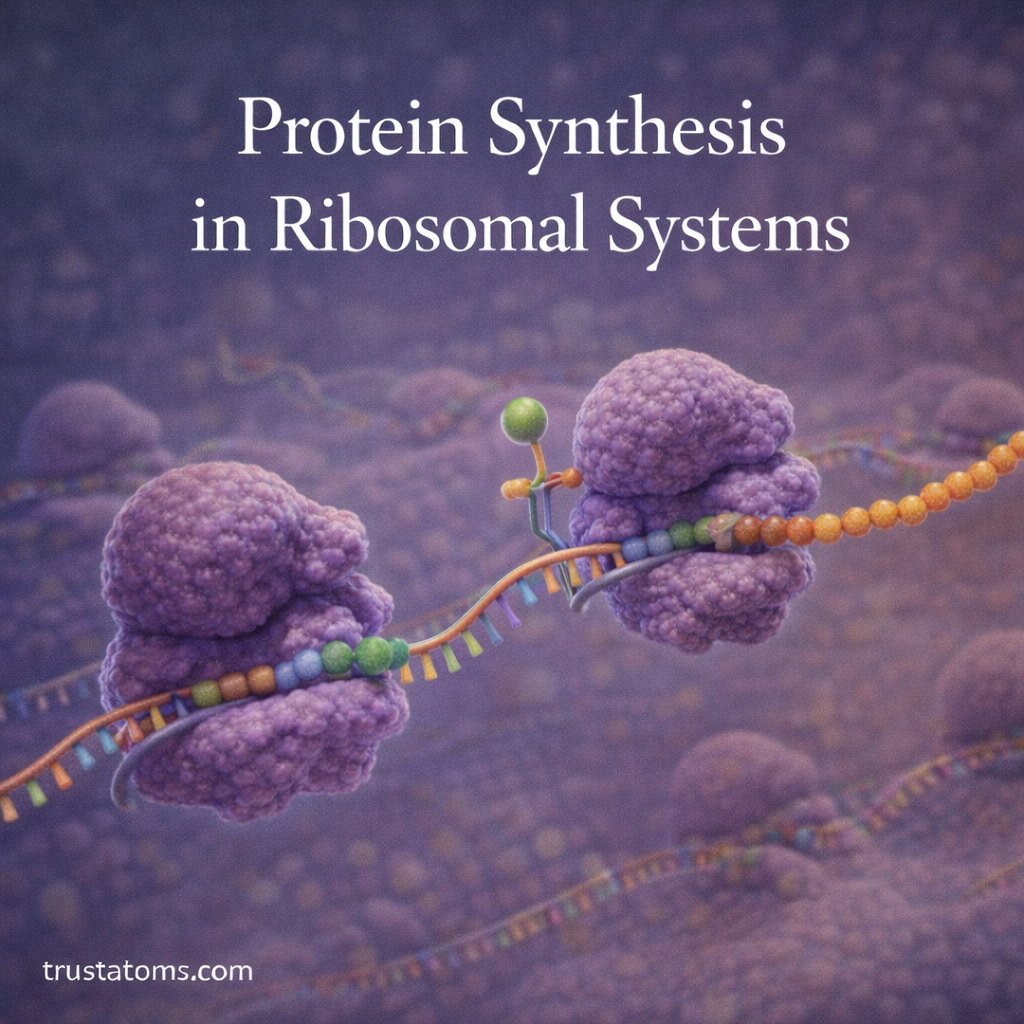
Protein synthesis is the biological process by which cells build proteins using genetic instructions stored in DNA. Within this process, ribosomal systems play the central role by translating messenger RNA (mRNA) into chains of amino acids that form functional proteins.
Proteins are essential molecules responsible for many cellular activities, including metabolism, structural support, communication, and immune defense. Because ribosomes perform the molecular work of assembling proteins, ribosomal systems are fundamental to life in all organisms.
Understanding protein synthesis in ribosomal systems helps explain how genetic information becomes the molecules that drive cellular function.
The Role of Ribosomal Systems in Protein Production
Ribosomal systems are composed of ribosomes and supporting molecules that work together to convert genetic information into proteins.
Protein synthesis occurs in two major stages:
- Transcription – DNA is copied into messenger RNA (mRNA).
- Translation – Ribosomes read the mRNA instructions and build proteins.
Ribosomal systems are responsible for translation, the stage where amino acids are assembled in a specific sequence to form a protein.
During translation, ribosomes coordinate the interaction between:
- Messenger RNA (mRNA)
- Transfer RNA (tRNA)
- Amino acids
This coordinated activity ensures that proteins are produced accurately according to genetic instructions.
Structure of Ribosomal Systems
Ribosomes are complex molecular machines made of ribosomal RNA (rRNA) and proteins.
Each ribosome contains two major subunits:
- Small subunit
- Large subunit
These subunits come together during protein synthesis and separate once translation is complete.
Small Ribosomal Subunit
The small subunit binds to the messenger RNA and helps position the genetic code so it can be read correctly.
Large Ribosomal Subunit
The large subunit forms peptide bonds between amino acids, allowing the protein chain to grow.
Together, the two subunits create an environment where protein synthesis can occur efficiently and accurately.
Key Molecules Involved in Ribosomal Protein Synthesis
Several molecules work together within ribosomal systems to build proteins.
Messenger RNA (mRNA)
mRNA carries genetic instructions copied from DNA. These instructions are organized into groups of three nucleotides called codons, each specifying a particular amino acid.
Transfer RNA (tRNA)
tRNA molecules deliver amino acids to the ribosome.
Each tRNA contains:
- An anticodon that matches a codon on the mRNA
- An attached amino acid
This ensures that the correct amino acid is added to the growing protein chain.
Amino Acids
Amino acids are the building blocks of proteins. There are 20 common amino acids used in biological systems.
Ribosomes link these amino acids together in a specific order determined by the mRNA sequence.
The Stages of Protein Synthesis in Ribosomal Systems
Protein synthesis occurs through three main stages of translation.
1. Initiation
During initiation:
- The small ribosomal subunit binds to the mRNA molecule.
- The ribosome identifies the start codon (AUG).
- A tRNA carrying the amino acid methionine binds to the start codon.
- The large ribosomal subunit joins the complex.
This forms the complete ribosome ready to begin protein synthesis.
2. Elongation
Elongation is the stage where the protein chain grows.
During this phase:
- A tRNA carrying an amino acid enters the ribosome.
- Its anticodon pairs with the matching mRNA codon.
- The ribosome forms a peptide bond between amino acids.
- The ribosome moves along the mRNA to the next codon.
This cycle repeats many times, gradually extending the polypeptide chain.
3. Termination
Termination occurs when the ribosome reaches a stop codon.
Stop codons include:
- UAA
- UAG
- UGA
At this stage:
- Release factors bind to the ribosome.
- The completed protein is released.
- Ribosomal subunits separate and can be reused for future translation.
Polyribosomes and Efficient Protein Production
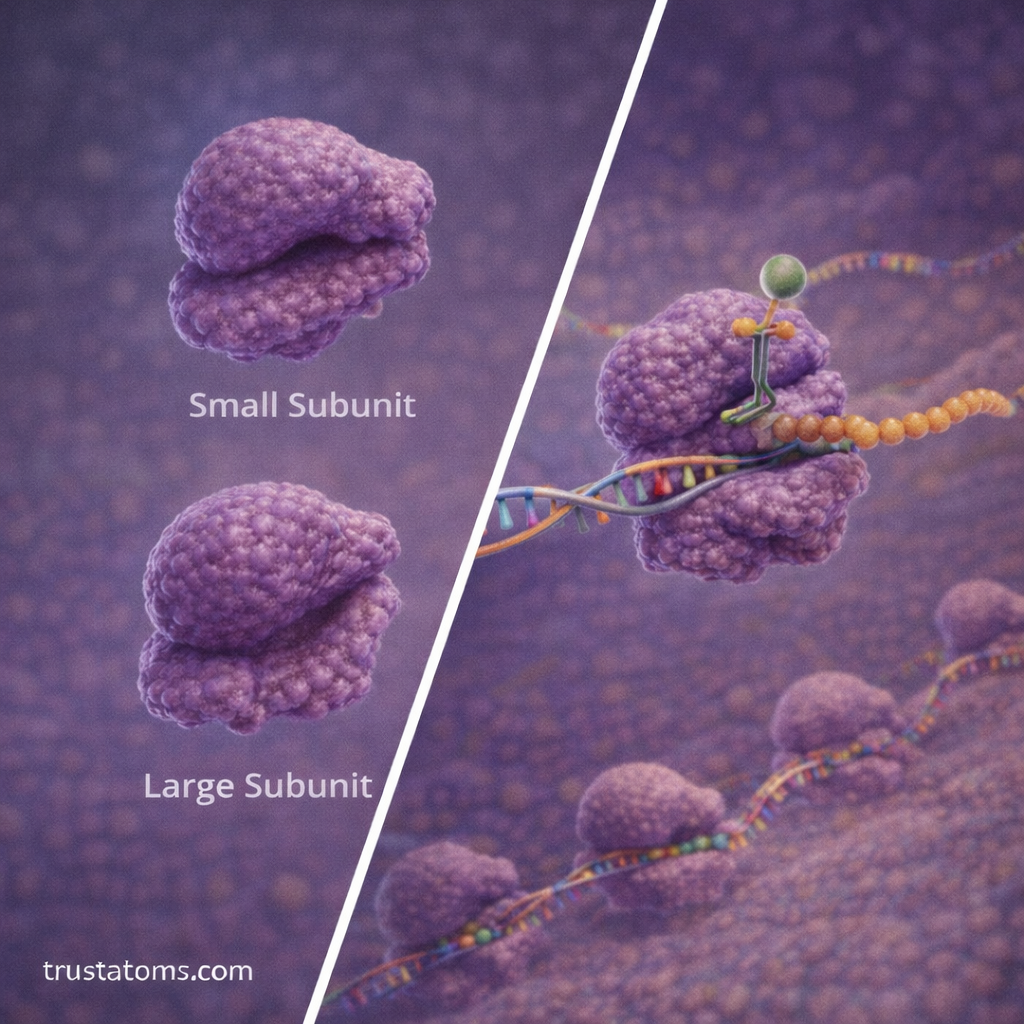
In many cells, multiple ribosomes can translate a single mRNA molecule at the same time.
This structure is known as a polyribosome or polysome.
Advantages of polyribosomes include:
- Faster protein production
- Increased efficiency in gene expression
- Simultaneous creation of multiple protein copies
Polyribosomes are commonly observed in rapidly growing or metabolically active cells.
Ribosomal Systems in Different Organisms
Although ribosomes are present in all living organisms, their structure differs slightly between prokaryotes and eukaryotes.
Prokaryotic Ribosomes
Prokaryotes include bacteria and archaea.
Their ribosomes are:
- Smaller (70S ribosomes)
- Located in the cytoplasm
- Capable of simultaneous transcription and translation
Eukaryotic Ribosomes
Eukaryotes include animals, plants, fungi, and protists.
Their ribosomes are:
- Larger (80S ribosomes)
- Found in the cytoplasm or attached to the rough endoplasmic reticulum
- Separate from transcription, which occurs in the nucleus
Despite these differences, the overall function of ribosomal systems remains the same.
Accuracy and Regulation of Ribosomal Protein Synthesis
Cells maintain accuracy during protein synthesis using several control mechanisms.
These include:
- Correct codon–anticodon pairing
- Ribosomal proofreading
- Enzymes that attach the correct amino acids to tRNA
Gene regulation can also influence protein synthesis by controlling:
- mRNA availability
- Ribosome activity
- Translation initiation
These regulatory mechanisms ensure that proteins are produced only when needed.
Importance of Ribosomal Systems in Biology
Ribosomal systems are essential because proteins control most biological activities.
Protein synthesis supports:
- Cellular metabolism
- Structural integrity of cells
- Signal transmission
- Immune responses
- Tissue growth and repair
Without ribosomes and the translation machinery, cells would be unable to produce the proteins required for survival.
Final Thoughts
Protein synthesis in ribosomal systems is one of the most important processes in molecular biology. By reading genetic instructions from messenger RNA and assembling amino acids into proteins, ribosomes transform genetic information into functional molecules.
This process allows cells to grow, adapt, and carry out complex biological activities. Because of its central role in gene expression, protein synthesis remains a key area of study in genetics, biotechnology, and medical research.