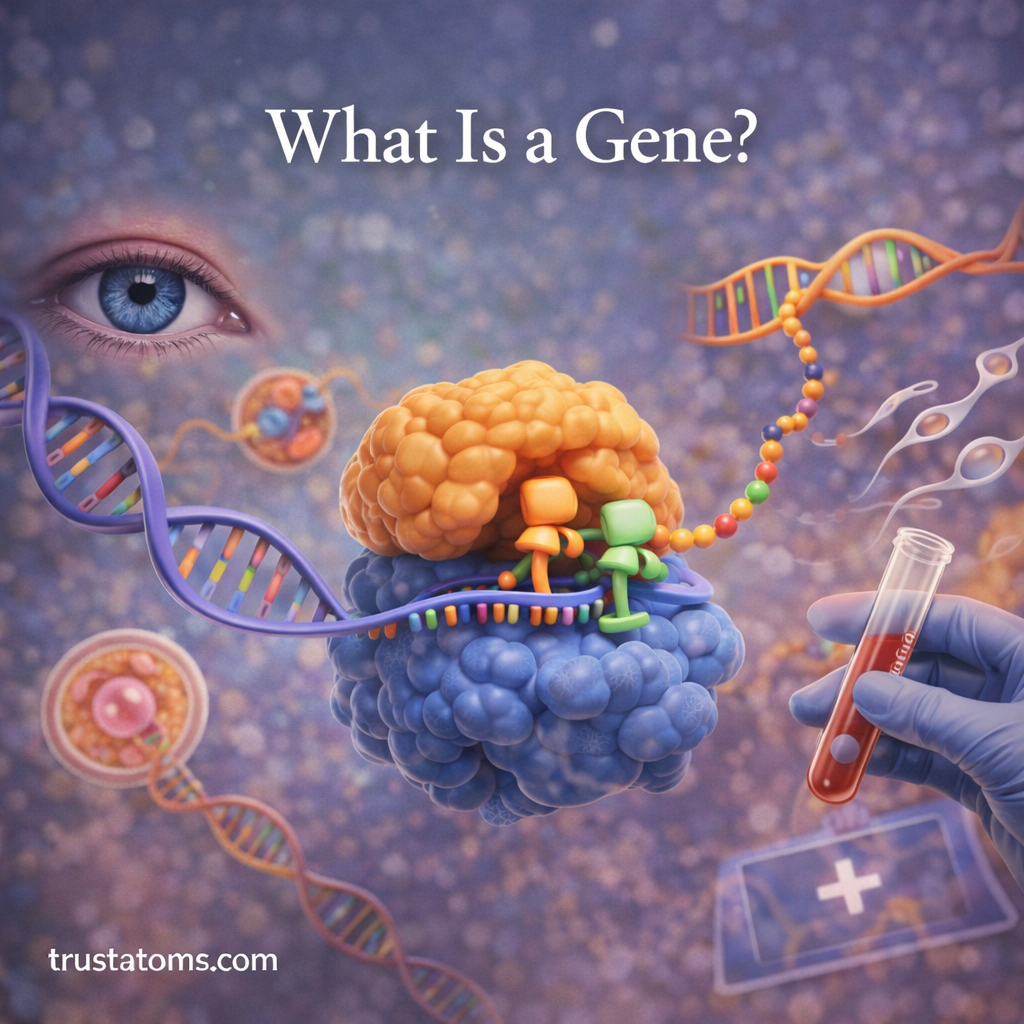
Genes are the fundamental units of heredity that carry the instructions for building and maintaining living organisms. These instructions are encoded within DNA and passed from parents to offspring through reproduction.
Every living organism—from bacteria to humans—contains genes that guide biological processes such as growth, development, metabolism, and reproduction. By controlling the production of proteins and other molecules, genes help determine how cells function and how traits appear in organisms.
Understanding what a gene is and how it works provides insight into genetics, evolution, health, and modern biotechnology.
Definition of a Gene
A gene is a specific sequence of DNA that contains instructions for producing a functional product, usually a protein or a functional RNA molecule.
These instructions allow cells to build molecules that perform essential tasks.
Key characteristics of genes include:
- Located on chromosomes within DNA
- Composed of sequences of nucleotides
- Responsible for producing proteins or RNA molecules
- Passed from parents to offspring
Genes act as biological instructions that guide how cells develop and function.
Where Genes Are Found
Genes are located within chromosomes, which are long DNA molecules packaged inside the nucleus of cells.
In humans:
- Each cell typically contains 23 pairs of chromosomes
- These chromosomes carry thousands of genes
- Humans are estimated to have around 20,000–25,000 genes
Genes are arranged along chromosomes in specific positions known as loci.
While most genes are located in the cell nucleus, some genes also exist in mitochondrial DNA, which is found inside mitochondria.
The Structure of a Gene
Although genes are sequences of DNA, they are organized into functional regions that help control how genetic information is used.
A typical gene contains several important parts.
Promoter Region
The promoter is a regulatory sequence located at the beginning of a gene.
Its main roles include:
- Providing a binding site for RNA polymerase
- Determining when a gene should be activated
- Helping control gene expression
Without promoters, genes cannot be properly transcribed.
Coding Region
The coding region contains the DNA sequence that determines the structure of a protein.
This region is read during transcription and translation, where genetic information is converted into a chain of amino acids.
Coding regions often include:
- Exons – sequences that remain in the final messenger RNA
- Introns – sequences removed during RNA processing
Terminator Region
The terminator signals the end of transcription.
When RNA polymerase reaches this sequence, it stops copying DNA into RNA.
How Genes Produce Proteins
Genes function by directing the production of proteins through a process known as gene expression.
Gene expression typically occurs in two major steps.
1. Transcription
During transcription:
- The DNA sequence of a gene is copied into messenger RNA (mRNA)
- The enzyme RNA polymerase performs this copying process
- The resulting mRNA carries genetic instructions out of the nucleus
2. Translation
Translation occurs in ribosomes.
During this step:
- Ribosomes read the mRNA sequence
- Transfer RNA molecules deliver amino acids
- Amino acids join together to form a protein chain
This process converts genetic information into functional molecules used by cells.
Genes and Biological Traits
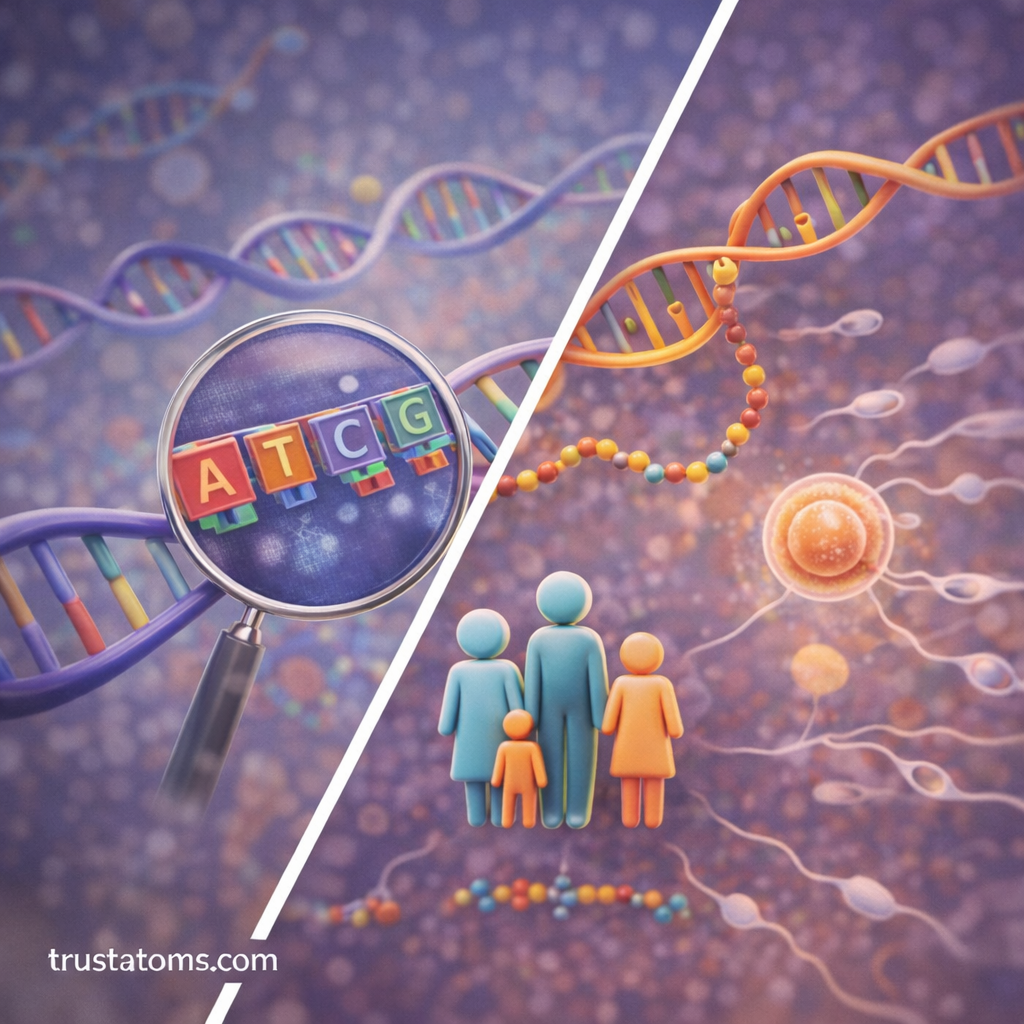
Genes influence many observable characteristics of organisms, known as traits.
Examples of traits influenced by genes include:
- Eye color
- Blood type
- Height potential
- Hair texture
- Metabolic functions
Traits often result from interactions between multiple genes and environmental factors, meaning that genetics does not act alone in determining physical characteristics.
Genetic Variation and Mutations
Genes can vary between individuals, creating differences in traits across populations.
Genetic variation arises from several processes.
Mutations
A mutation is a change in the DNA sequence of a gene.
Types of mutations include:
- Substitution of one nucleotide for another
- Insertions of additional nucleotides
- Deletions of nucleotides
Some mutations have little effect, while others can influence protein function.
Genetic Recombination
During reproduction, genes from parents mix and rearrange.
This process creates new genetic combinations in offspring.
Genetic variation plays an important role in evolution and natural selection.
Gene Regulation
Not all genes are active at the same time in every cell. Cells control gene activity through a process called gene regulation.
Gene regulation allows cells to:
- Activate genes when needed
- Turn off genes that are unnecessary
- Respond to environmental signals
- Specialize into different cell types
For example, muscle cells and nerve cells contain the same DNA but express different sets of genes.
This selective activation helps create specialized tissues and organs.
Genes in Modern Science and Medicine
Genes play a central role in many areas of scientific research and medical advancements.
Important applications include:
- Genetic testing for inherited diseases
- Gene therapy treatments
- Personalized medicine based on genetic profiles
- Biotechnology and genetic engineering
Scientists also study genes to better understand complex conditions such as cancer, neurological disorders, and metabolic diseases.
Why Genes Are Important
Genes serve as the blueprint for life. They guide how organisms develop, grow, and function at the cellular level.
Their importance includes:
- Storing hereditary information
- Directing protein production
- Influencing biological traits
- Supporting evolution and adaptation
Without genes, cells would not have the instructions needed to carry out essential biological processes.
Final Thoughts
Genes are the basic units of heredity that store and transmit biological information across generations. Encoded within DNA, they provide the instructions cells need to produce proteins and regulate biological activities.
Through processes such as transcription, translation, and gene regulation, genes control how organisms grow, develop, and respond to their environment. As research in genetics continues to expand, scientists are gaining deeper insights into how genes influence health, evolution, and the complexity of life itself.