Waves are one of the most important concepts in physics because they explain how energy travels through space and matter.
From ocean swells and sound vibrations to light from distant stars, waves allow energy to move without permanently transporting material.
In this guide, you’ll learn:
- The main types of waves in physics
- How waves are classified
- Real-world examples of each type
- Why understanding wave types matters
What Is a Wave?
In physics, a wave is a repeating motion that transfers energy from one location to another.
The key idea:
Waves transfer energy, not matter.
Particles in the medium may move temporarily, but they return to their original position after the wave passes.
The Two Main Categories of Waves

Waves are first divided into two broad groups:
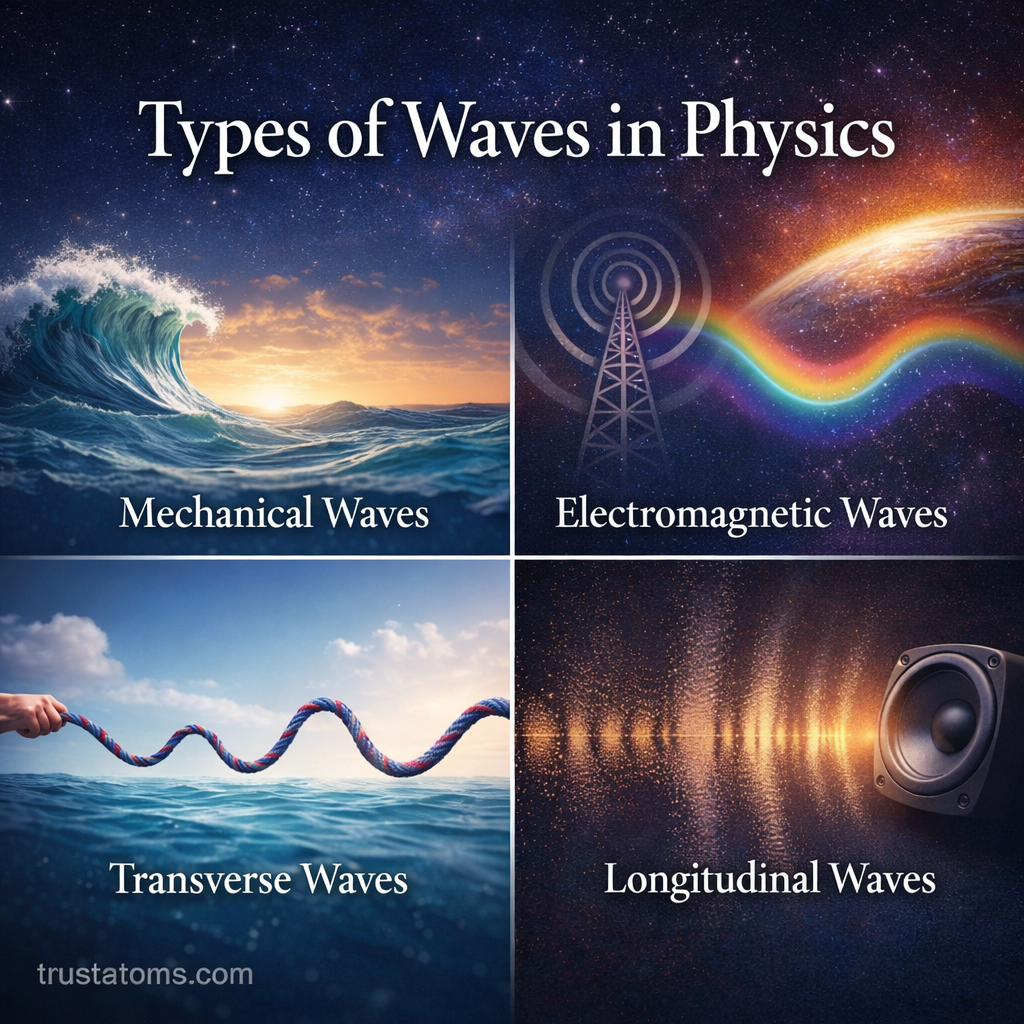
- Mechanical waves
- Electromagnetic waves
Let’s break them down.
Mechanical Waves
Mechanical waves require a medium to travel through.
A medium can be:
- Air
- Water
- Solid materials
- Any physical substance
Without a medium, mechanical waves cannot exist.
Examples of Mechanical Waves
- Sound waves traveling through air
- Ocean surface waves
- Seismic waves during earthquakes
- Waves traveling along a rope
For example, sound cannot travel in outer space because there is no air to carry the vibrations.
Electromagnetic Waves
Electromagnetic waves do not require a medium.
They can travel through empty space.
These waves are made of oscillating electric and magnetic fields.
Examples of Electromagnetic Waves
- Radio waves
- Microwaves
- Infrared radiation
- Visible light
- Ultraviolet radiation
- X-rays
- Gamma rays
Sunlight reaching Earth is a perfect example of electromagnetic waves traveling through space.
Classification by Particle Motion
Waves can also be classified based on how particles move relative to the direction the wave travels.
This gives us two important types:
- Transverse waves
- Longitudinal waves
Transverse Waves
In transverse waves, particles move perpendicular (at right angles) to the direction of wave travel.
If the wave moves forward, the particles move up and down.
Examples of Transverse Waves
- Ocean waves
- Light waves
- Waves on a rope
- Surface water ripples
These waves have visible features like:
- Crests (high points)
- Troughs (low points)
Longitudinal Waves
In longitudinal waves, particles move parallel to the direction of wave travel.
The motion creates alternating regions of:
- Compressions (particles close together)
- Rarefactions (particles spread apart)
Examples of Longitudinal Waves
- Sound waves
- Compression waves in springs
- Seismic primary (P) waves
Instead of moving up and down, particles vibrate back and forth.
Surface Waves
Surface waves combine both transverse and longitudinal motion.
They occur at the boundary between two different media.
Example
Ocean waves move water particles in circular or rolling patterns, combining both motions.
Surface waves are common in water and also appear in certain seismic events.
Matter Waves
In modern physics, matter itself can behave like a wave.
This idea comes from quantum mechanics.
Electrons and other particles exhibit wave-like behavior under certain conditions.
Matter waves help explain:
- Atomic structure
- Electron behavior
- Quantum phenomena
This wave-particle duality is a cornerstone of modern physics.
Seismic Waves
Seismic waves are energy waves generated by earthquakes.
They are a special type of mechanical wave and come in different forms:
- P-waves (longitudinal)
- S-waves (transverse)
- Surface waves
Studying seismic waves helps scientists understand Earth’s interior.
Why Understanding Wave Types Matters
Different wave types behave differently.
Knowing the type of wave helps scientists:
- Predict how it will travel
- Understand how fast it moves
- Measure energy transfer
- Design communication systems
- Study natural disasters
Wave classification is essential in physics, engineering, astronomy, and medicine.
Key Differences at a Glance
Here’s a simple comparison:
Mechanical waves:
- Require a medium
- Cannot travel in a vacuum
Electromagnetic waves:
- Do not require a medium
- Can travel through space
Transverse waves:
- Particle motion is perpendicular
Longitudinal waves:
- Particle motion is parallel
Understanding these distinctions makes wave behavior much easier to grasp.
Final Thoughts
Waves are everywhere in the universe.
Whether it’s sound in the air, light from the Sun, ocean swells, or radio signals, waves allow energy to travel across vast distances.
By understanding the different types of waves in physics, you gain insight into how energy moves through both matter and space — a concept that shapes much of modern science.