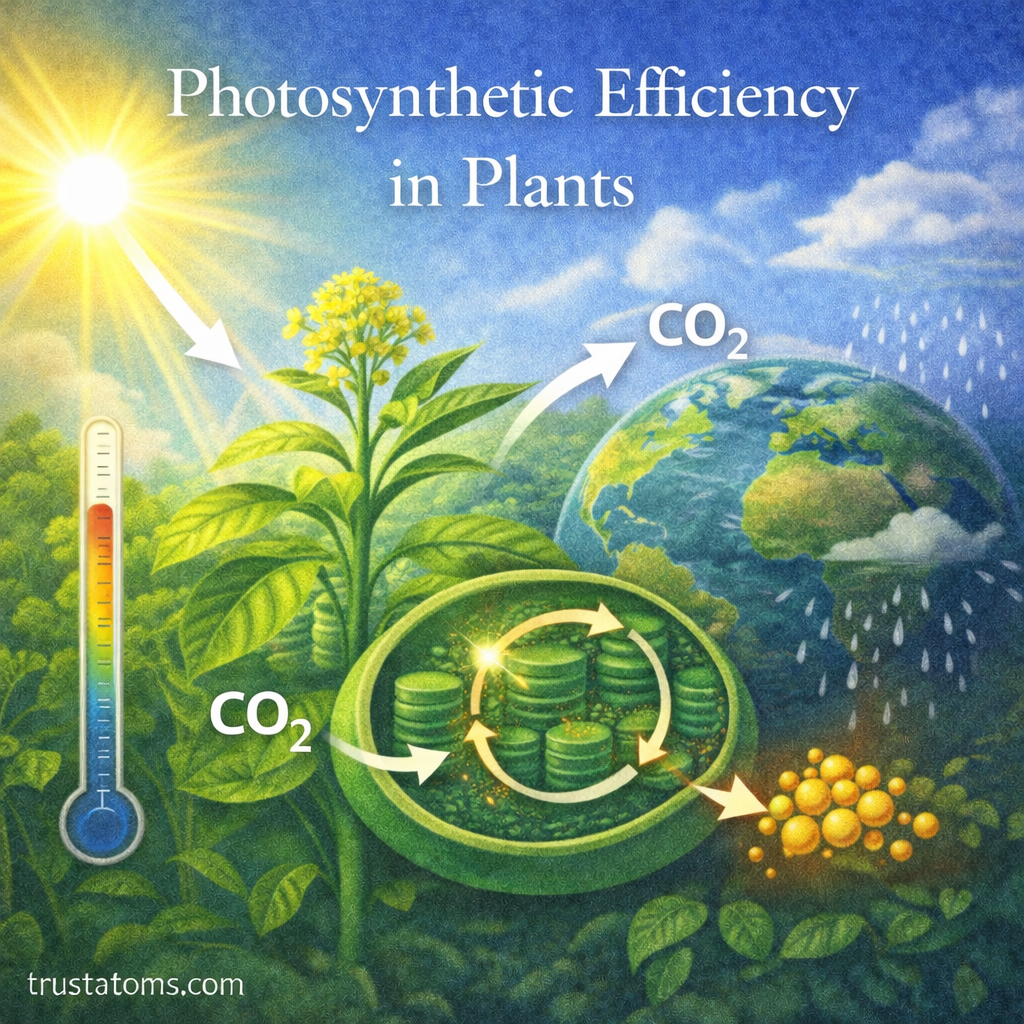
Photosynthesis is the process that allows plants to convert sunlight into chemical energy. This energy supports plant growth and ultimately fuels nearly every food chain on Earth. However, not all of the sunlight that reaches a plant is converted into usable energy.
The ability of plants to convert light energy into chemical energy is known as photosynthetic efficiency. This concept describes how effectively plants capture sunlight and transform it into carbohydrates that power metabolism, growth, and reproduction.
Understanding photosynthetic efficiency helps scientists improve crop yields, study plant adaptation, and better understand how ecosystems respond to environmental change.
What Is Photosynthetic Efficiency?
Photosynthetic efficiency refers to the percentage of light energy absorbed by plants that is converted into chemical energy during photosynthesis.
Although sunlight provides an enormous amount of energy, plants can only use a small portion of it. Much of the incoming light is reflected, transmitted, or lost as heat.
In general:
- Only certain wavelengths of light are useful for photosynthesis
- Some energy is lost during chemical reactions
- Environmental conditions affect the overall process
Even under ideal conditions, plants convert only a small fraction of sunlight into stored chemical energy.
Why Photosynthetic Efficiency Matters
Photosynthetic efficiency is important because it determines how much energy plants can capture and store.
Higher efficiency can lead to:
- Faster plant growth
- Increased crop productivity
- Greater biomass production
- Improved carbon dioxide absorption
Because plants form the base of most ecosystems, their efficiency directly influences the amount of energy available to other organisms.
In agriculture, improving photosynthetic efficiency is a major goal for increasing food production.
The Role of Light in Photosynthesis
Sunlight is the primary energy source for photosynthesis, but plants can only use specific wavelengths.
The range of light that drives photosynthesis is called photosynthetically active radiation (PAR).
PAR includes wavelengths between 400 and 700 nanometers, which correspond to visible light.
Light Absorption by Pigments
Plants contain pigments that capture light energy.
The most important pigments include:
- Chlorophyll a
- Chlorophyll b
- Carotenoids
Each pigment absorbs different wavelengths of light, allowing plants to capture a broader portion of the light spectrum.
Chlorophyll primarily absorbs blue and red light, while green light is mostly reflected, giving plants their green color.
Energy Loss During Photosynthesis
Photosynthesis involves multiple biochemical steps, and energy is lost at several stages.
Common sources of energy loss include:
- Reflection of unused light wavelengths
- Heat loss during energy conversion
- Inefficiencies in electron transport
- Metabolic processes within the plant
Because of these limitations, photosynthesis is never perfectly efficient.
However, plants have evolved strategies to improve energy capture and reduce unnecessary losses.
Environmental Factors That Affect Photosynthetic Efficiency
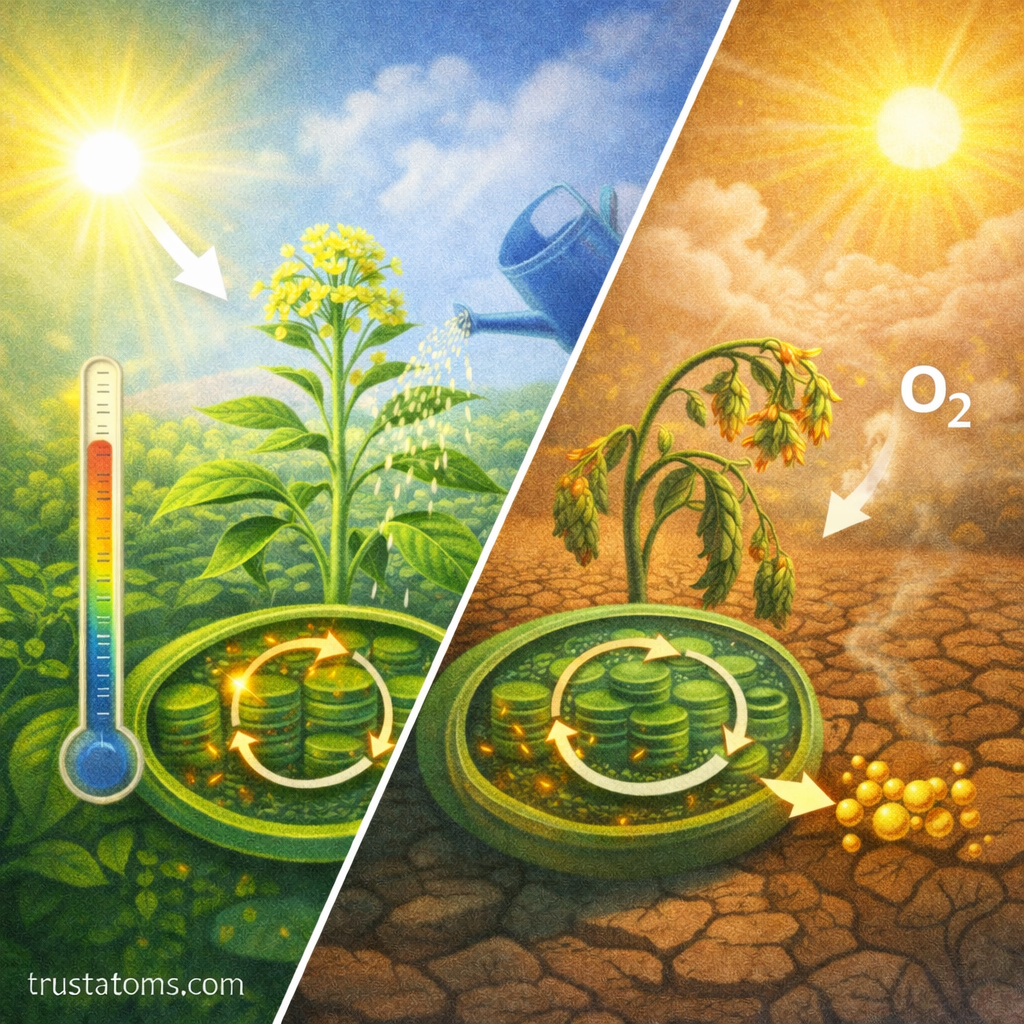
Photosynthetic efficiency depends heavily on environmental conditions.
Several factors can increase or limit how effectively plants perform photosynthesis.
Light Intensity
Light intensity strongly influences photosynthesis.
At low light levels:
- Photosynthesis occurs slowly
- Energy production is limited
As light intensity increases, the rate of photosynthesis rises until it reaches a light saturation point, where additional light no longer increases productivity.
Too much light can also damage photosynthetic machinery, reducing efficiency.
Carbon Dioxide Concentration
Carbon dioxide is a key raw material in photosynthesis.
Higher CO₂ concentrations can increase photosynthetic rates because more carbon is available for sugar production.
However, once enzymes involved in carbon fixation become saturated, additional CO₂ provides little benefit.
Temperature
Photosynthesis relies on enzymes, which are sensitive to temperature.
Optimal temperatures allow enzymes to function efficiently.
If temperatures become too high:
- Enzymes lose efficiency
- Photorespiration increases
- Photosynthesis slows down
Cold temperatures can also reduce photosynthetic activity by slowing chemical reactions.
Water Availability
Water is essential for photosynthesis and plant metabolism.
When water is limited:
- Plants close their stomata
- Carbon dioxide intake decreases
- Photosynthesis slows
Prolonged drought conditions can significantly reduce photosynthetic efficiency.
Photorespiration and Efficiency Loss
One major limitation to photosynthetic efficiency is a process known as photorespiration.
Photorespiration occurs when the enzyme RuBisCO reacts with oxygen instead of carbon dioxide.
This reaction leads to:
- Reduced sugar production
- Energy loss
- Lower photosynthetic efficiency
Photorespiration becomes more common in hot, dry conditions where oxygen levels inside leaves increase.
Adaptations That Improve Photosynthetic Efficiency
Some plants have evolved specialized mechanisms to reduce photorespiration and improve carbon fixation.
Two important adaptations are C4 photosynthesis and CAM photosynthesis.
C4 Photosynthesis
C4 plants use a specialized pathway that concentrates carbon dioxide around the enzyme RuBisCO.
This adaptation helps reduce photorespiration.
Examples of C4 plants include:
- Corn
- Sugarcane
- Sorghum
- Some grasses
C4 plants often perform well in hot, sunny environments.
CAM Photosynthesis
CAM plants open their stomata at night instead of during the day.
They store carbon dioxide overnight and use it during daylight hours for photosynthesis.
This adaptation helps conserve water in dry environments.
Examples of CAM plants include:
- Cacti
- Pineapple
- Aloe plants
- Many succulents
CAM plants are common in desert and semi-arid regions.
Measuring Photosynthetic Efficiency
Scientists use several methods to measure how efficiently plants perform photosynthesis.
Common approaches include:
- Measuring carbon dioxide uptake
- Monitoring oxygen production
- Tracking chlorophyll fluorescence
- Analyzing biomass production
These measurements help researchers understand how plants respond to environmental conditions and how efficiently they convert light energy into chemical energy.
Improving Photosynthetic Efficiency in Agriculture
Increasing photosynthetic efficiency is a major goal in modern agriculture.
Researchers are studying ways to improve crop productivity by:
- Breeding plants with more efficient photosynthetic pathways
- Modifying plant pigments to absorb more light
- Reducing photorespiration
- Improving plant tolerance to environmental stress
Even small improvements in efficiency could significantly increase global food production.
Photosynthetic Efficiency and Climate Change
Photosynthetic efficiency also plays an important role in Earth’s climate system.
Through photosynthesis, plants remove carbon dioxide from the atmosphere and store it in organic matter.
This process helps regulate atmospheric carbon levels and influences the global carbon cycle.
Understanding how environmental changes affect plant efficiency is critical for predicting future climate patterns.
Key Takeaways
- Photosynthetic efficiency describes how effectively plants convert sunlight into chemical energy.
- Only a portion of sunlight can be used for photosynthesis.
- Energy is lost during several stages of the photosynthetic process.
- Environmental factors such as light, temperature, carbon dioxide, and water affect efficiency.
- Photorespiration reduces the effectiveness of carbon fixation.
- Some plants use specialized pathways such as C4 and CAM photosynthesis to improve efficiency.
Photosynthetic efficiency determines how much energy plants capture from sunlight and ultimately influences the productivity of ecosystems and agriculture around the world.