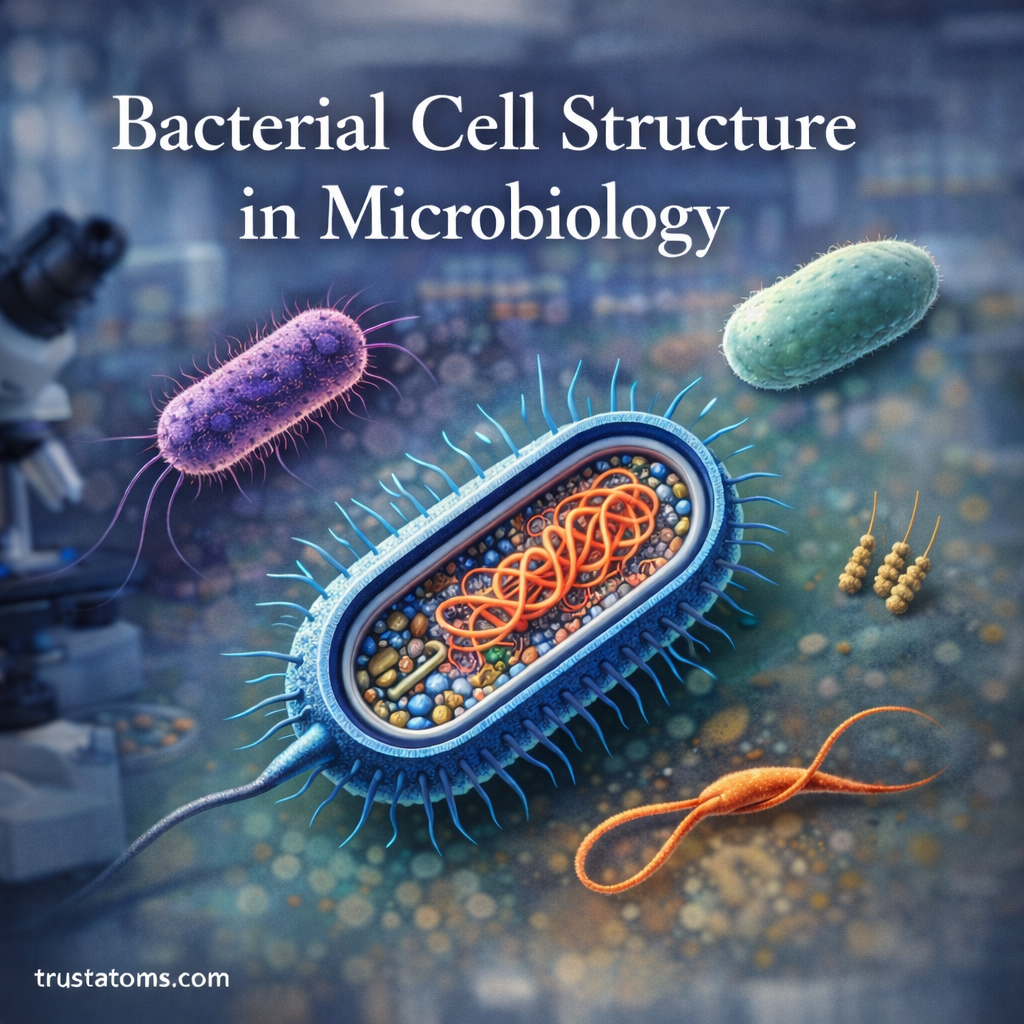
Bacteria are among the simplest forms of life, yet their cellular structure is highly efficient and well adapted for survival. In microbiology, studying bacterial cell structure helps scientists understand how bacteria grow, reproduce, move, and interact with their environment.
Although bacterial cells are much smaller and simpler than plant or animal cells, they contain specialized components that allow them to perform essential life processes. Understanding these structures is fundamental in fields such as medicine, biotechnology, and environmental science.
What Is a Bacterial Cell?
A bacterial cell is a single-celled prokaryotic organism. Unlike eukaryotic cells (such as human or plant cells), bacterial cells do not contain a nucleus or membrane-bound organelles.
Instead, their genetic material and cellular machinery exist within a compact and efficient internal structure.
Typical bacterial cells range from 0.5 to 5 micrometers in size and can reproduce rapidly under favorable conditions.
Key characteristics include:
- Single-celled organization
- Lack of a true nucleus
- Circular DNA
- Simple internal structure
- Protective outer layers
Overview of Bacterial Cell Structure
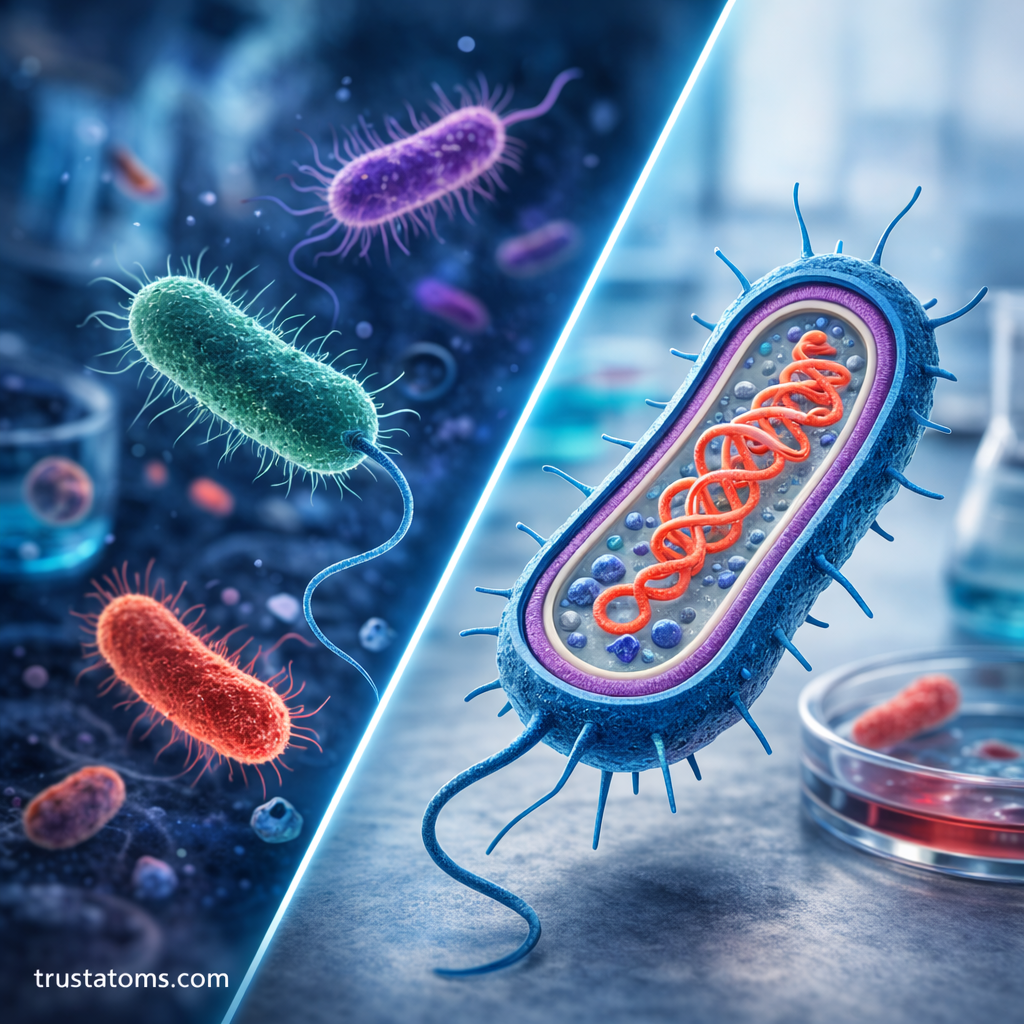
A bacterial cell contains several important components that support survival and reproduction.
The main structural parts include:
- Cell envelope (cell wall and membrane)
- Cytoplasm
- Nucleoid (DNA region)
- Ribosomes
- External structures such as flagella or pili
Each structure performs a specific function that helps the bacterium maintain life.
The Cell Envelope
The cell envelope is the outer protective covering of a bacterial cell. It consists mainly of the cell wall and the cell membrane.
These layers protect the cell and regulate interactions with the environment.
Cell Wall
The cell wall provides strength and shape to the bacterium. It prevents the cell from bursting due to internal pressure and protects it from physical damage.
Most bacterial cell walls are made of a material called peptidoglycan, a mesh-like structure that gives rigidity to the cell.
Scientists often classify bacteria based on their cell wall structure, especially in the Gram staining test, which divides bacteria into:
- Gram-positive bacteria – thick peptidoglycan layer
- Gram-negative bacteria – thinner peptidoglycan layer with an additional outer membrane
This distinction is important in microbiology and medicine because it affects how bacteria respond to antibiotics.
Cell Membrane
Located just inside the cell wall, the cell membrane is a thin, flexible barrier.
Its main functions include:
- Controlling what enters and leaves the cell
- Supporting metabolic processes
- Producing cellular energy
- Maintaining internal balance
The membrane contains proteins that help transport nutrients and waste products.
Cytoplasm
The cytoplasm is the gel-like interior of the bacterial cell. It fills most of the cell’s internal space and contains water, enzymes, nutrients, and cellular molecules.
Many chemical reactions necessary for life occur within the cytoplasm.
Inside this region are also several key cellular structures, including ribosomes and the nucleoid.
Nucleoid (Bacterial DNA)
Bacteria do not have a nucleus. Instead, their genetic material is located in a region called the nucleoid.
The nucleoid contains a single circular chromosome made of DNA.
This DNA stores the instructions for:
- Cell growth
- Metabolism
- Reproduction
- Response to environmental conditions
Because bacteria lack a nuclear membrane, the DNA is directly exposed to the cytoplasm.
Ribosomes
Ribosomes are small molecular machines responsible for producing proteins.
Proteins are essential for many bacterial functions, including:
- Building cell structures
- Catalyzing chemical reactions
- Transporting molecules
- Supporting metabolism
Although bacterial ribosomes perform the same function as those in eukaryotic cells, they are smaller in size.
This difference is important because many antibiotics specifically target bacterial ribosomes without harming human cells.
Plasmids
Some bacteria contain extra DNA molecules known as plasmids.
Plasmids are small circular pieces of DNA separate from the main chromosome.
They often carry genes that provide advantages, such as:
- Antibiotic resistance
- Toxin production
- Specialized metabolic abilities
Plasmids can sometimes be transferred between bacteria, allowing genetic traits to spread rapidly.
External Structures of Bacteria
In addition to internal components, many bacteria have external structures that help them interact with their environment.
Flagella
Flagella are long, whip-like structures used for movement.
Bacteria use flagella to swim through liquids or move toward favorable environments, such as areas with nutrients.
Pili (Fimbriae)
Pili, also known as fimbriae, are short hair-like structures on the bacterial surface.
Their functions include:
- Attaching to surfaces
- Connecting to other bacterial cells
- Transferring genetic material
Some specialized pili enable bacteria to exchange plasmids in a process called conjugation.
Capsule (Glycocalyx)
Some bacteria produce a protective outer coating called a capsule.
This layer helps bacteria:
- Resist drying
- Avoid immune system defenses
- Attach to surfaces
- Form biofilms
Capsules can increase the ability of certain bacteria to cause disease.
Differences Between Bacterial and Eukaryotic Cells
Bacterial cells differ significantly from the cells of plants, animals, and fungi.
Key differences include:
| Feature | Bacterial Cells | Eukaryotic Cells |
|---|---|---|
| Nucleus | No | Yes |
| DNA shape | Circular | Linear |
| Organelles | None | Many |
| Size | Smaller | Larger |
| Reproduction | Binary fission | Mitosis/meiosis |
These structural differences are why bacteria are classified as prokaryotes, while plants and animals are eukaryotes.
Why Bacterial Cell Structure Matters
Understanding bacterial cell structure is important for several scientific fields.
Medicine
Knowledge of bacterial structures helps scientists:
- Develop antibiotics
- Understand bacterial infections
- Target specific cellular components
Biotechnology
Bacteria are widely used in biotechnology for producing:
- Medicines
- Industrial enzymes
- Biofuels
- Genetically engineered products
Understanding bacterial structure helps scientists manipulate bacterial cells safely and effectively.
Environmental Science
Bacteria play key roles in ecosystems by recycling nutrients and supporting soil health.
Studying their cellular structure helps researchers understand how bacteria survive in different environments.
Final Thoughts
Bacterial cell structure may appear simple compared to complex organisms, but it is remarkably efficient. Each component—from the cell wall to the nucleoid—serves a vital function that allows bacteria to survive, reproduce, and adapt.
By studying bacterial cell structure, microbiologists gain valuable insights into disease prevention, biotechnology innovation, and the fundamental processes that sustain life at the microscopic level.