Relativity is a theory in physics that explains how space, time, gravity, and motion are connected. Developed in the early 20th century, it transformed our understanding of the universe.
Relativity shows that time is not universal, space can curve, and gravity is not simply a force pulling objects together — it is the result of spacetime bending.
There are two main parts of relativity:
- Special Relativity
- General Relativity
Together, they describe how the universe behaves at very high speeds and in strong gravitational fields.
What Is Relativity in Simple Terms?
Relativity is the idea that measurements of space and time depend on how fast you are moving and where you are located in a gravitational field.
In everyday life, time feels constant and space feels fixed. But at extremely high speeds or near massive objects like stars and black holes, space and time behave differently.
Relativity explains these differences.
Special Relativity
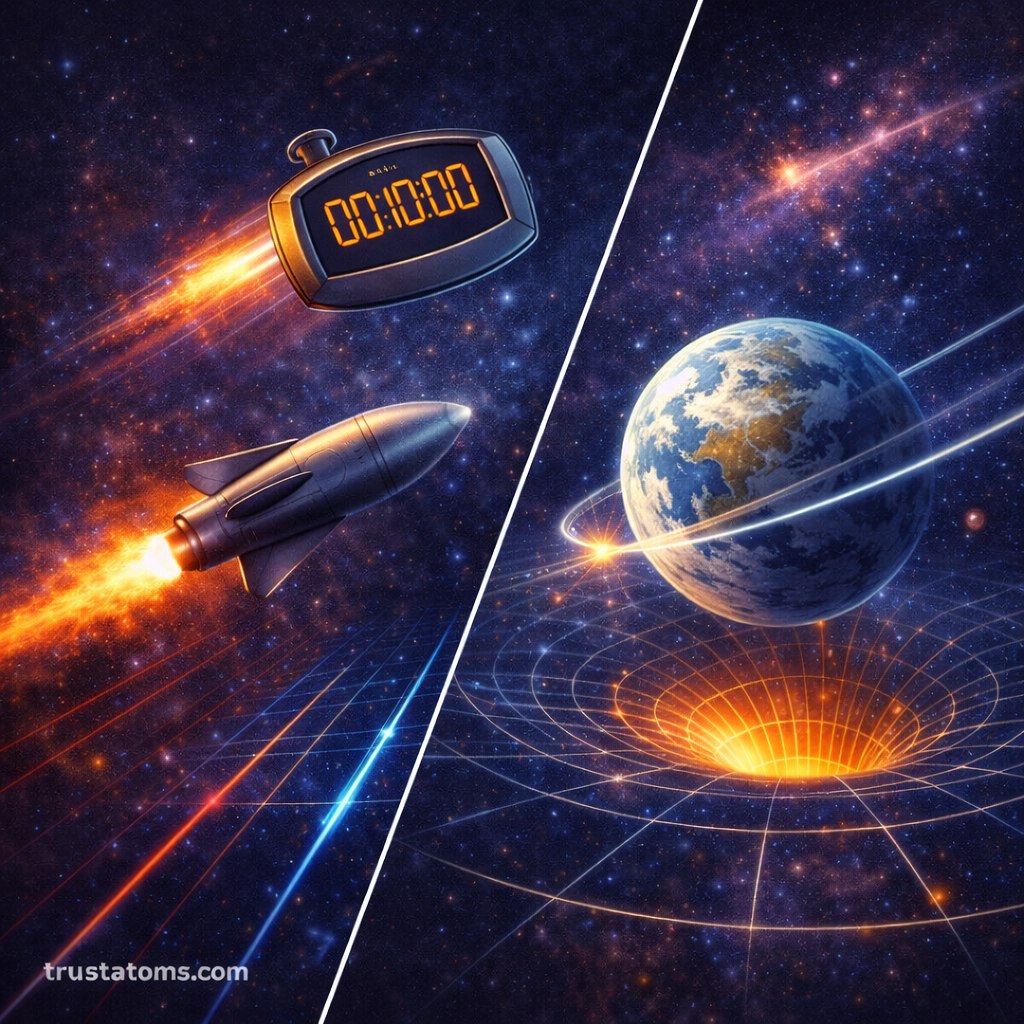
Special relativity focuses on motion at constant speeds, especially speeds close to the speed of light.
It introduced two key principles:
- The laws of physics are the same for all observers moving at constant velocity.
- The speed of light in a vacuum is always the same, no matter how fast the observer is moving.
These ideas lead to surprising consequences.
Time Dilation
Time passes more slowly for objects moving at high speeds compared to stationary observers.
An astronaut traveling near the speed of light would age more slowly than someone on Earth.
Length Contraction
Objects moving close to the speed of light appear shorter in the direction of motion.
Mass–Energy Equivalence
One of the most famous outcomes of special relativity is:
E = mc²
This equation shows that mass and energy are interchangeable. Even a small amount of mass can convert into enormous energy.
General Relativity
General relativity expands the theory to include gravity.
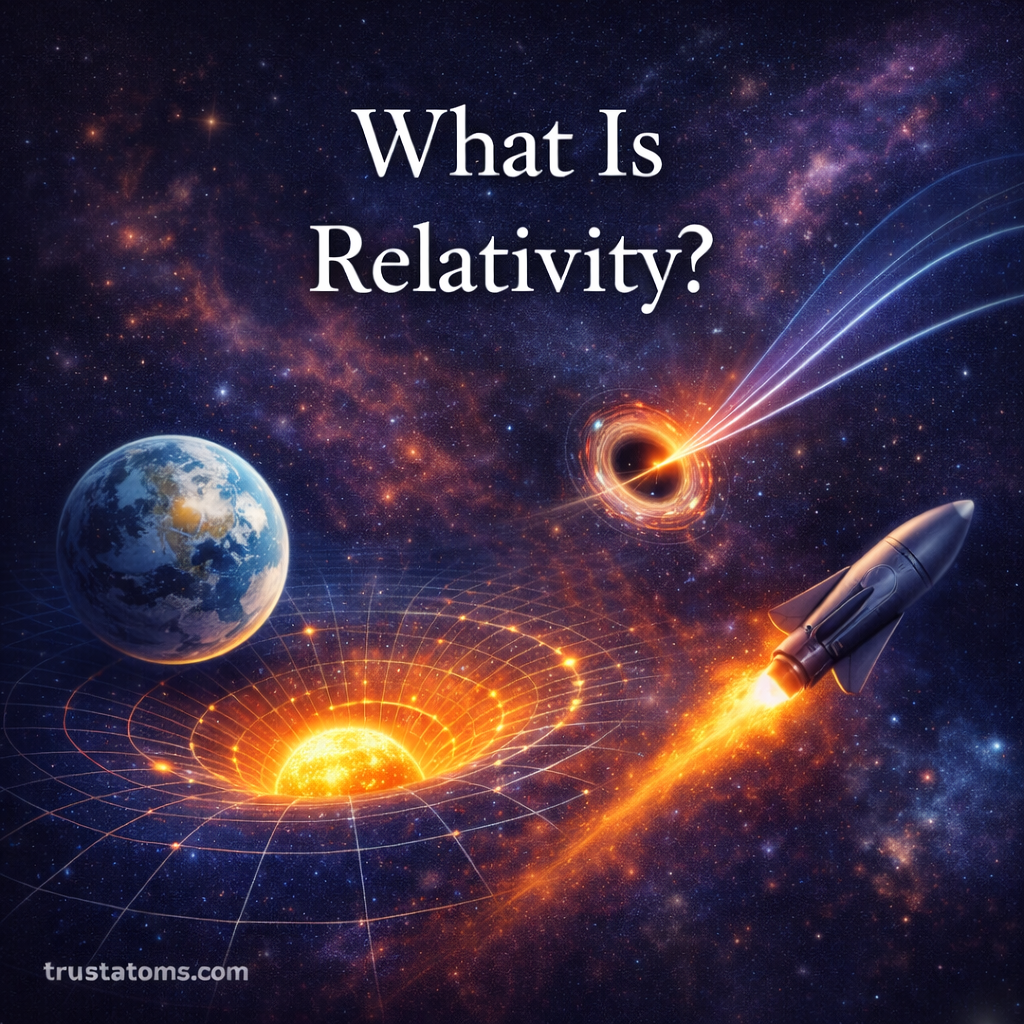
Instead of describing gravity as a force, it explains gravity as the curvature of spacetime caused by mass and energy.
Massive objects like planets and stars bend the fabric of spacetime around them. Other objects move along these curves.
An analogy often used is:
- Imagine a heavy ball placed on a stretched rubber sheet.
- The sheet bends.
- Smaller balls roll toward the heavy ball because of the curvature.
In reality, spacetime curvature is a four-dimensional phenomenon involving three dimensions of space and one of time.
Key Concepts of Relativity
Relativity introduces several important ideas.
Spacetime
Space and time are not separate. They form a combined four-dimensional structure called spacetime.
Gravity as Geometry
Gravity is not a pulling force in general relativity. It is the natural motion of objects following curved spacetime paths.
Relativity of Simultaneity
Two events that appear simultaneous to one observer may not be simultaneous to another moving observer.
Evidence for Relativity
Relativity is not just theoretical — it has strong experimental support.
GPS Systems
Global Positioning System satellites must correct for both special and general relativity. Without these corrections, GPS locations would quickly become inaccurate.
Gravitational Lensing
Light from distant stars bends around massive objects, confirming spacetime curvature.
Time Dilation Experiments
Precise atomic clocks flown on airplanes have shown measurable time differences compared to clocks on Earth.
Gravitational Waves
Ripples in spacetime caused by massive cosmic events have been detected, supporting general relativity.
Relativity vs. Newtonian Physics
Newtonian physics works extremely well for everyday situations:
- Low speeds
- Weak gravitational fields
- Ordinary distances
Relativity becomes important when:
- Speeds approach the speed of light
- Gravity is very strong
- Objects are extremely massive
Newton’s laws are still useful approximations, but relativity provides a deeper, more accurate description of reality.
Why Relativity Matters
Relativity reshaped physics in several major ways:
- It changed our understanding of time.
- It redefined gravity.
- It revealed the connection between mass and energy.
- It laid the groundwork for modern cosmology.
The theory helps scientists understand:
- Black holes
- The expansion of the universe
- The Big Bang
- The behavior of extreme astrophysical objects
Without relativity, modern astronomy and space science would not be possible.
Common Misconceptions About Relativity
Relativity does not mean:
- “Everything is relative” in a philosophical sense.
- That reality changes based on opinion.
It is a precise scientific theory with mathematical predictions and experimental verification.
It applies under specific physical conditions involving motion and gravity.
Final Thoughts
Relativity is a theory that describes how space and time behave at high speeds and in strong gravitational fields.
Special relativity shows that time and length depend on motion. General relativity explains gravity as the curvature of spacetime.
Though it may seem abstract, relativity has practical applications in modern technology and astronomy.
It remains one of the most important scientific breakthroughs in history — revealing that the universe is far more dynamic and interconnected than once believed.