Density is a physical property that describes how much mass is contained within a given volume.
In simple terms, density tells us how tightly matter is packed together.
Some materials feel heavy for their size, while others feel light. That difference is density.
Understanding density helps explain why objects float or sink, how planets are structured, and how materials behave in science and engineering.
The Basic Definition of Density
Density is defined as:
Mass divided by volume.
This means:
- If two objects have the same volume but different masses, the heavier one has greater density.
- If two objects have the same mass but different volumes, the smaller one has greater density.
For example:
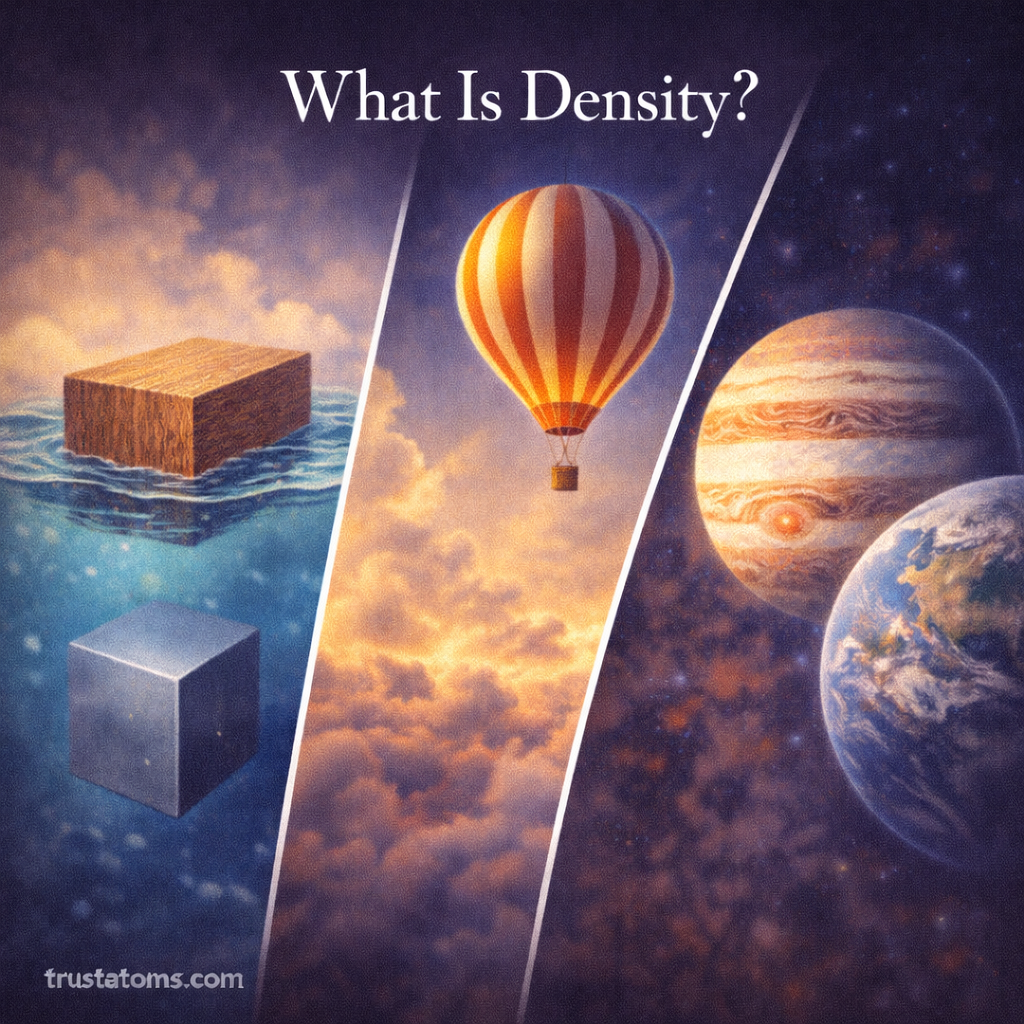
- A block of iron and a block of wood the same size do not weigh the same.
- Iron is denser than wood because more mass is packed into the same space.
Units of Density
In physics, density is typically measured in:
- Kilograms per cubic meter (kg/m³) in the metric system
- Grams per cubic centimeter (g/cm³) for smaller objects
Both units describe how much mass exists within a specific amount of space.
Why Density Matters
Density plays an important role in many physical processes.
It helps determine:
- Whether an object floats or sinks
- How hot air rises
- How ocean currents form
- How materials are classified
It is one of the most useful and widely applied properties in physics.
Density and Floating
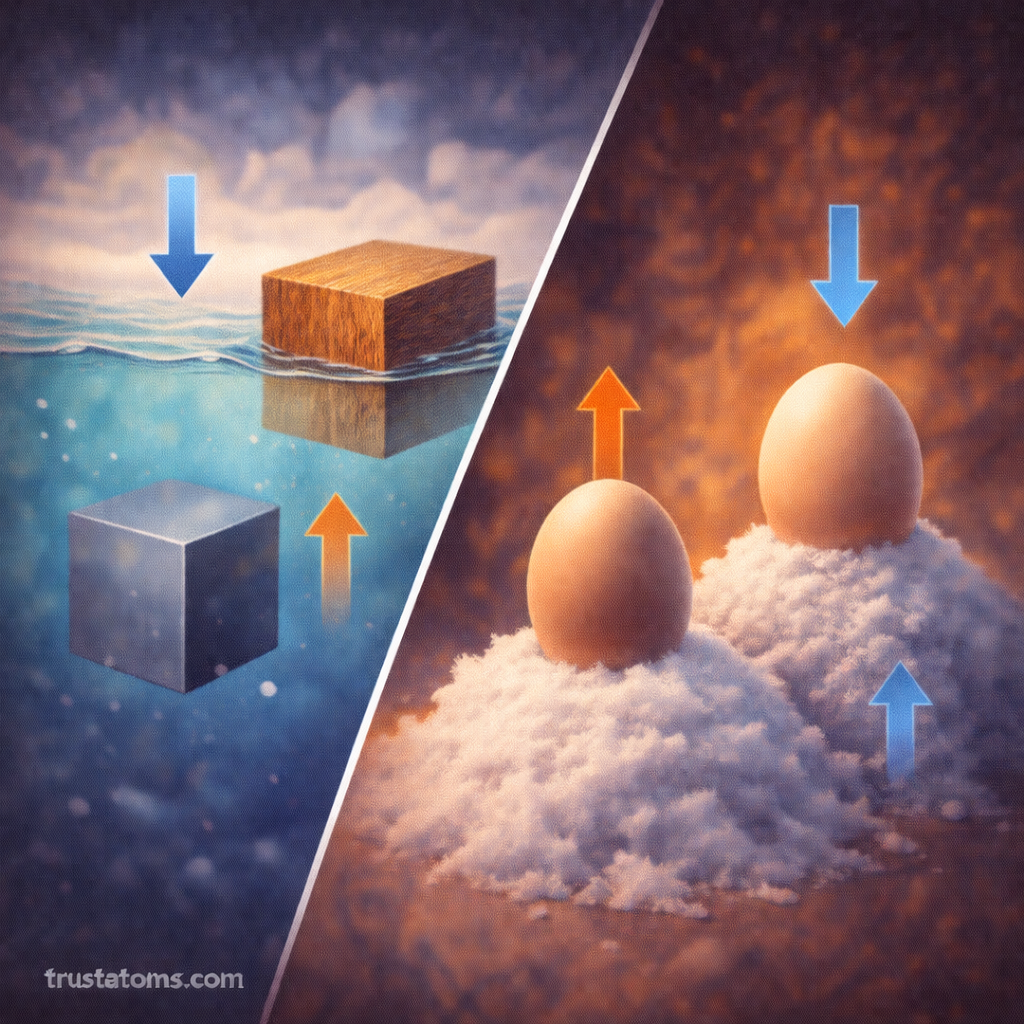
One of the most familiar examples of density is floating.
An object floats in a fluid if:
- Its average density is less than the density of the fluid.
An object sinks if:
- Its average density is greater than the fluid’s density.
This explains why:
- Wood floats in water.
- Rocks sink.
- Ships made of steel can float (because their overall density includes air inside).
Floating depends on the comparison between densities, not just weight.
Density in Solids, Liquids, and Gases
Density varies across states of matter.
Solids
- Particles are tightly packed.
- Typically have higher density.
- Example: metals are denser than most liquids.
Liquids
- Particles are close but able to move.
- Often less dense than solids.
- Water is denser than many other liquids.
Gases
- Particles are far apart.
- Very low density.
- Air is much less dense than water.
This difference explains why bubbles rise in water and why helium balloons float in air.
Density and Temperature
Temperature affects density.
When most materials are heated:
- Particles move faster.
- The material expands.
- Volume increases.
- Density decreases.
This is why:
- Hot air rises in the atmosphere.
- Heated liquids expand.
- Warm ocean water moves differently than cold water.
An important exception is water. Near freezing, water behaves unusually and becomes less dense as it freezes. That is why ice floats.
Density and Planetary Science
Density helps scientists understand planets and stars.
By calculating average density, scientists can estimate:
- Whether a planet is rocky or gaseous
- The composition of Earth’s core
- The structure of stars
For example:
- Gas giants like Jupiter have lower average density than rocky planets like Earth.
- Extremely dense objects like neutron stars contain enormous mass in tiny volumes.
Density gives clues about the structure of the universe.
Real-World Applications of Density
Density is used in many industries and sciences.
Engineering
- Selecting construction materials
- Designing ships and submarines
- Manufacturing lightweight components
Chemistry
- Identifying substances
- Determining purity
- Mixing solutions
Medicine
- Measuring bone density
- Understanding body composition
Density is a practical measurement used daily in laboratories and industries.
Common Misconceptions About Density
There are a few misunderstandings about density.
- Heavy objects are not always denser than light ones.
- Large objects are not automatically more dense.
- Floating does not mean “weightless.”
Density depends on both mass and volume together.
The Big Picture
Density describes how much mass is packed into a given amount of space.
It:
- Determines whether objects float or sink
- Changes with temperature
- Varies between solids, liquids, and gases
- Helps scientists understand planets and stars
From ocean currents to hot air balloons to material design, density is one of the most fundamental and useful concepts in physics.
Understanding density gives you insight into how matter behaves in the world around you.