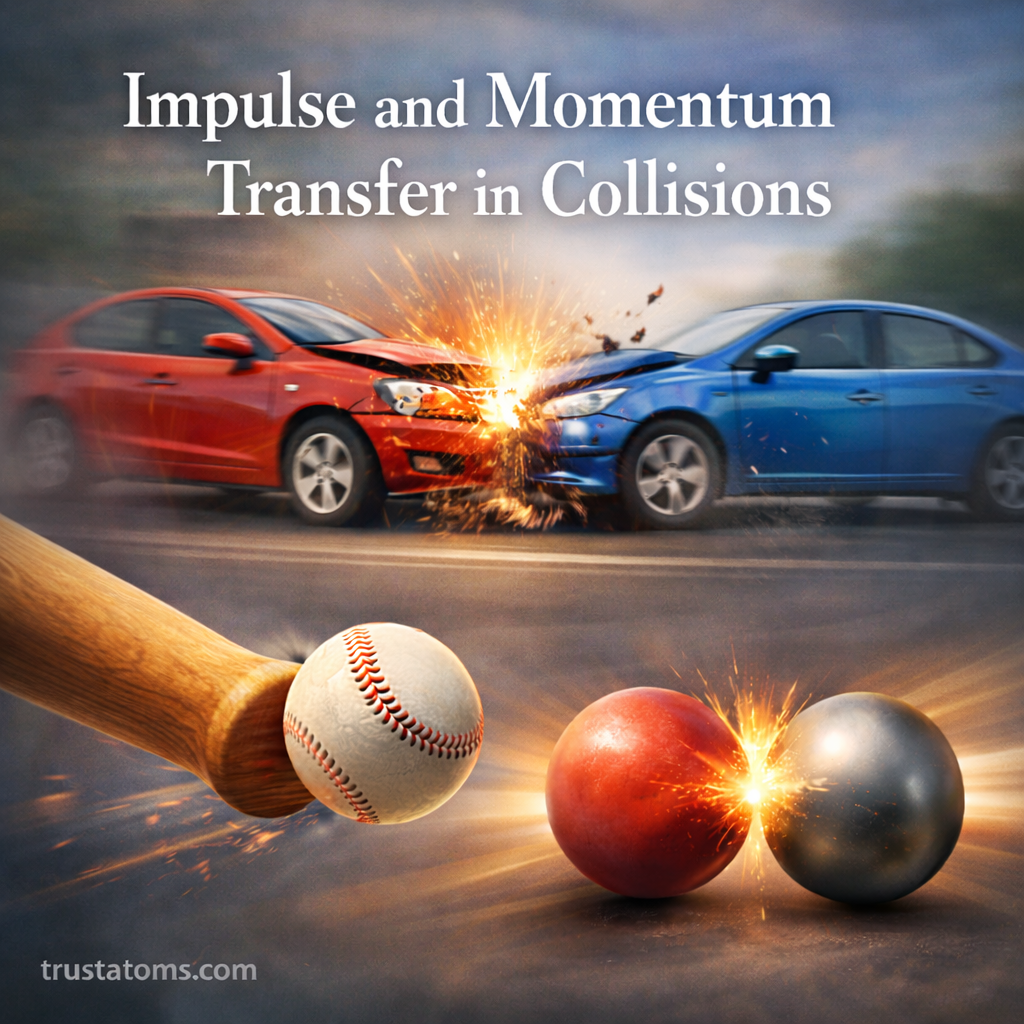
Collisions are everywhere — from a baseball hitting a bat to cars braking suddenly at a red light. Behind each impact lies a powerful physics principle: impulse and momentum transfer.
Understanding how momentum changes during a collision explains why airbags save lives, why athletes “follow through,” and why softer materials reduce injury. In this guide, we’ll break down impulse and momentum in a clear, practical way — without heavy math.
What Is Momentum?
Momentum describes how much motion an object has. It depends on two things:
- How much mass the object has
- How fast it’s moving
In simple terms:
- A heavy truck moving slowly can have the same momentum as a small car moving fast.
- A stationary object has zero momentum.
Momentum is a vector quantity, meaning it has both magnitude (how much) and direction (which way).
Why Momentum Matters
Momentum tells us how hard something is to stop. The greater the momentum:
- The harder it is to change its motion
- The more force is needed to stop it
- The greater its potential impact during a collision
What Is Impulse?
Impulse describes how momentum changes during a collision.
Instead of focusing only on force, impulse considers:
- How strong the force is
- How long the force acts
This is crucial because a small force acting for a long time can have the same effect as a large force acting for a short time.
Key Idea
Impulse equals the change in momentum.
If momentum changes a lot, the impulse was large.
If momentum changes only a little, the impulse was small.
The Impulse–Momentum Theorem
The relationship between impulse and momentum is called the impulse–momentum theorem.
It states:
Change in momentum = Force × Time interval
This explains why extending the time of impact reduces force. The same momentum change spread over more time lowers the force experienced.
Momentum Transfer in Collisions
When two objects collide, momentum is transferred between them.
One of the most important laws in physics applies here:
Conservation of Momentum
In an isolated system (no outside forces):
Total momentum before collision = Total momentum after collision
This remains true whether objects bounce apart or stick together.
Types of Collisions
Not all collisions behave the same way. Physicists classify them into two main categories.
1. Elastic Collisions
In elastic collisions:
- Objects bounce apart
- Total momentum is conserved
- Kinetic energy is also conserved
Example:
- Billiard balls striking each other
Energy is transferred efficiently, and little energy is lost as heat or deformation.
2. Inelastic Collisions
In inelastic collisions:
- Objects may stick together
- Momentum is conserved
- Kinetic energy is NOT conserved
Some energy is transformed into:
- Heat
- Sound
- Deformation
Example:
- A car crash
- A lump of clay hitting the floor
A special case is a perfectly inelastic collision, where objects stick together after impact.
Why Increasing Impact Time Reduces Force

This is one of the most important real-world applications of impulse.
If the change in momentum is fixed:
- Increasing the time interval
- Decreases the average force
Real-World Examples
- Airbags
- Increase stopping time
- Reduce force on passengers
- Catching a Ball
- Pulling hands backward increases impact time
- Reduces force on hands
- Crash Barriers
- Crumple zones extend collision time
- Reduce injury
The physics is simple: same momentum change, longer time, smaller force.
Step-by-Step: What Happens During a Collision?
- Objects approach each other with initial momentum.
- Contact occurs.
- A force acts over a short time interval.
- Momentum is transferred.
- Objects separate (or stick together).
During this short time window, forces can be extremely large — even though the total momentum remains conserved.
Graphical Interpretation of Impulse
Impulse can also be visualized as the area under a force-versus-time graph.
- A tall, narrow spike represents a large force over short time.
- A shorter, wider curve represents smaller force over longer time.
- If the area is equal, the impulse is equal.
This explains why padding and cushioning work so effectively.
Common Misconceptions
“Force alone determines damage.”
Not true. Time matters just as much as force.
“Momentum disappears in a collision.”
Momentum doesn’t disappear in an isolated system. It transfers between objects.
“If energy isn’t conserved, momentum isn’t either.”
Incorrect. Momentum is conserved even when kinetic energy is not.
Why This Topic Is Foundational in Physics
Impulse and momentum transfer help explain:
- Sports impacts
- Vehicle safety engineering
- Rocket propulsion
- Particle collisions in physics experiments
They connect motion, force, and time into one unified principle.
Final Takeaway
Impulse explains how forces change motion over time. Momentum explains how motion is conserved in collisions.
Together, they reveal why:
- Extending impact time reduces force
- Total momentum remains constant in isolated systems
- Different types of collisions behave differently
From everyday sports to advanced engineering, impulse and momentum form one of the most practical and powerful ideas in classical physics.