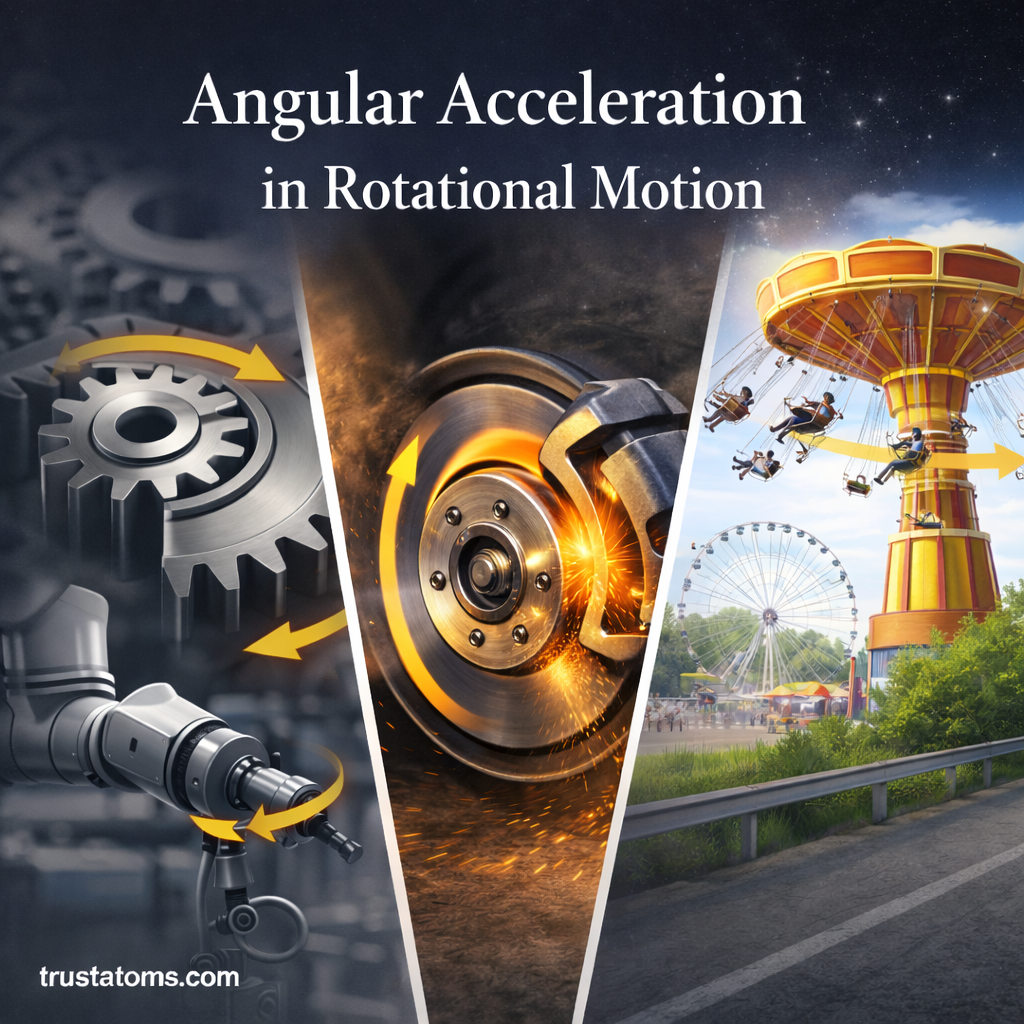
Angular acceleration is one of the core concepts in rotational physics. It describes how quickly a rotating object changes its angular velocity over time.
From car wheels speeding up at a traffic light to turbines gradually slowing down after shutdown, angular acceleration plays a central role in understanding how rotating systems behave.
In this guide, we’ll break down angular acceleration clearly, connect it to linear motion, and explore how it applies in real mechanical systems.
What Is Angular Acceleration?
Angular acceleration measures how fast angular velocity changes.
If a rotating object:
- Speeds up → positive angular acceleration
- Slows down → negative angular acceleration
- Reverses direction → angular acceleration changes sign
In simple terms:
If angular velocity tells you how fast something spins, angular acceleration tells you how quickly that spinning rate changes.
Angular Acceleration vs Linear Acceleration
Rotational motion mirrors linear motion in structure.
Here’s the comparison:
- Linear velocity → Angular velocity
- Linear acceleration → Angular acceleration
- Straight-line motion → Rotational motion
Just as linear acceleration changes how fast an object moves forward, angular acceleration changes how fast it rotates.
Understanding linear acceleration first makes angular acceleration much easier to grasp.
How Angular Acceleration Works
Imagine a ceiling fan.
When you turn it on:
- The motor applies torque.
- The blades start rotating slowly.
- Their rotational speed increases.
- Angular acceleration gradually decreases as it reaches constant speed.
Once the fan reaches steady speed:
- Angular acceleration becomes zero.
- Angular velocity remains constant.
When you turn it off:
- Friction causes negative angular acceleration.
- The fan slows until it stops.
Units of Angular Acceleration
Angular acceleration is measured in:
- Radians per second squared
This unit reflects:
- Change in angular velocity
- Over a given time interval
Because angular motion is measured in radians, the acceleration reflects how quickly that angular rate changes.
Relationship Between Angular Acceleration and Tangential Acceleration
Points on a rotating rigid body experience linear effects due to angular acceleration.
If a rotating object speeds up:
- Points along the edge experience tangential acceleration.
- The farther from the axis, the greater the tangential effect.
Important idea:
All points share the same angular acceleration,
but their linear acceleration depends on distance from the axis.
This explains why the outer edge of a spinning disk experiences stronger motion effects than the center.
Constant Angular Acceleration
Many physics problems assume constant angular acceleration for simplicity.
Under constant angular acceleration:
- Angular velocity changes at a steady rate.
- Angular displacement follows predictable patterns.
- Rotational kinematic equations apply.
This is similar to linear motion under constant acceleration.
Examples include:
- A motor steadily increasing speed
- A rotating platform slowing uniformly
- A machine spinning up at startup
Angular Acceleration in Real-World Systems

Angular acceleration appears in countless systems.
Automotive Systems
- Wheels accelerate when the driver presses the gas pedal.
- Brake systems produce negative angular acceleration.
- Engine crankshafts change rotational speed continuously.
Industrial Machinery
- Conveyor rollers start and stop.
- Turbines ramp up gradually.
- Rotating shafts experience controlled acceleration during operation.
Sports and Human Motion
- A figure skater increases spin rate by pulling arms inward.
- A baseball pitcher accelerates the arm before releasing the ball.
- A cyclist increases pedaling rotation during sprinting.
Torque and Angular Acceleration
Although this article focuses on kinematics (motion description), it’s important to note:
Angular acceleration does not occur without cause.
In rotational dynamics:
- Torque produces angular acceleration.
- Greater torque leads to greater angular acceleration.
- Resistance (like friction) reduces angular acceleration.
While kinematics describes how motion changes, dynamics explains why it changes.
Direction of Angular Acceleration
Angular acceleration has direction.
In physics:
- Counterclockwise rotation is usually positive.
- Clockwise rotation is usually negative.
If a rotating object slows down while spinning counterclockwise:
- Angular velocity is positive.
- Angular acceleration is negative.
Understanding direction prevents sign mistakes in calculations.
Common Misconceptions
Students often confuse:
- Angular velocity with angular acceleration
- Centripetal acceleration with angular acceleration
- Constant speed with no acceleration
Remember:
- If speed is constant but direction changes, acceleration may still exist (centripetal).
- Angular acceleration only occurs when rotational speed changes.
- A rotating object can have zero angular acceleration but still experience centripetal acceleration.
Step-by-Step Approach to Solving Problems
When analyzing angular acceleration:
- Identify whether acceleration is constant.
- Determine initial and final angular velocity.
- Identify time interval or angular displacement.
- Use appropriate rotational kinematic relationships.
- Convert to linear quantities if necessary.
This structured approach helps avoid confusion.
Why Angular Acceleration Matters
Angular acceleration is critical in:
- Mechanical engineering
- Robotics
- Aerospace systems
- Vehicle design
- Power generation
Engineers must control angular acceleration to:
- Prevent mechanical failure
- Reduce wear and tear
- Ensure safe system startup and shutdown
- Improve energy efficiency
Understanding angular acceleration allows accurate prediction of rotating system behavior.
Key Takeaways
- Angular acceleration measures change in rotational speed over time.
- It is measured in radians per second squared.
- All points on a rigid body share the same angular acceleration.
- Linear effects increase with distance from the axis.
- Torque causes angular acceleration.
- Constant angular acceleration simplifies motion analysis.
Final Thoughts
Angular acceleration bridges the gap between simple rotation and the deeper study of rotational dynamics. It helps explain how machines start, how vehicles slow down, and how mechanical systems transition between motion states.
From small electric motors to massive turbines, angular acceleration governs how rotational systems evolve over time. Mastering this concept builds a strong foundation for advanced physics and engineering studies.